
Search Results
Keyword:High-Luminosity LHC

CERN Accelerator Complex Enters Full LS3 Shutdown for Upgrades, Paving the Way for the High-Luminosity LHC Era
On the morning of August 31 local time, the injector complex and the Antimatter Factory at the European Organization for Nuclear Research (CERN) ceased operation after completing their final beam deliveries, officially entering the third Long Shutdown (LS3) phase. Earlier, the Large Hadron Collider (LHC) had been closed in June, marking the flagship accelerator as the first to kick off LS3 upgrade work at the center. Bettina Mikulec (left), head of the Operations Group at CERN, handed a symbolic baton—a miniature superconducting magnet from the LHC—to Jean-Philippe Tock (right), head of the LS3 Coordination Group, with CERN Director-General Mark Thomson (second from left) and Oliver Brüning (third from left), head of Accelerators and Technology, in attendance.
2026-09-01
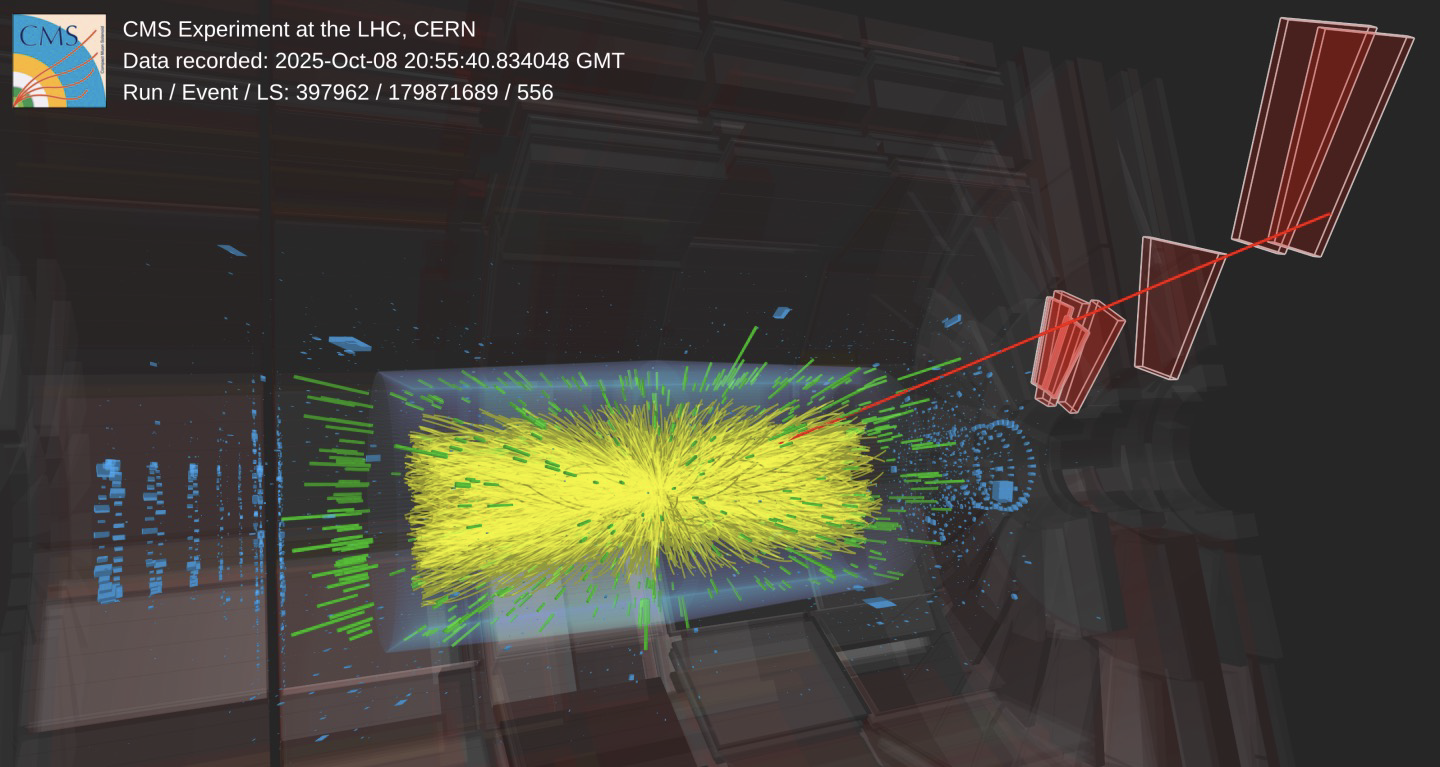
CMS completes high-pileup collision test, validating particle reconstruction algorithms for High-Luminosity LHC operation
In 2025, the Large Hadron Collider (LHC) conducted a dedicated test over several days to simulate high-intensity collision conditions closer to those expected during future operation of the High-Luminosity Large Hadron Collider (HL-LHC). The Compact Muon Solenoid (CMS) experiment team used this opportunity to test whether existing particle tracking, identification, and reconstruction software, along with a new class of machine learning methods, can adapt to the more complex collision conditions of the HL-LHC era. During LHC operation, each crossing of proton beams produces multiple proton–proton collisions simultaneously, a phenomenon known as pileup. The current Run 3 features approximately 65 simultaneous interactions, while the HL-LHC is expected to reach 140 to 200. To...
2026-08-10