
CMS completes high-pileup collision test, validating particle reconstruction algorithms for High-Luminosity LHC operation
 Scan to share
In 2025, the Large Hadron Collider (LHC) conducted a dedicated test over several days to simulate high-intensity collision conditions closer to those expected during future operation of the High-Luminosity Large Hadron Collider (HL-LHC). The Compact Muon Solenoid (CMS) experiment team used this opportunity to test whether existing particle tracking, identification, and reconstruction software, along with a new class of machine learning methods, can adapt to the more complex collision conditions of the HL-LHC era.
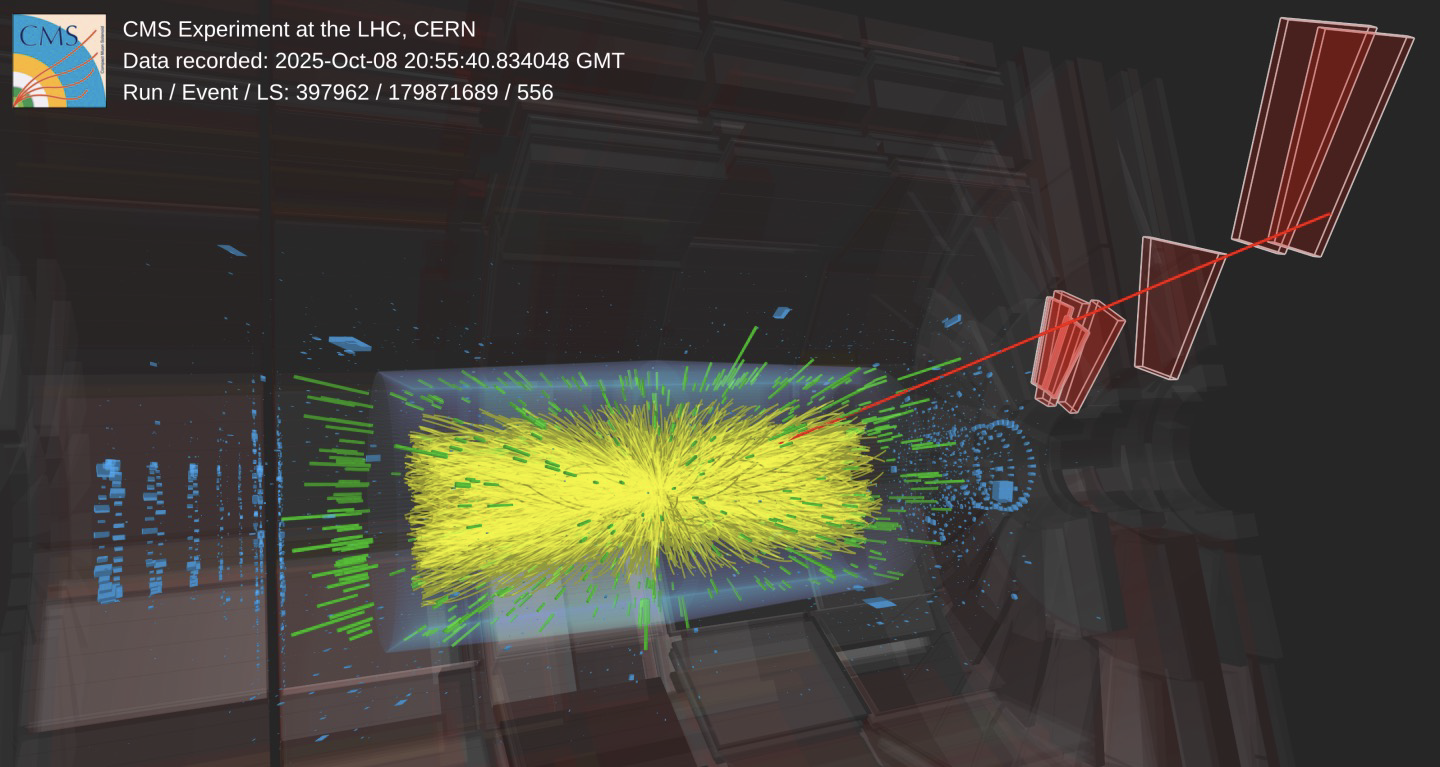
During LHC operation, each crossing of proton beams produces multiple proton–proton collisions simultaneously, a phenomenon known as "pileup." The current Run 3 features approximately 65 simultaneous interactions, while the HL-LHC is expected to reach 140 to 200. To approach this environment, the LHC reduced the number of proton bunches in this study, achieving approximately 150 simultaneous interactions per crossing, while keeping the total collision rate and detector radiation dose at lower levels to avoid subjecting existing detectors to conditions beyond their design capabilities.
CMS focused this time on the barrel region. The calorimeter design in this region will be largely retained in the HL-LHC era, while the endcap regions will be equipped with new detectors in the future. The researchers compared two particle reconstruction methods: one is the particle-flow (PF) technique long used by CMS, which integrates information from the tracking detector, calorimeters, and muon system through established rules; the other is machine-learned particle flow (MLPF), in which a single machine learning model learns from simulated data how particles manifest in the detector. Both methods were also combined with the pileup per particle identification (PUPPI) technique to reduce the interference of pileup interactions on reconstruction results.
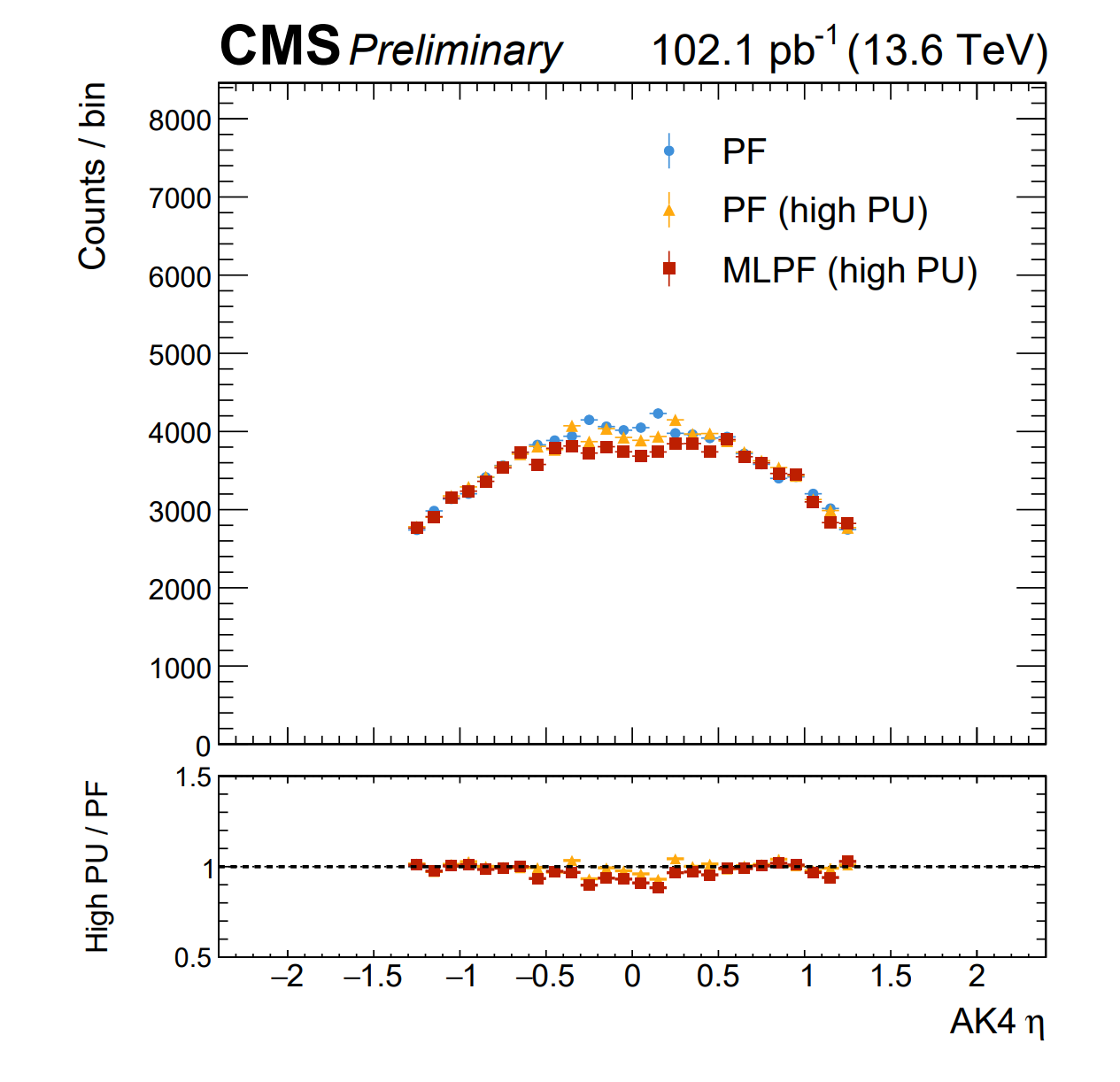
Figure above: Under different pileup conditions, PF and MLPF reconstruct jets (collimated sprays of particles) in a similar manner
The test results show that under high-pileup and nominal data-taking conditions, PF and MLPF produce overall consistent results in reconstructing jets and their energies, with no special treatment required for high-pileup environments. In this test, MLPF was trained only on data from normal conditions and was not retrained for extreme pileup scenarios. In the stress test, MLPF missed more low-energy particles compared to PF, while showing a stronger tendency to identify high-energy particles; nevertheless, the total energy per event reconstructed by both methods was largely consistent.
Valdis Slokenbergs, a doctoral student at Texas Tech University, noted that previewing the detector's future operating conditions helps evaluate algorithm effectiveness and lays the groundwork for collider physics research over the next decade.
The CMS team considers these results encouraging. The particle-flow toolchain, including standard PF, MLPF, and PUPPI, demonstrated stable performance under conditions close to those of the HL-LHC. The few areas where MLPF differed from PF also provide clear directions for subsequent retraining and optimization. As studies on the endcap regions continue, these early tests will help CMS better prepare for the HL-LHC running phase.
Disclaimer: Information republished from partner media, institutions or other websites is provided for reference and communication purposes only. It does not imply endorsement of its views or verification of its accuracy. Please contact us if any content infringes rights or requires correction.