
Search Results
Keyword:cosmic ray detection

The "13th Five-Year" Science and Education Infrastructure Cosmic Ray Physics Research and Detection Technology Platform Project Passed Acceptance
On July 29, 2026, the Finance Bureau of the Chinese Academy of Sciences organized the acceptance meeting for the Cosmic Ray Physics Research and Detection Technology Platform Project (hereinafter referred to as the Research Platform). The meeting was chaired by Wei Zichao, Director of the Investment and Infrastructure Projects Division of the Academy. Tan Zhouliang, Vice President and Member of the Party Leadership Group of the Chengdu Branch of the Chinese Academy of Sciences, and Liu Congzhan, Deputy Director of the Institute of High Energy Physics of the Chinese Academy of Sciences, delivered speeches respectively. Academician Cao Zhen, Project Manager of the Research Platform, gave an overall introduction to the project construction, and Researcher Zhang Shoushan of the project team presented a summary report on the project construction. Subsequently, the acceptance expert group inspected the construction and installation works on site, verified the procurement, installation, and operation of project equipment, and verified the completion of project investment...
2026-08-11
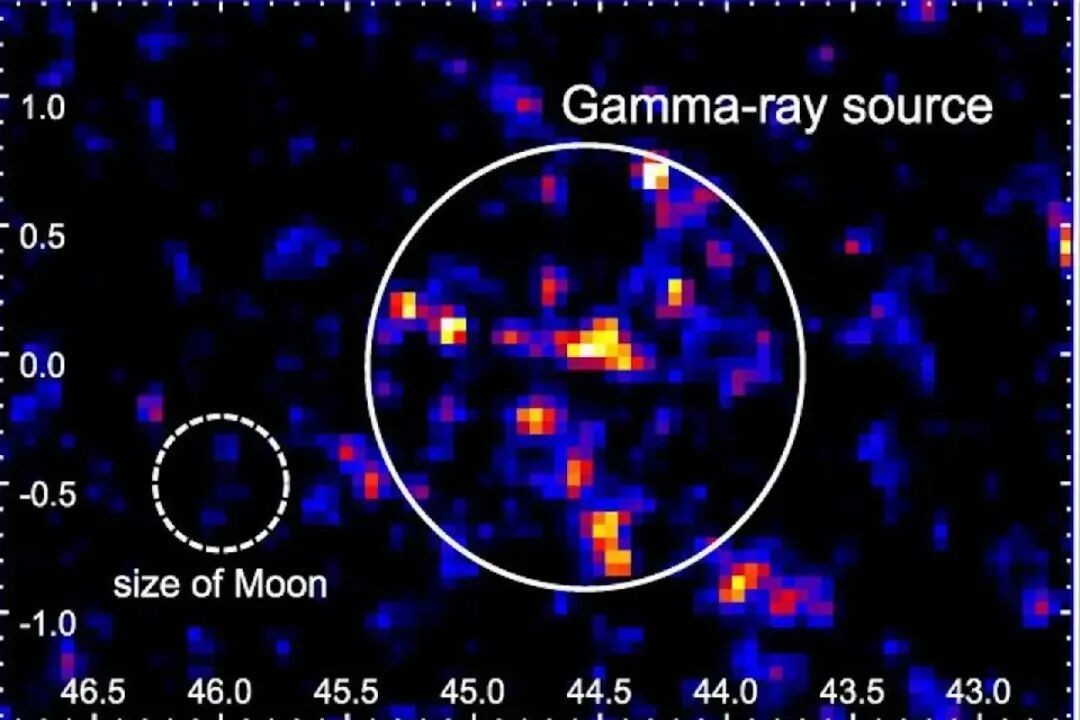
"Triple-Arrow Assault" Confirms a Cosmic "Natural Accelerator" Ejecting Protons at Energies 100 Times That of the Large Hadron Collider
Astronomers, using three observation facilities operating in different wavelength bands, have confirmed a mysterious celestial body in the direction of the Aquila constellation in the Milky Way as a natural cosmic accelerator. This object is continuously ejecting high-speed particles with energies far exceeding any man-made accelerator on Earth, equivalent to 100 times that of the Large Hadron Collider (LHC). This discovery provides key clues for tracing the origin of the highest-energy cosmic rays in the Milky Way, and the research findings were published in the latest issue of The Astrophysical Journal. A size comparison between the gamma-ray source (large circle) and the Moon (small circle). Image credit: The Astrophysical Journal. PeV (peta-electronvolt) energy cosmic rays are high-energy diffuse gamma-ray radiation, and...
2026-08-11