
"Triple-Arrow Assault" Confirms a Cosmic "Natural Accelerator" Ejecting Protons at Energies 100 Times That of the Large Hadron Collider
 Scan to share
Astronomers, using three observation facilities operating in different wavelength bands, have confirmed a mysterious celestial body in the direction of the Aquila constellation in the Milky Way as a cosmic “natural accelerator.” This object is continuously ejecting high-speed particles with energies far exceeding any man-made accelerator on Earth, equivalent to 100 times that of the Large Hadron Collider (LHC). This discovery provides key clues for tracing the origin of the highest-energy cosmic rays in the Milky Way, and the research findings were published in the latest issue of The Astrophysical Journal.
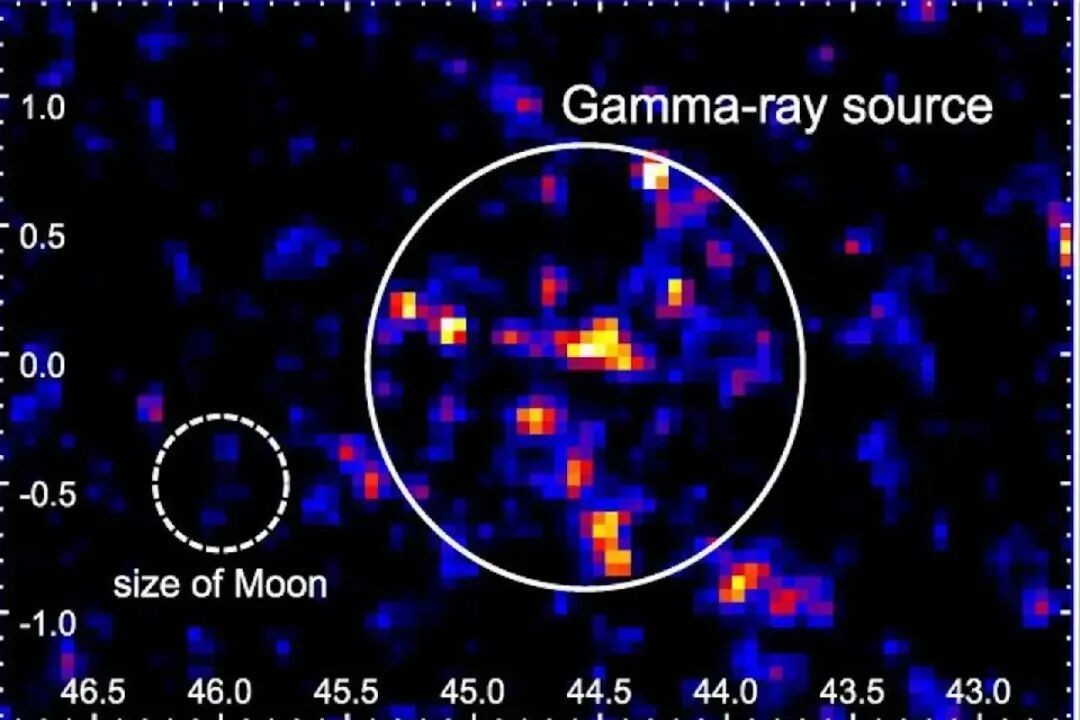
A size comparison between the gamma-ray source (large circle) and the Moon (small circle). Image credit: The Astrophysical Journal
PeV (peta-electronvolt) energy cosmic rays are high-energy diffuse gamma-ray radiation, and celestial bodies capable of accelerating cosmic rays to PeV energies are known as “PeV accelerators.” PeV accelerators are extremely difficult to detect in the universe. On one hand, the paths of high-energy protons are deflected when propagating through interstellar magnetic fields, making it impossible to trace them back to their sources; on the other hand, fast-moving electrons can also produce lower-energy gamma rays, requiring a distinction between these two possibilities. China’s Large High Altitude Air Shower Observatory (LHAASO, “Lasso”) has previously discovered and reported 43 sub-PeV gamma-ray sources, which are currently the most promising candidates for PeV accelerators.
The celestial body investigated in this study is designated LHAASO J1912+1014u. Initially classified as a supernova remnant, subsequent detections of gamma-ray streams emanating from this object by multiple observatories prompted astronomers to reassess its nature. Gamma rays are typically the products of collisions between accelerated particles and surrounding gas, leading astronomers to suspect that this should be a PeV accelerator capable of accelerating protons to peta-electronvolt energies.
In light of this, a research team including astrophysicists from Hiroshima University in Japan decided to conduct their analysis with the force of a “triple-arrow assault”—integrating data from three observation facilities sensitive to different bands of the electromagnetic spectrum: NASA’s Fermi Large Area Telescope, Japan’s FUGIN radio telescope, and NASA’s Chandra X-ray Observatory. By constructing a detailed multi-wavelength model, the team ruled out electrons as the source of the gamma rays and confirmed that LHAASO J1912+1014u is a cosmic-ray proton PeV accelerator.
Cosmic rays are high-speed, high-energy particles that exist primarily in the form of protons, with their energies measured in electronvolts. The highest energy of Galactic cosmic rays can exceed 1 PeV, and this astonishing energy grants them a significant position in astronomy and astrophysics.
Although it has now been confirmed that this celestial body possesses the ability to accelerate protons to record-breaking energies, the exact nature of the object behind this “natural accelerator” remains an unsolved mystery. Nevertheless, the greater value of this study lies in its methodological breakthrough—through data integration, astronomers have now mastered an effective pathway for searching and identifying PeV accelerators. In addition to LHAASO J1912+1014u, dozens of possible proton PeV accelerator candidates are scattered throughout the Milky Way, awaiting confirmation through subsequent observations.
This progress is expected to help scientists further understand the true origins of these high-energy particles that traverse interstellar space at near-light speeds and profoundly influence numerous astrophysical activities within the Milky Way.
Disclaimer: Information republished from partner media, institutions or other websites is provided for reference and communication purposes only. It does not imply endorsement of its views or verification of its accuracy. Please contact us if any content infringes rights or requires correction.