
QST completes first gyrotron 170 GHz microwave output test at ITER site
 Scan to share
The National Institutes for Quantum Science and Technology (QST) of Japan announced on July 31 that it has completed the integration and operational testing of the first gyrotron system at the International Thermonuclear Experimental Reactor (ITER) site in southern France, successfully producing 170 GHz microwave output. This system is used for ITER plasma generation and heating, and is one of the key devices for ITER's plan to commence operations in 2034.
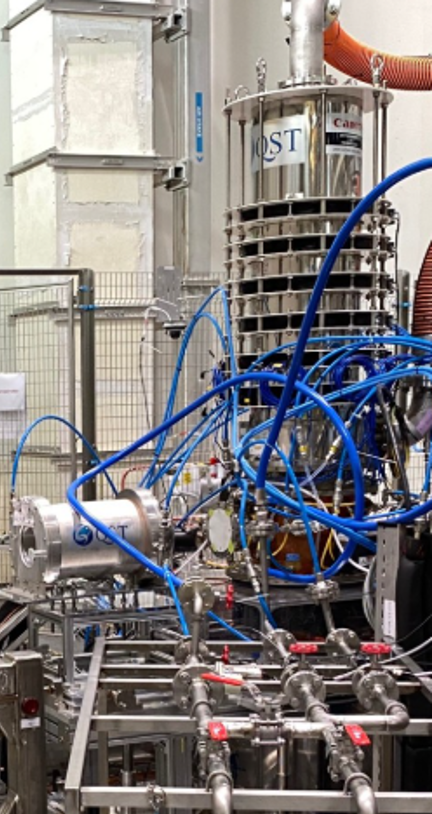
The core equipment of this test is the gyrotron, a high-power microwave source. Gyrotron operation requires the coordinated work of peripheral equipment such as power supplies, superconducting coils, and cooling systems. QST previously completed performance testing of eight ITER gyrotron systems at the gyrotron test facility of the Naka Fusion Institute in Japan, and transported components including gyrotrons, superconducting coils, and quasi-optical matching units to the ITER site. Over the past three years, QST has advanced system installation, commissioning, and operational preparation at the site.
During the on-site testing of gyrotron No. 1, technicians were required to precisely align the superconducting coil, weighing approximately 1 ton with a height of 1.1 meters and a diameter of 1.4 meters, with the gyrotron, keeping the deviation between the magnetic field center axis of the superconducting coil and the central axis of the gyrotron within 1 millimeter. Subsequently, the team conducted precise commissioning of the main power supply procured from the European side, as well as electrode power supplies procured by QST, including the anode power supply and body power supply, ensuring stable operation of multiple power supply systems capable of outputting tens of kilovolts.
During gyrotron operation, electrons emitted by the electron gun are accelerated along magnetic field lines under approximately 75 kV high voltage, and excite a rotating electric field in the resonant cavity, thereby generating 170 GHz microwaves. Since the equipment had been stored at the ITER site for some time after arrival, gases may have been adsorbed on the inner walls of the gyrotron. QST on-site personnel first guided the implementation of heater aging treatment to release adsorbed gases before proceeding to high-voltage beam extraction testing.
In the early stage of testing, the team observed the thermal distribution after microwave heating of grid paper using an infrared thermal camera, and found that the beam pattern exhibited splitting, indicating that competing modes other than 170 GHz may have been excited in the resonant cavity. Subsequently, technicians re-measured the position of the superconducting coil using a laser displacement meter, and under QST guidance, made fine adjustments of approximately 1 millimeter in the horizontal direction, ultimately obtaining a normal mode beam pattern. Frequency measurement results showed a strong signal at 170.135 GHz, confirming that the gyrotron was oscillating normally at the design frequency.
To further improve performance, QST enhanced the alignment accuracy between the gyrotron and the central axis of the superconducting coil to the 0.1 millimeter level, completing this round of testing. As a next step, QST plans to establish a transmission system from the gyrotron output to the microwave absorption device, the "dummy load," and conduct on-site acceptance testing, with the goal of achieving sustained microwave output of several hundred seconds at a rated power of 1 million watts. The remaining seven gyrotron systems will also be tested sequentially under QST's leadership as planned, to support ITER in achieving initial plasma and entering the research operation phase.
Disclaimer: Information republished from partner media, institutions or other websites is provided for reference and communication purposes only. It does not imply endorsement of its views or verification of its accuracy. Please contact us if any content infringes rights or requires correction.