
Russia's Vector Research Center Proposes Quantum Dots for Boron Delivery in Neutron Capture Therapy
 Scan to share
Russia's Vector Research Center has proposed using quantum dots as targeted boron delivery systems in boron neutron capture therapy (BNCT) to explore more precise approaches to tumor treatment. Yuri Tumanov, the center's chief researcher, presented this research progress at the "Engineering Biology and Biopharmaceuticals" conference.
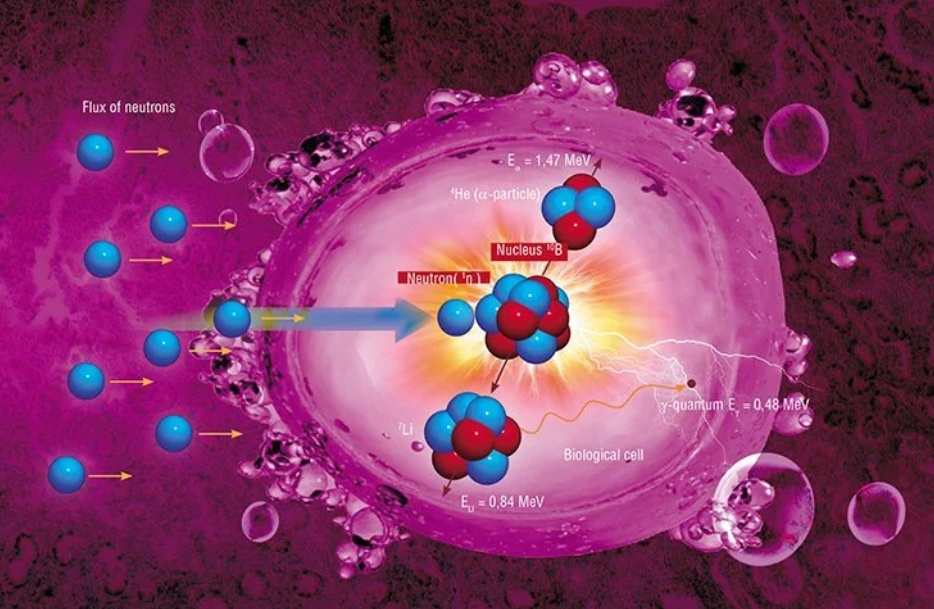
Boron neutron capture therapy is a cancer treatment method that combines boron-containing drugs with neutron irradiation. The basic concept involves first allowing boron-containing drugs to accumulate in tumor cells, then subjecting the patient to neutron irradiation, which triggers a nuclear reaction that releases energy concentrated within boron-containing cancer cells, thereby destroying tumor cells. How to construct boron delivery systems that are low-toxicity, highly efficient, and capable of participating in targeted tumor destruction remains one of the key challenges in this field.
In his presentation, Tumanov reported that the research team synthesized boron-containing quantum dots through continuous processing of crystalline boron powder dispersions. Quantum dots are tiny particles only a few nanometers in size, whose light absorption and emission characteristics change with particle size. When used for boron delivery, quantum dots exhibit strong fluorescence and luminescence properties, serving as visible markers that help more precisely locate and target tumors during radiation therapy. Additionally, these particles can persist in the body for up to approximately one month.
According to the introduction, the technology is currently in the animal preclinical trial stage. After injection of the relevant compounds, experimental animals will be sent to the Budker Institute of Nuclear Physics of the Siberian Branch of the Russian Academy of Sciences for irradiation using a dedicated neutron source. Researchers are evaluating compound toxicity in mouse experiments and observing the distribution of particles in different organs after administration, accumulating data for subsequent expansion to studies in larger mammals.
The All-Russian International Conference "Engineering Biology and Biopharmaceuticals" was held in Novosibirsk from July 28 to 31, 2026, commemorating the 100th anniversary of the birth of Academician D.G. Knorre of the Russian Academy of Sciences. Organized by the Institute of Chemical Biology and Fundamental Medicine of the Siberian Branch of the Russian Academy of Sciences, the conference covered topics including therapeutic drug and vaccine development.
Disclaimer: Information republished from partner media, institutions or other websites is provided for reference and communication purposes only. It does not imply endorsement of its views or verification of its accuracy. Please contact us if any content infringes rights or requires correction.