
DUNE Prototype Detector Undergoes 300 kV Pressure Test at CERN
 Scan to share
The Deep Underground Neutrino Experiment (DUNE), an international collaborative project led by the Fermi National Accelerator Laboratory under the U.S. Department of Energy, is conducting pressure tests on the prototype detector ProtoDUNE at CERN's Neutrino Platform to verify the long-term stability of the relevant detection technology under extreme operating conditions.
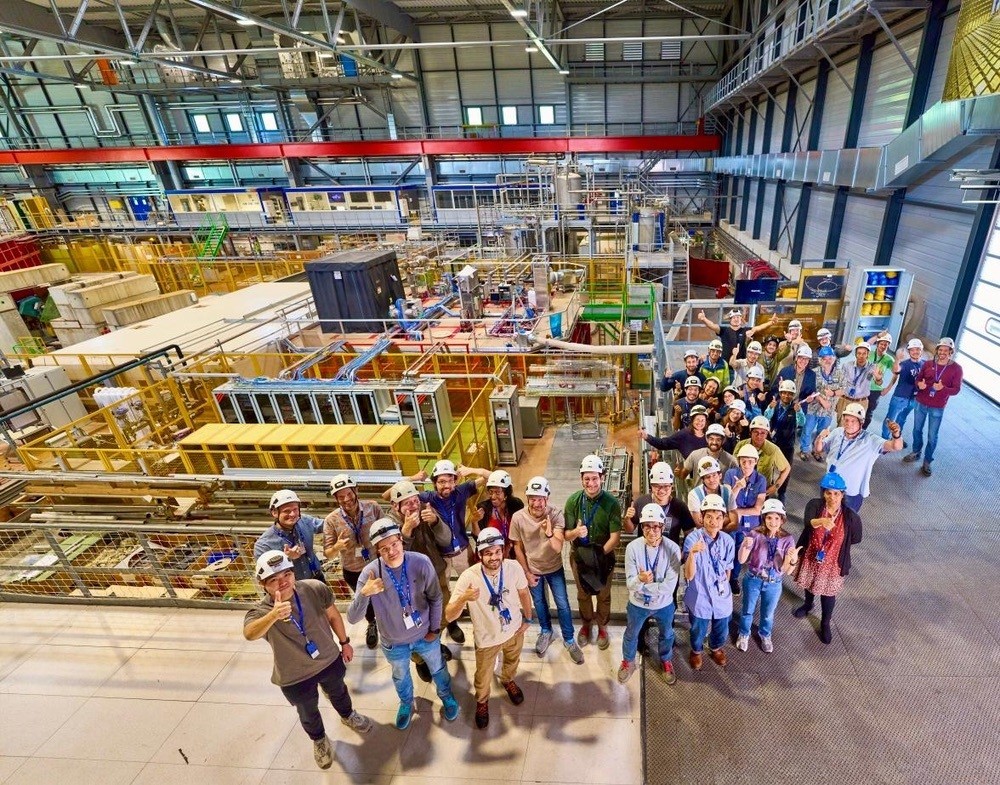
DUNE is designed as a large-scale neutrino research experiment aimed at studying the properties of neutrinos and their role in the evolution of the universe. The experiment will install large liquid argon time projection chamber detectors approximately one mile underground at the Sanford Underground Research Facility in South Dakota, USA. Once the detectors are filled with liquid argon and sealed, internal components will be difficult to access directly for extended periods, making prototype testing a critical step before formal construction.
Currently, two ProtoDUNE prototype detectors, each weighing approximately 770 tons, are installed at CERN's Neutrino Platform. Previously, the research team successfully tested the Anode Plane Assembly (APA) technology between 2018 and 2024. This technology utilizes planes of metallic wires to collect current generated by drifting electrons and has already been applied in other neutrino experiments.
Meanwhile, the collaborative team is also advancing a new approach known as "vertical drift." This approach replaces traditional wire planes with copper channels on printed circuit boards and extends electron drift distances through a new geometric configuration, enabling the detector to record more neutrino events with fewer components. However, the increased electron drift distance also requires higher voltages to maintain the electric field, and the research team plans to gradually increase the voltage to 300 kV.
Researchers explain that when neutrinos interact with argon atoms, charged particles are produced and ionization tracks are left behind; the released electrons are guided to the readout plane under the influence of a strong electric field, and the relevant data can be used to reconstruct particle track directions and energies, thereby inferring the position, energy, and type of the original neutrino.
The ProtoDUNE vertical drift detector has completed preliminary commissioning and demonstrated stable performance. This pressure test was initiated on May 22, 2026, and is scheduled for completion in the fall. The research team stated that the test will simulate DUNE's future operating conditions on a smaller-scale prototype, with particular focus on observing the performance of detector components under high-voltage environments. In addition to neutrinos produced by the Fermilab accelerator, DUNE will also detect neutrino signals from the cosmos in the future, including neutrino events that could be used to identify early signs of supernova explosions.
Disclaimer: Information republished from partner media, institutions or other websites is provided for reference and communication purposes only. It does not imply endorsement of its views or verification of its accuracy. Please contact us if any content infringes rights or requires correction.