
Swiss PSI Ultracold Neutron Experiment Finds No Signs of "Mirror World" Oscillation
 Scan to share
The Paul Scherrer Institute (PSI) in Switzerland announced on July 28 that its researchers detected approximately 25 billion neutrons in an ultracold neutron experiment and found no signs of neutrons spontaneously transforming into "mirror neutrons." The results constrain, with high certainty, the theoretical possibility of neutrons disappearing into the so-called "mirror world."
The "mirror world" hypothesis posits that every elementary particle in the real world may have a corresponding mirror particle, such as mirror electrons, mirror protons, and mirror neutrons. Such particles interact extremely weakly with ordinary matter, potentially connecting primarily through gravity or rare oscillations of neutral particles, and have therefore also been considered as one of the dark matter candidates.
Researchers at the PSI Center for Neutron and Muon Sciences stated that proving the existence of mirror particles through gravitational interaction alone is difficult, so the experiment focused on whether neutral particles could oscillate between the ordinary matter world and the mirror world. According to relevant hypotheses, electrically neutral particles such as neutrons may, in rare cases, transform into mirror particles, appearing as "disappearing" in experiments; they may subsequently transform back into ordinary neutrons.
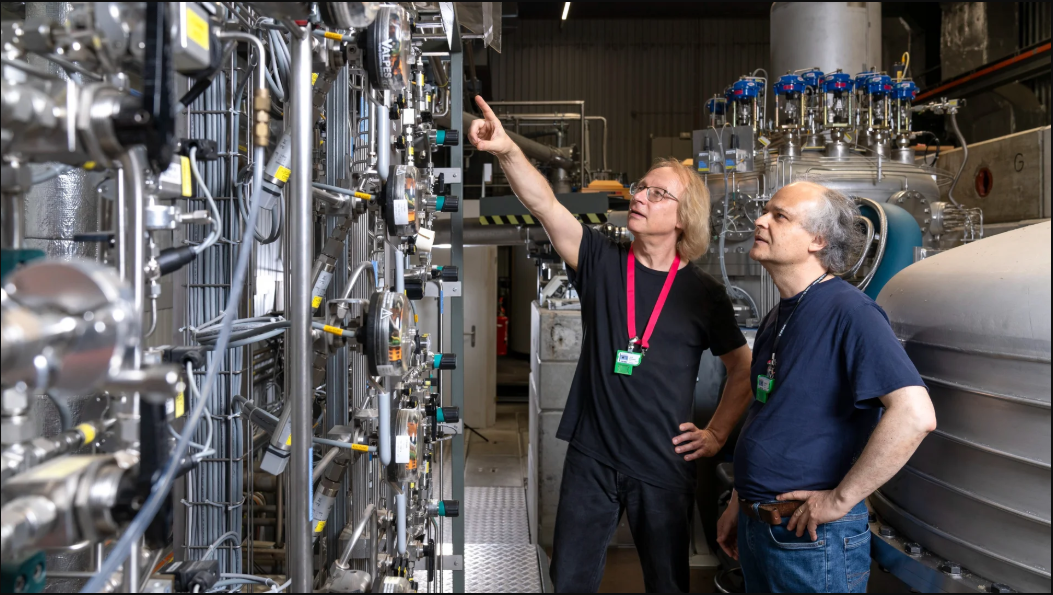
To test this idea, the PSI research team, in collaboration with scientists from ETH Zurich and the Jagiellonian University in Kraków, conducted precision measurements using ultracold neutrons produced by PSI's high-intensity proton accelerator. In the experiment, researchers stored ultracold neutrons in a special non-magnetic stainless steel vacuum vessel and precisely controlled the surrounding magnetic field using magnetic field coils. Since the probability of oscillation between neutrons and mirror neutrons is highly sensitive to the magnetic field, the team gradually varied the magnetic field strength and direction during measurements to cover the relevant regions where oscillation could occur.
Researchers stored approximately 1.5 million neutrons in a large stainless steel tank every 5 minutes, and after each storage period of about 200 seconds, emptied and counted the remaining neutrons in the tank. This process continued for several months, ultimately accumulating a total of approximately 25 billion measured neutrons. The experimental results showed no signal of neutron-mirror neutron oscillation within the scanned condition range.
PSI researchers believe that this result essentially rules out previous speculations regarding neutrons transforming into mirror particles. Although the experiment found no evidence of the mirror world's existence, it still holds significant reference value for particle physics and theoretical research on dark matter. Researchers stated that by further narrowing the parameter space of relevant hypotheses, the experimental results will prompt theoretical physics research to explore new explanatory pathways.
Disclaimer: Information republished from partner media, institutions or other websites is provided for reference and communication purposes only. It does not imply endorsement of its views or verification of its accuracy. Please contact us if any content infringes rights or requires correction.