
After 25 Years, the Muon Wobble Puzzle Sees Key New Progress in Physics
 Scan to share
For 25 years, precise measurements of how muons "wobble" in a magnetic field have been a major puzzle in particle physics. Early experiments showed a discrepancy between the measured value of the muon's g-factor and theoretical predictions, a difference once seen as a possible hint of unknown particles. Recent new theoretical calculations and experimental analyses have brought a new twist to this puzzle.
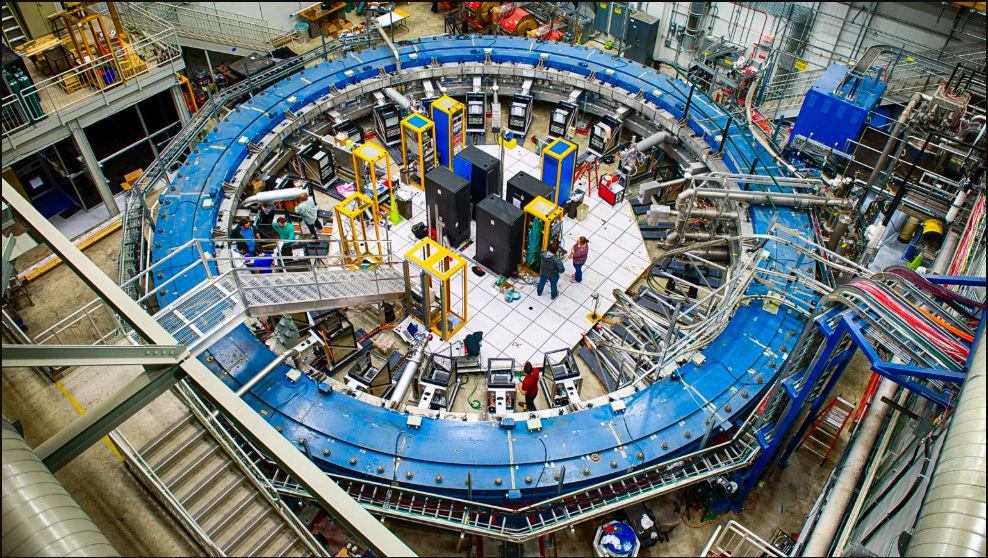
The muon is a "cousin" of the electron, heavier in mass, and precesses like a tiny magnet in a magnetic field. Its extra wobble is quantified by the muon "g-2" coefficient. According to quantum theory, known particles and interactions influence this coefficient through fleeting quantum fluctuations, making muon g-2 an important window for testing the Standard Model and searching for potential new physics.
In 2001, the US Brookhaven National Laboratory measured a higher-than-expected muon g-factor, drawing attention from the physics community. Subsequently, the relevant magnetic ring was transported to the US Fermi National Accelerator Laboratory, where the upgraded experiment continued to improve measurement precision. In 2021, Fermilab's new measurement results still showed a significant discrepancy with theoretical predictions based on the "data-driven method," with the gap at one point approaching the stringent standard required to confirm a new discovery in particle physics.
The so-called data-driven method uses experimental data from electron-positron collisions producing quark-antiquark pairs to infer the strong interaction's contribution to muon g-2. Because the strong interaction is difficult to handle precisely with conventional analytical methods, this approach has long been used to calculate the theoretical expectation for the muon.
However, another calculation based on lattice quantum chromodynamics has reached a different conclusion. The BMW research group, composed of researchers from Budapest in Hungary, Marseille in France, and Wuppertal in Germany, published its results in 2021 after years of refining computational methods and improving simulation precision. Their lattice calculation showed that the muon wobble measured at Fermilab can be explained by known particles and known interactions. Since then, other independent lattice calculation teams have also produced similar results, leading many physicists to believe that the muon g-2 anomaly may not be evidence of new particles.
A new question then arises: if the lattice quantum chromodynamics calculation is correct, why would the electron-positron collision data that previously supported the data-driven method lead to a different prediction?
One focus points to the VEPP-2000 collider in Novosibirsk, southern Siberia, Russia. This facility measures the production rates of quark-antiquark pairs such as pions through electron-positron collisions. These data are an important basis for inferring the strong interaction's contribution to the muon. In 2023, the VEPP-2000 team published pion production rate measurements using an upgraded detector, which showed significant discrepancies with its own past data and with results from some other collider experiments.
This discrepancy has prompted extensive scrutiny from physicists. According to available information, no clear problem has yet been identified in the measurement. Meanwhile, the latest lattice simulation results are consistent with VEPP-2000's new measurement rates, and preliminary data from another detector at VEPP-2000 also appear to support this direction. However, a 2023 analysis of data from the earlier BABAR collider in California is more consistent with the old pion production rates.
At present, the physics community has not reached a definitive conclusion on these conflicting results. The discrepancies may stem from experimental procedures, data processing, or unrecognized systematic errors, and may also leave room for continued discussion of signs of new particles. Until it is determined which is more reliable—the old pion production rates or the new measurement results—the muon g-2 problem will remain a key topic in particle physics and quantum chromodynamics research.
Disclaimer: Information republished from partner media, institutions or other websites is provided for reference and communication purposes only. It does not imply endorsement of its views or verification of its accuracy. Please contact us if any content infringes rights or requires correction.