
First Experimental Result Published from the High-Intensity Heavy-Ion Accelerator Facility
 Scan to share
Recently, the research team from the Institute of Modern Physics (IMP) of the Chinese Academy of Sciences, together with collaborators, successfully produced and identified the rare isotope hafnium-153 using the High-Intensity Heavy-Ion Accelerator Facility (HIAF). This is the first physics result obtained during the commissioning of HIAF, demonstrating that China's new-generation high-intensity heavy-ion research facility is capable of exploring unknown nuclides and expanding the nuclear chart. It marks the official commencement of HIAF's scientific discovery journey. The result was published as a short communication in *Science Bulletin*.
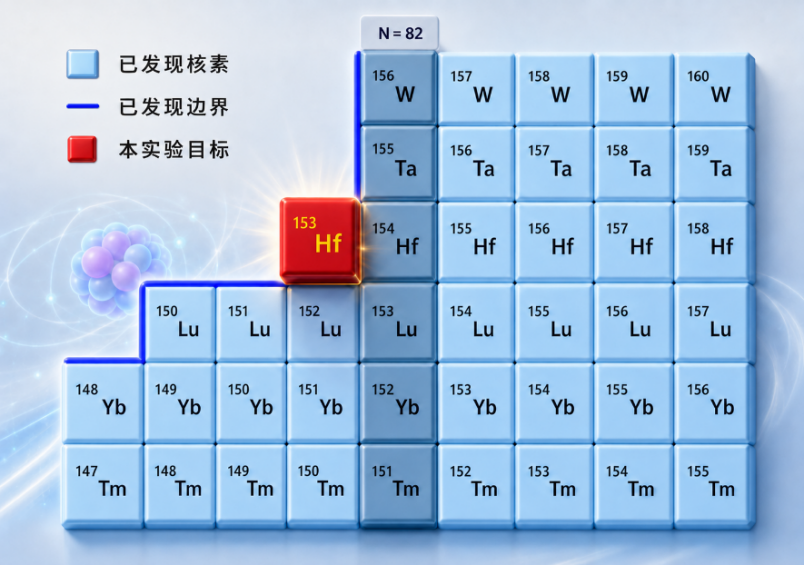
Figure: Position of hafnium-153 on the nuclear chart; the blue line indicates the boundary of known nuclides. Image | Hu Houyu, Li Hongfu
Atomic nuclei are composed of protons and neutrons, and different combinations of proton and neutron numbers form the diverse world of nuclides. Exploring unknown nuclides and investigating the boundaries of nuclear existence are important frontiers in nuclear physics. Hafnium-153 is located in the neutron-deficient heavy-mass region and is an important subject for studying the evolution of nuclear structure and the limits of nuclear stability. It had not been reported prior to this experiment. The discovery and precise measurement of this nuclide will help test nuclear theory models and deepen our understanding of nuclear structure regularities.
In the experiment, the research team used a bismuth-209 beam provided by the HIAF Booster Ring (BRing) to bombard a graphite target, producing radioactive nuclides via projectile fragmentation reactions. The reaction products were filtered through the High-energy Radioactive Ion Beam Line (HIRIBL) and then injected into the high-precision storage ring spectrometer (SRing). Using isochronous mass spectrometry, the team observed a total of 10 hafnium-153 ions. The measurement results indicate that hafnium-153 is a bound or weakly bound nuclide, consistent with predictions from existing theoretical models. Concurrently, RIKEN in Japan also independently reported the observation of hafnium-153, and the two studies corroborate each other, further highlighting the significant research value of this nuclide.
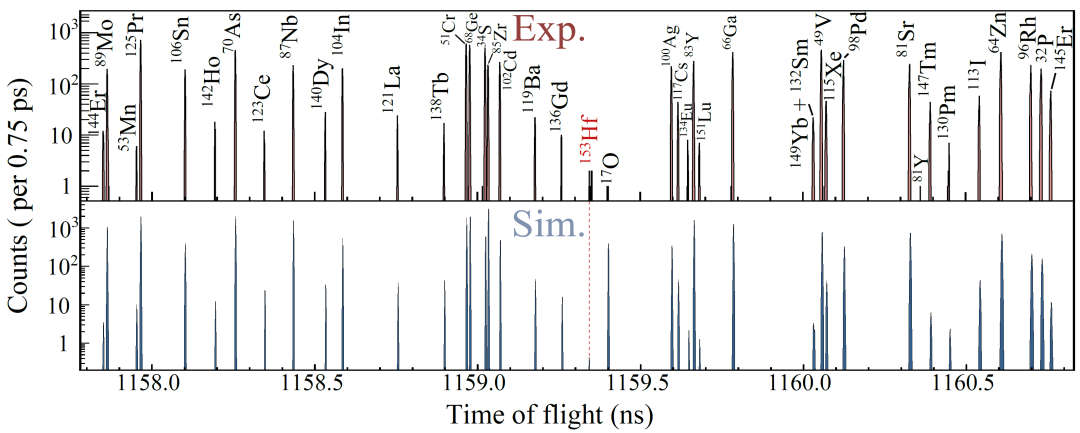
Figure: Comparison between the experimentally measured ion cyclotron period spectrum and the simulated period spectrum. The peak located at 1159.348 ns is unambiguously identified as hafnium-153. Image source | Institute of Modern Physics
The successful detection of hafnium-153, which has an extremely low production probability, benefited from the synergistic development of several key technologies at HIAF. The high-intensity heavy-ion beam enhanced the production capability of rare nuclides, the high-performance radioactive beam line achieved efficient separation of the target nuclide, and the isochronous mass spectrometry technique of the high-precision storage ring provided sensitive single-ion detection capability, offering crucial support for identifying rare nuclides. As HIAF's performance continues to improve, the detection capability of future experiments is expected to increase by approximately two orders of magnitude. HIAF will play an even more important role in exploring unknown nuclear regions, discovering new nuclides, and studying the properties of atomic nuclei under extreme conditions.
This research was jointly completed by the National Key Laboratory of Heavy-Ion Science and Technology at the Institute of Modern Physics of the Chinese Academy of Sciences, together with the University of Chinese Academy of Sciences, the GSI Helmholtz Centre for Heavy Ion Research in Germany, the University of Cologne in Germany, East China University of Technology, and the Guangdong Provincial Laboratory of Advanced Energy Science and Technology. The study was supported by the National Key Research and Development Program, the HIAF Project, the Youth Innovation Promotion Association of the Chinese Academy of Sciences, the National Natural Science Foundation of China, the Guangdong Provincial Talent Program, and the Gansu Provincial Science and Technology Program.
Disclaimer: Information republished from partner media, institutions or other websites is provided for reference and communication purposes only. It does not imply endorsement of its views or verification of its accuracy. Please contact us if any content infringes rights or requires correction.