
Search Results
Keyword:High-Intensity Heavy-Ion Accelerator
National Major Science and Technology Infrastructure Project "High-Intensity Heavy-Ion Accelerator Facility" Passes Special Financial and Asset Acceptance
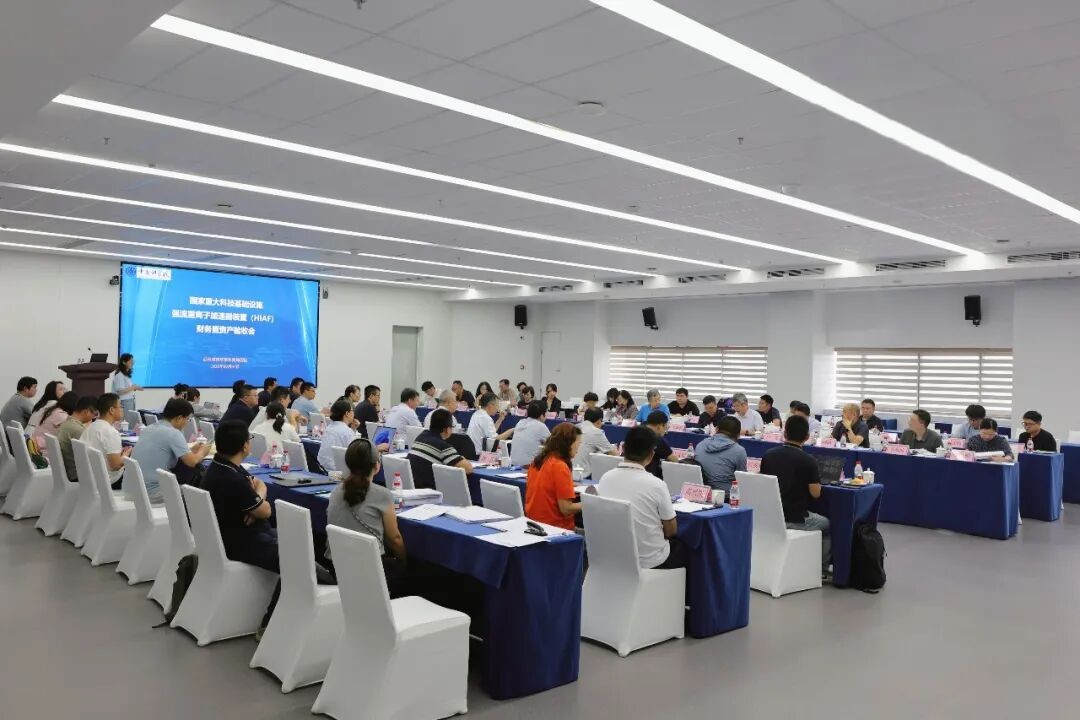
From September 6 to 7, the Bureau of Finance and Assets and the Bureau of Science and Technology Basic Capacity of the Chinese Academy of Sciences organized a financial expert group and an asset expert group to carry out special financial and asset acceptance work on the National Major Science and Technology Infrastructure—the High-Intensity Heavy-Ion Accelerator Facility (HIAF) project. The expert group consisted of 13 experts from the Chinese Academy of Sciences, research institutes, and universities. Figure: Acceptance meeting site. The expert group listened to reports on the project's construction, financial asset management, and investment completion. The financial acceptance expert group reviewed materials such as the financial summary report and the completion financial final accounts audit report, conducted on-site inspections of final account statements and account books, and spot-checked contracts and accounting vouchers, followed by on-site inquiries and discussions on the financial investment completion status. The asset acceptance expert group reviewed materials including the asset summary report and procurement ledgers, conducted on-site spot checks of process equipment for the High-Intensity Heavy-Ion Accelerator, experimental terminal systems, facility auxiliary equipment, and public supporting systems, and held on-site inquiries and discussions on asset delivery status.
2026-09-09
First Experimental Result Published from the High-Intensity Heavy-Ion Accelerator Facility
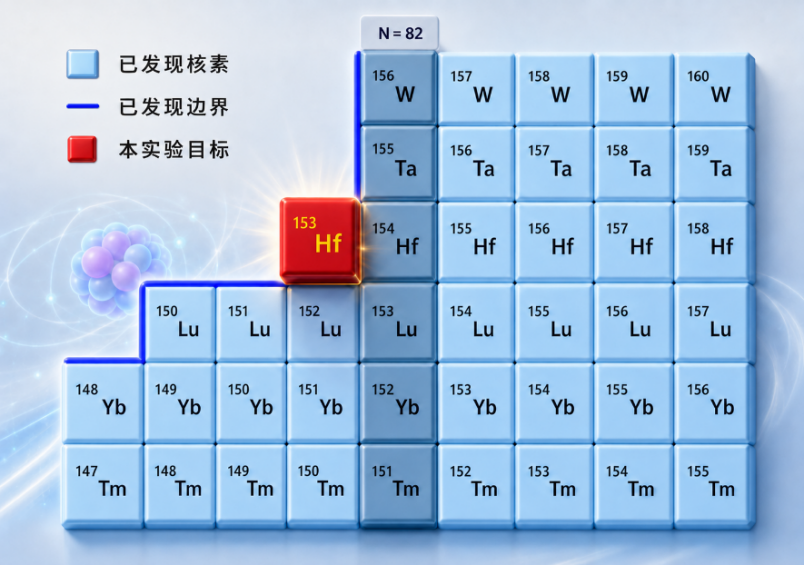
Recently, the research team from the Institute of Modern Physics (IMP) of the Chinese Academy of Sciences, together with collaborators, successfully produced and identified the rare isotope hafnium-153 using the High-Intensity Heavy-Ion Accelerator Facility (HIAF). This is the first physics result obtained during the commissioning of HIAF, demonstrating that China's new-generation high-intensity heavy-ion research facility is capable of exploring unknown nuclides and expanding the nuclear chart. It marks the official commencement of HIAF's scientific discovery journey. The result was published as a short communication in *Science Bulletin*. Figure: Position of hafnium-153 on the nuclear chart; the blue line indicates the boundary of known nuclides. Image | Hu Houyu, Li Hongfu. Atomic nuclei are composed of protons and neutrons, and different combinations of proton and neutron numbers form the diverse world of nuclides. Exploring unknown nuclides and investigating the boundaries of nuclear existence are important frontiers in nuclear physics. Hafnium-153 is located in the neutron-deficient heavy-mass region and is an important subject for studying the evolution of nuclear structure and the limits of nuclear stability. It had not been reported prior to this experiment. The discovery and precise measurement of this nuclide will help test nuclear theory models and deepen our understanding of nuclear structure regularities.
2026-08-03