
Study Shows Sustained Deuterium Fusion in Palladium and Titanium Metal Foils at Ultra-Low Energies
 Scan to share
U.S. researchers have observed a low-energy deuterium fusion phenomenon in thin palladium and titanium metal foils: when the incident deuteron energy drops to levels where fusion reactions are generally expected to weaken significantly or even nearly cease, the reactions continue to occur. Experiments show that as incident energy decreases, the fusion rate does not continue to decline exponentially but instead enters a plateau region below approximately 2 keV. At the lowest detectable energy, the measured low-energy fusion rate exceeds predictions from isolated-nucleus models by more than 10^18 times.
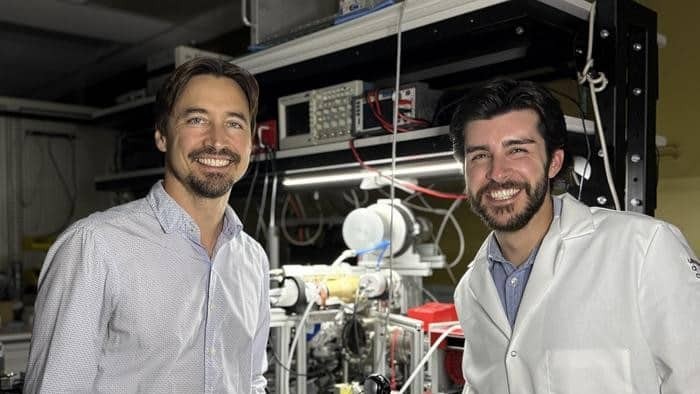
Image courtesy of Marina Light/University of California, Davis
The related research was conducted by teams at the University of California, Davis and Lawrence Berkeley National Laboratory, with findings published in Nature Communications. The researchers believe that electrons in the metal, lattice defects, and locally high-concentration deuterium environments may collectively alter the conditions under which nuclear reactions occur. However, the team also emphasized that even with the relatively large enhancement factor, the current absolute fusion rate remains far below the level required for energy applications.
Nuclear fusion requires positively charged nuclei to approach each other, but Coulomb repulsion exists between them. In plasma fusion research, reactors typically need to operate at temperatures corresponding to collision energies of approximately 10 keV; as energy decreases further, fusion probability drops rapidly. Quantum tunneling allows nuclei to react at energies below the classical barrier, but in the low-energy regime, this probability is typically extremely low.
Unlike plasmas, solid metals contain complex electron and lattice environments. Jeremy Munday, a researcher at the University of California, Davis, stated that electrons, defects, and high-concentration deuterium in the metal lattice may create reaction environments that do not exist in conventional plasmas. The metal's electron cloud can partially screen the repulsion between nuclei, making it easier for them to approach. This "electron screening effect" has attracted ongoing attention since the 1990s, but its microscopic mechanism has not yet been fully elucidated.
The experimental setup employs a membrane reactor that places a metal foil approximately 0.25 mm thick between two environments. On one side is an electrochemical cell that injects deuterium from the liquid phase into the metal foil through a process similar to battery charging; on the other side is a vacuum environment where a deuterium ion beam bombards the same metal foil and enters the near-surface region of the foil. Each fusion reaction produces fast protons or neutrons, which the research team recorded using independent detectors, and background measurements and control experiments were conducted to rule out spurious signals.
Experimental results show that in both palladium and titanium metals, the fusion yield enters a plateau region when the incident energy drops below approximately 2 keV. After electrochemically introducing additional deuterium into the metal, the yield approximately doubled. The researchers believe this indicates that the material environment does not merely passively host nuclear reactions but may actively influence low-energy nuclear reaction processes.
Konrad Czerski, professor of nuclear and medical physics at the University of Szczecin in Poland, believes these results corroborate findings his team previously obtained in the European CleanHME project. He stated that his team observed similar plateau regions in zirconium, palladium, and titanium using different methods, with palladium data showing good agreement with the U.S. team's results, though titanium data still show discrepancies.
Regarding the origin of the plateau region, researchers hold differing interpretations. The U.S. team tends to favor the view that damaged surface layers of the foils may produce anomalously enhanced screening effects; Czerski, on the other hand, believes the plateau is related to deuterium fusion in metals under ordinary thermal energies and does not necessarily imply a change in screening energy.
Munday stated that the next key step is to identify the microscopic origin of the low-energy plateau, including the roles of electron screening, surface damage, and the migration and trapping of deuterium in metals. The U.S. team also plans to investigate whether light illumination or crystal vibrations affect reaction rates. In terms of near-term applications, the researchers believe that compact neutron sources are more realistic than fusion power devices.
Disclaimer: Information republished from partner media, institutions or other websites is provided for reference and communication purposes only. It does not imply endorsement of its views or verification of its accuracy. Please contact us if any content infringes rights or requires correction.