
Germany Achieves First Capture of Argon Nuclei at 30% Speed of Light with Electron Cooling
 Scan to share
On August 3, researchers at the GSI Helmholtz Centre for Heavy Ion Research in Germany successfully decelerated and captured fully ionized argon ions (^36Ar^18+) for the first time using the HITRAP highly charged ion trap facility. These ions, having lost all their electron shells, can be regarded as “bare nuclei”, with an initial velocity of approximately 30% of the speed of light. The research findings have been published in the journal Physical Review X.
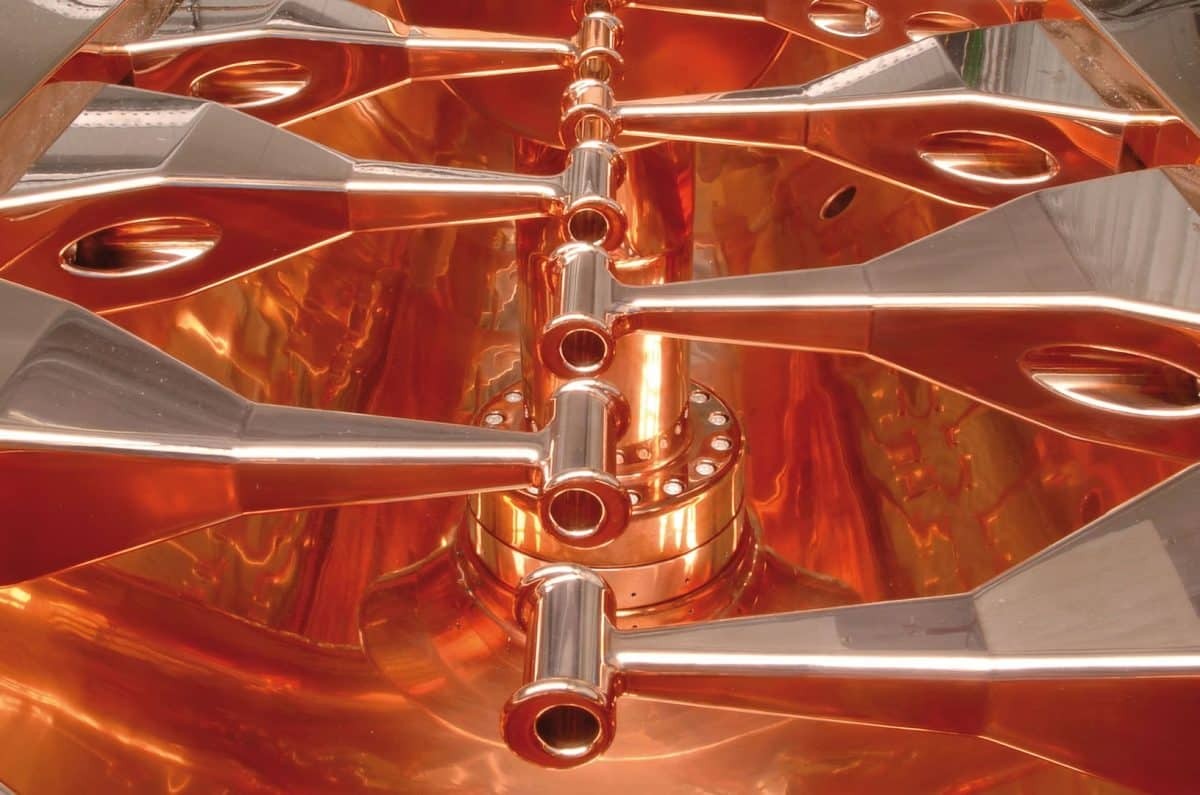
The interior of the radiofrequency resonator that slows down the ions
Highly charged ions typically need to be produced via particle accelerators and are formed under strong electric fields and high-energy conditions. Since these ions are generated at extremely high velocities, they must first be stopped, captured, and cooled before precision physics measurements can be conducted. The research team stated that this experiment achieved, for the first time, the entire process from producing highly charged ions to storing them in a special trap for at least 11 seconds.
The Penning trap used in this experiment confines particles through the combined action of magnetic and electric fields. A uniform magnetic field causes the ions to undergo helical motion in the radial direction, thereby restricting their movement in two dimensions; an electrostatic field confines the ions in the third direction, preventing them from escaping along the magnetic field lines. To enter this trap, the kinetic energy of the argon ions needed to be reduced by a factor of approximately 10,000.
After capture, the ion energy remained relatively high, making it difficult to meet the requirements for precise studies. The researchers subsequently employed the electron cooling method, introducing an electron beam with energy matched to that of the trapped argon ions into the Penning trap. The electrons remove part of the energy during their interaction with the ions, further cooling the ions and extending their residence time in the trap.
The researchers stated that this is the first report of electron cooling techniques applied to highly charged ions in a Penning trap. This achievement is expected to provide new experimental conditions for high-precision measurements of heavy ions and highly charged ions, and to further promote related nuclear physics research.
Disclaimer: Information republished from partner media, institutions or other websites is provided for reference and communication purposes only. It does not imply endorsement of its views or verification of its accuracy. Please contact us if any content infringes rights or requires correction.