
Antineutrinos Detected for the First Time in Spent Fuel Elements
 Scan to share
Even after a nuclear reactor has been shut down, the radioactive fuel continues to emit a faint stream of antineutrinos. The Double Chooz collaboration, led by scientists from the Max Planck Institute for Nuclear Physics (MPIK), has succeeded for the first time in measuring this elusive signal, opening up new prospects for reactor monitoring, nuclear safety, and control procedures.
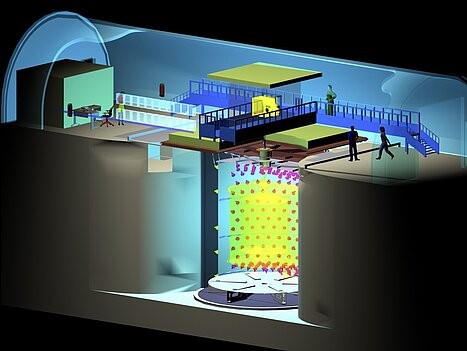
The Double Chooz detector. Image credit: Double Chooz collaboration.
The research team conducted these measurements at the Chooz nuclear power plant in northern France. The Double Chooz detector is located approximately 400 meters underground, in close proximity to two reactor cores. Inside, the detector contains more than 30 cubic meters of liquid scintillator material, which emits faint light signals when antineutrinos interact with it.
The researchers analyzed 17.2 days of data collected during a period when both reactor units were completely shut down, recording approximately 100 potential antineutrino events. These events originated from residual radioactive material in the reactor cores as well as in the spent fuel cooling pools. The measurements showed excellent agreement with detailed simulations of remaining nuclear fuel inventory and the decay of long-lived fission products, marking the first experimental direct verification of theoretical predictions regarding antineutrino emissions from decommissioned reactors and spent fuel.
The Double Chooz collaboration has worked for years to reduce background signals and refine analysis techniques, ultimately achieving the detection of the faint residual antineutrino signal after reactor shutdown. Furthermore, preliminary results from the JUNO-TAO experiment, presented recently at the Neutrino 2026 conference, indicate that other research teams are also exploring in this direction.
The collaboration's findings not only provide publicly available reference data for understanding residual radiation in decommissioned reactors and spent fuel pools, but more importantly, they herald that antineutrino detectors will in the future provide crucial information during reactor maintenance phases and after shutdown, thereby independently verifying reactor status and spent fuel levels, further enhancing nuclear safety and security. The Double Chooz experiment was originally designed to study neutrino oscillations and played a key role in measuring the neutrino mixing angle θ13, laying the groundwork for future research on neutrino matter-antimatter asymmetry.
Disclaimer: Information republished from partner media, institutions or other websites is provided for reference and communication purposes only. It does not imply endorsement of its views or verification of its accuracy. Please contact us if any content infringes rights or requires correction.