
Colorado State University produces first ultracold neutral plasma with electron temperature below 1 kelvin
 Scan to share
Researchers at Colorado State University have, for the first time, produced an ultracold neutral plasma by combining laser cooling techniques with strong magnetic fields. Measurements show that the electron temperature in this plasma is less than 1 kelvin above absolute zero, making it one of the lowest electron temperatures ever measured in a plasma.
The research was published in Physics of Plasmas. The new method proposed in the paper helps test plasma theories under more controllable experimental conditions and improve computational models of plasma behavior in extreme environments. The researchers believe this achievement could provide references for the design of future fusion energy systems and the study of astrophysical systems such as white dwarfs.
Plasma is often referred to as the fourth state of matter and constitutes the vast majority of visible matter in the universe. When a gas gains sufficiently high energy, atoms become ionized, forming a system composed of free electrons, positively charged ions, and some neutral atoms. Plasma exists widely in the interiors of stars and can also be produced in laboratories through electrical energy, lasers, or thermal energy.
Unlike high-temperature plasmas, the Colorado State University team first cooled atoms to near absolute zero before converting them into a plasma. The low-temperature conditions significantly slow the motion of charged particles, allowing researchers to measure particle responses more clearly and compare experimental results with existing theoretical predictions.
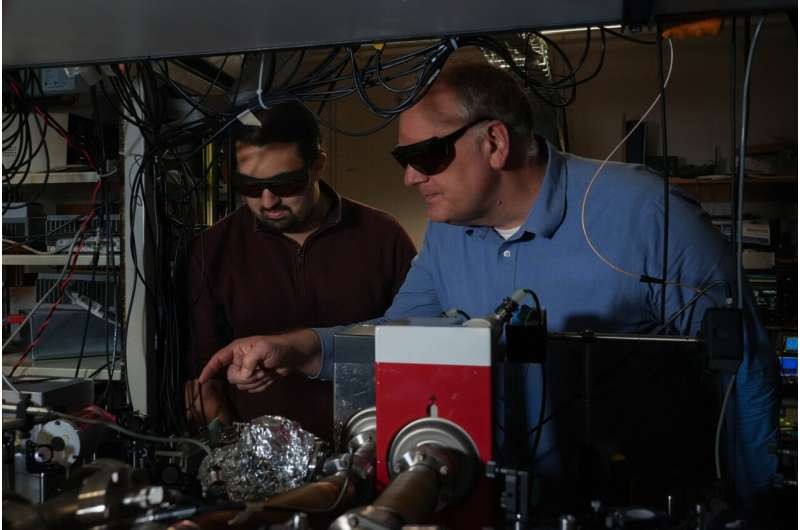
Roberts (right) and Baker working together in the laboratory. Image credit: Colorado State University/College of Natural Sciences
Ryan C. Baker, a graduate student at Colorado State University and first author of the paper, stated that plasma systems at low temperatures become exceptionally complex. He noted that at extremely low temperatures, the experimentally produced system simultaneously contains tightly bound atoms, loosely bound atoms, and free electrons, and these components interact in unexpected ways. To extract meaningful information from the experimental data, the research team developed a new simulation-driven analytical approach.
This research has potential value for fusion energy studies. Fusion reactors need to recreate plasma environments similar to those inside stars on Earth, and such environments are characterized by extremely high temperatures, complex structures, and poor stability. How to confine plasma for sufficiently long durations while maintaining a controllable state is one of the key scientific and engineering challenges for the practical application of fusion energy.
At low temperatures, electric field interactions between particles become more prominent relative to the thermal motion of particles. Therefore, the plasma produced by the Colorado State University team can be used to study the response of charged particles in magnetic fields. Magnetic fields can restrict electron motion, which is closely related to fusion plasma confinement and the development of related models.
The research was led by Jacob Roberts, a professor of physics at Colorado State University. He stated that constructing experimental conditions suitable for testing complex plasma theories is not easy, but the results help researchers assess the feasible boundaries of low-temperature plasma experiments and clarify questions in fusion energy fundamental research that still require deeper exploration.
Roberts also noted that these experimental insights can be used to understand dense plasmas that may exist in white dwarfs and other extreme environments in the universe. Since researchers cannot easily travel to these celestial environments to collect data, controllable simulations in the laboratory are of great significance for validating related theories.
The paper shows that researchers can use magnetic fields to further lower the plasma temperature as needed for experiments. The experimental results also align with previous theoretical predictions regarding the minimum temperature limit of such plasmas. Roberts stated that for decades, the scientific community has debated how low the temperature of such plasmas could reach, and this work not only created an extremely cold electron environment in the laboratory but also demonstrated a new pathway for producing a range of extreme plasma conditions.
The paper is titled "The effect of magnetization on electron heating in low-density ultracold neutral plasmas," with authors including Ryan C. Baker et al., and was published in Physics of Plasmas.
Disclaimer: Information republished from partner media, institutions or other websites is provided for reference and communication purposes only. It does not imply endorsement of its views or verification of its accuracy. Please contact us if any content infringes rights or requires correction.