
IAEA Publishes Report on Aging Management of Spent Fuel Dry Storage Systems
 Scan to share
The International Atomic Energy Agency (IAEA) has published the findings of a decade-long study on aging management of spent fuel dry storage systems.
According to IAEA estimates, by the end of 2024, spent fuel discharged from nuclear power plants worldwide had exceeded 400,000 tonnes of heavy metal (tHM). Of this, 106,000 tHM is in dry storage, a long-term storage method that is becoming increasingly common compared with wet storage.
Most IAEA member states are still decades away from commissioning permanent spent fuel repositories, which means dry storage systems will likely need to continue operating safely beyond their design lifetimes. Wet storage has been in operation for decades, and the IAEA states that aging management of such facilities is generally well understood. Utilities choose dry storage for its passive safety features, and many dry storage facilities have already received license extensions. The IAEA expects demand for dry storage to continue growing, with service periods extending well beyond the original 20-to-40-year licensing terms, potentially exceeding 120 years. Aging management programs (AMPs) are therefore needed to verify continued safe operation.
This year, the IAEA published the Aging Management Program for Spent Fuel Dry Storage Systems, the final report of the Coordinated Research Project on Aging Management Programs for Spent Fuel Dry Storage Systems. The project consolidated research results contributed by participating member states from October 2016 to October 2021, aiming to summarize methodological experience from various countries in developing and implementing AMPs for dry storage systems, and to support countries in advancing their AMPs through case studies and reference examples from different nations.
Elements of an aging management program. Given the dozens of dry storage designs currently in use, the IAEA notes that an AMP should be specifically tailored to the storage system to which it applies. Because some designs are dual-purpose casks (DPCs) licensed for both storage and transport, the IAEA's Transport Safety Standards Committee (TRANSSC) has also established a working group to address aging management of transport packages.
The IAEA report describes a range of different technologies. It first notes the need to distinguish between two categories of facilities: casks that can be used for transport and are eligible for Type B(U) package approval, and storage structures not intended for transport.
For casks, two categories currently exist based on primary material: metal casks, or concrete casks with metal liners. In either type, spent fuel is stored in sealed canisters or as bare fuel loaded into baskets. Storage structures are distinguished by their equipment and complexity. Spent fuel can be simply placed in sealed canisters, whether ventilated or not; sealed canisters or bare fuel can also be stored in storage buildings (or vaults) equipped with additional equipment such as cranes. Fuel in storage units may be arranged vertically (in single or multiple units) or horizontally, and may be located above or below ground.
The first step in an AMP is to identify, on a case-by-case basis and with reference to the safety assessment and licensing basis, the materials and environmental conditions (such as humidity, temperature, and salt content) of each structure, system, and component (SSC) within the scope of application. Environments listed in the report include: outdoor air, deionized water, helium, groundwater/soil, sheltered environments, fully enclosed or lined environments, and environments embedded in concrete, metal, or neutron shielding materials.
Dry storage SSCs must ensure criticality safety, shielding, containment, heat transfer, structural integrity, and retrievability
An AMP should identify credible aging effects and establish management measures, covering: concrete overpacks and support pads, spent fuel assembly materials, and materials of various components in dry cask storage systems. A plan that only detects SSC failures cannot be considered an effective AMP. Effective inspection, testing, and monitoring methods are needed to detect aging effects before a structure or system loses function or fails.
Identifying credible aging effects on materials of various components in dry cask storage systems and establishing management measures is the first step of an AMP
It must be clearly defined when, where, and how program data will be collected, and the methods or techniques used (such as visual inspection, volumetric examination, or surface examination) and their frequencies must be justified with reference to applicable codes and standards.
In an effective performance monitoring program, the "aging effect detection" element discusses and establishes the methods to be used for performance monitoring, while also justifying the frequency of these monitoring activities.
What is a "safety-related item"? Safety-related SSCs (and associated subcomponents) must ensure the following safety functions: criticality safety, shielding, containment, heat transfer, structural integrity, and retrievability. Another way to define them is as follows:
Containment boundary: Confines radioactive material under normal, abnormal, and accident conditions
Criticality control: Maintains a subcritical configuration under normal, abnormal, and accident conditions
Radiation shielding: Reduces radiation emitted by contents under normal, abnormal, and accident conditions
Heat transfer: Removes decay heat under normal conditions and protects temperature-sensitive components such as lead shielding and seals under abnormal and accident conditions
Structural support: Maintains the safety of contents under normal, abnormal, and accident conditions
Fuel retrievability: Supports operations such as loading, unloading, maintenance, monitoring, or transport; loss of this function could prevent the removal of individual or encapsulated fuel assemblies from wet or dry storage, or the removal of sealed canisters containing assemblies from storage casks, overpacks, or storage locations.
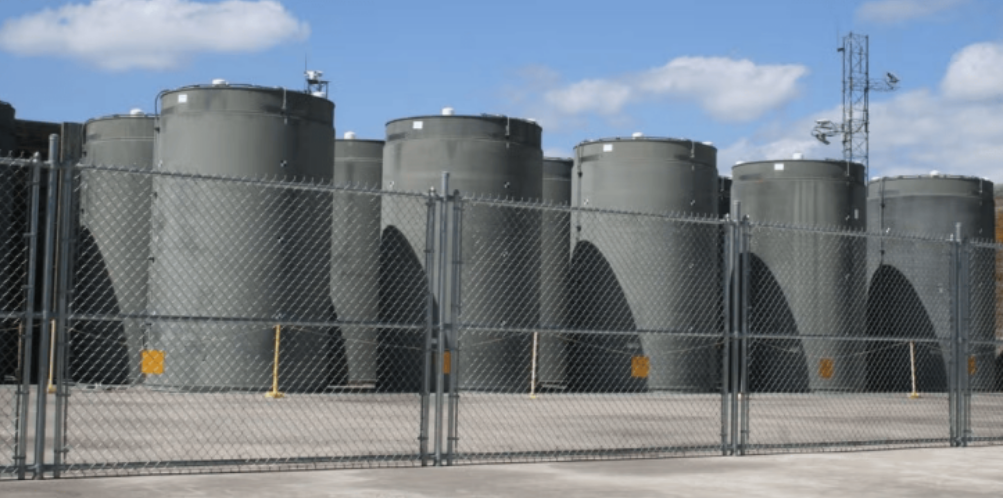
Operating experience. In the United States alone, more than 50 dry storage facility designs have received general licenses from the U.S. Nuclear Regulatory Commission (NRC). Canister sizes and concrete overpack designs vary widely, which complicates accessibility issues—annular gaps and widths, access routes, welding processes, materials, and weld locations all differ. However, 95% of the global inventory consists of bolted cask systems containing bare fuel, or concrete storage overpacks with welded sealed canisters. Bolted cask systems are more common in the United States, while welded sealed canisters are more prevalent outside the U.S. Bolted cask systems have evolved over 30 to 35 years. The report states: "They are a mature industrial technology, and no serious incidents or accidents have ever occurred, including casks loaded with fuel during the Fukushima Daiichi accident, which remained intact."
Regulatory inspection of bolted cask systems is technically less challenging, as all external components can be visually inspected. If operational needs require lifting the cask, the bottom can be inspected as well. Internal components are protected by nitrogen or helium, with leak detection provided through pressure monitoring.
More than 50 dry storage facility designs have received NRC approval in the United States
Routine inspections are performed in situ, typically without the need for lifting and handling systems, although casks may be moved to a dedicated area every 10 years for more detailed visual inspection. The cask is accessible at any time during normal operation, and corrosion on external surfaces can be detected without dedicated inspection. Experience to date shows only wear marks and limited localized corrosion from paint damage during handling.
Several operating events involving corrosion of trunnion bolts have occurred, which could affect safe handling of the cask. The corrective measure is to inspect for corrosion, replace bolts if necessary, and reseal. Newer cask designs incorporate improvements in which all trunnion bolts are protected by sealed stainless steel rings that prevent boron-containing water from seeping into the bolt shaft holes during loading.
The U.S. Nuclear Energy Institute (NEI) commissioned the Institute of Nuclear Power Operations (INPO) to establish an information clearinghouse on aging of dry cask storage SSCs. The clearinghouse consolidates positive inspection results confirming storage integrity, as well as lessons learned that may require industry-wide corrective action. After 33 inspection reports, no significant repair actions have yet been required by the industry.
In September 2016, corrosion was discovered on the carbon steel shell of a Holtec HI-STORM 100 overpack at the Hatch nuclear power plant. The corrosion occurred behind a fallen radiation warning sign and was repaired by abrasive blasting and repainting. In October 2020, direct and video inspections were conducted on a standardized NUHOMS HSM and stainless steel canister at the Susquehanna nuclear power plant, revealing chloride deposits on the canister; sampling results indicated no threat to safety functions.
Orano's NUHOMS MATRIX is one of many dry storage designs worldwide
Aging management of bolted casks at the North Anna nuclear power plant provides a typical case: Orano TN-32 dry storage casks are painted white to facilitate visual inspection and provide general corrosion protection.
Extending facility service life. Some dry storage systems have reached their expected service life, but condition surveys of the storage systems support extending the licensed service life.
Aging management programs in many countries provide such information, drawing on aging management experience from nuclear power plants and employing personnel with plant experience as storage facility operators. The IAEA report notes that during the report preparation period, significant technical progress was made in the inspection field, evolving from laboratory scale to routine operation and now incorporated into U.S. storage license renewal processes. For example, temperature data from different positions on the canister are used for monitoring. As sensor technology matures, entirely new monitoring possibilities are expected to emerge.
The report concludes: "As storage durations continue to extend, aging management programs will remain an important safety cornerstone for dry storage systems."
Disclaimer: Information republished from partner media, institutions or other websites is provided for reference and communication purposes only. It does not imply endorsement of its views or verification of its accuracy. Please contact us if any content infringes rights or requires correction.