
Italian Neutrino Telescope Undersea Network Captures Fin Whale Songs
 Scan to share
August 5 news, after months of silence, fin whale songs have once again been recorded in the southern Ionian Sea. This observation was jointly completed by multiple experiments connected to the underwater infrastructure of the Southern National Laboratory of the Italian National Institute for Nuclear Physics (LNS-INFN), involving three projects: ITINERIS, LOWNOISER, and VONGOLA. The related work was carried out with the participation of LNS-INFN and the Sicilian Center for Nuclear Physics and Structure of Matter (CSFNSM).
The detection occurred in late winter. At that time, the eastern Mediterranean region was affected by strong anthropogenic noise from a long-term geophysical survey of offshore oil and gas resources, and only weeks had passed since the transit of Hurricane "Harry." Researchers identified fin whale signals amid the complex acoustic background and, combining traditional acoustic sensors with fiber-optic distributed acoustic sensing technology, tracked the movement trajectory of the whale group in the waters southeast of Sicily.
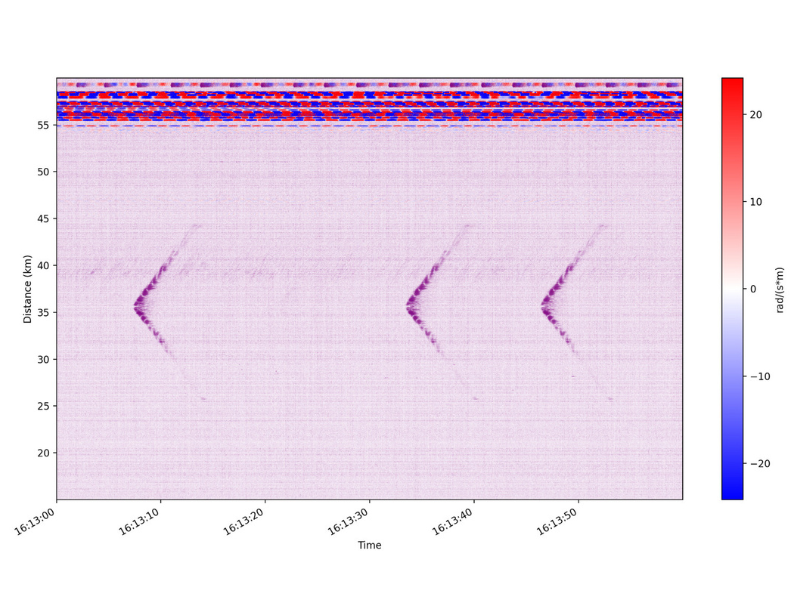
Acoustic signals generated by whale songs detected by the DAS system INFN
According to reports, the LNS acoustic sensors installed under the ITINERIS project were the first to detect the relevant signals. This project, led by the Italian National Research Council, aims to build an integrated infrastructure network for studying environmental processes. Subsequently, the distributed acoustic sensing system deployed under the VONGOLA project confirmed the recording, and the LOWNOISER project also validated the observations. The VONGOLA project focuses on marine biodiversity monitoring and mitigation of anthropogenic impacts, while the LOWNOISER project focuses on the control of underwater noise pollution from maritime traffic.
Researchers from LNS-INFN stated that this is the first time whale songs have been simultaneously recorded using significantly different measurement systems. The research team simultaneously used piezoelectric hydrophone data from the ITINERIS project and distributed acoustic sensing data from the LOWNOISER and VONGOLA projects to achieve continuous monitoring of the marine soundscape.
Distributed acoustic sensing technology utilizes laser pulses transmitted through submarine fiber-optic cables, detecting acoustic disturbances by analyzing changes in reflected light. Through this method, submarine fiber-optic cables can be transformed into a monitoring chain composed of numerous "virtual hydrophones," enabling real-time capture of marine soundscape changes and distinguishing between natural and anthropogenic sound sources. Researchers noted that the relevant sensing cables extend over 100 kilometers, capable of detecting fin whale low-frequency calls at approximately 20 hertz and tracking their activity over a wide area.
Researchers stated that the Mediterranean fin whale population is in an endangered state, and records of this species' activity in the Ionian Sea remain relatively limited. Fin whale songs are primarily associated with courtship and reproduction, but the relationship between their vocalization behavior and environmental conditions still requires further study. Maritime traffic noise is considered a significant disturbance factor for this species, and the new technology will help assess the degree of overlap between different acoustic signals, thereby better understanding the impact of human activities on fin whale communication, orientation, and migration.
This observation also continues the tradition of basic physics infrastructure serving marine scientific research. For over a decade, acoustic sensors on the submarine infrastructure off the coast of Sicily have been used to monitor cetacean activity in the Ionian Sea basin. These sensors originate from technologies related to the KM3NeT underwater neutrino telescope. Today, the new dedicated monitoring systems can not only identify cetacean signals but also continuously record anthropogenic noise and its impact on marine ecosystems.
The research team believes that this achievement demonstrates that the Ionian Sea underwater observation network, built by the Italian National Institute for Nuclear Physics for the KM3NeT telescope and neutrino fundamental physics research, is becoming a long-term marine biodiversity observation platform integrating physics, bioacoustics, artificial intelligence, and environmental monitoring functions.
Disclaimer: Information republished from partner media, institutions or other websites is provided for reference and communication purposes only. It does not imply endorsement of its views or verification of its accuracy. Please contact us if any content infringes rights or requires correction.