
Russian Far East nuclear submarine base adds anti-drone nets, unmanned equipment protection prompts adjustments across multiple platforms
 Scan to share
Satellite imagery shows Russia has installed anti-drone protective nets over multiple nuclear submarines at the Vilyuchinsk naval base on the Kamchatka Peninsula. The base hosts the Pacific Fleet's nuclear submarine deployment. A total of eight moored submarines are covered by the protection, including the "Borei"-class and "Borei-A"-class ballistic missile submarines, as well as the "Oscar"-class, "Yasen"-class, and "Akula"-class attack submarines.
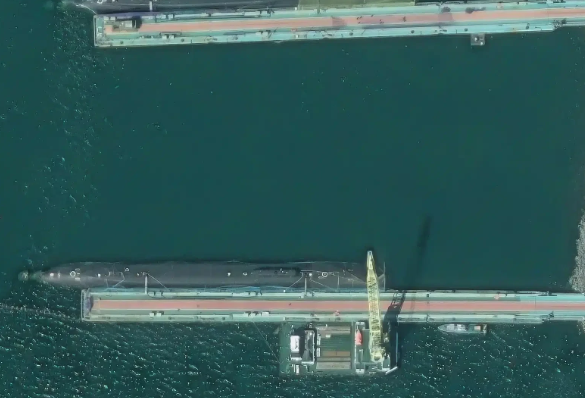
These protective installations consist mainly of L-shaped steel frames along the piers and retractable netting. When submarines are berthed, the nets can cover the upper hull; before submarines depart port, the netting is rolled up and stowed. Such facilities cannot withstand long-range cruise drones or heavy missile strikes, but can provide a degree of physical shielding against low-cost threats such as small FPV drones and improvised unmanned devices. The Russian side has also deployed double-layer floating barriers on the outer side of the mooring area to prevent unmanned surface vessels from entering the harbor.
This change reflects how the proliferation of small unmanned equipment is influencing mooring protection designs for various maritime platforms. As sea-based strategic assets, nuclear submarines face potential risks from low-altitude small unmanned devices while in port, making the use of low-cost facilities to enhance berthing safety a direction of adjustment on the platform support side.
Meanwhile, Iraqi security forces have seized a batch of Shahed-107 loitering munitions, at least 12 units. This system has a range exceeding 300 kilometers and a warhead of approximately 15 kilograms, primarily used to strike nodes such as control stations, storage tanks, and pumping stations. Iraq is strengthening weapons control and personnel management to restrict unauthorized armed groups from using unmanned equipment.
In Southeast Asia, Indonesia is advancing its submarine force renewal. Indonesia's PT PAL shipyard has cut steel in Surabaya for the first Scorpene Evolved conventional submarine, a project stemming from a two-submarine construction agreement signed between Indonesia and France's Naval Group in 2024. The submarine features a full lithium-ion battery system, offering improved endurance and submerged capability compared to traditional lead-acid battery versions, with a range exceeding 8,000 nautical miles, at-sea deployment of 78 to 80 days, continuous submerged operation of over 12 days, and is equipped with 533 mm torpedo tubes capable of launching heavy torpedoes and SM39 "Exocet" anti-ship missiles. The project also includes technology transfer to more than 400 Indonesian engineers to help Indonesia enhance its domestic submarine construction and systems integration capabilities.
Disclaimer: Information republished from partner media, institutions or other websites is provided for reference and communication purposes only. It does not imply endorsement of its views or verification of its accuracy. Please contact us if any content infringes rights or requires correction.