
Argonne National Laboratory Measures Dust Resuspension Behavior in Radioactive Contamination Scenarios
 Scan to share
Researchers at the U.S. Department of Energy's Argonne National Laboratory recently conducted field experiments to simulate the movement of dust particles on concrete surfaces under radioactive contamination scenarios, measuring the effects of pedestrian activity and vehicle traffic on dust dispersion. The study was published in the journal Health Physics and received support from the U.S. Department of Homeland Security Science and Technology Directorate and the Radiological/Nuclear Emergency Response and Recovery Research and Development Program.
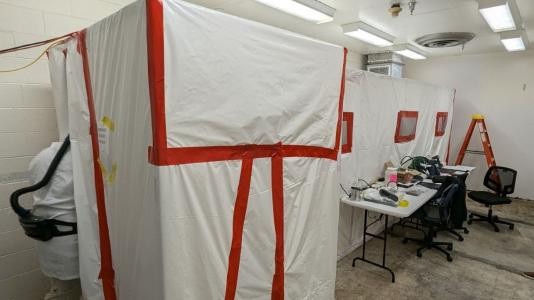
To control humidity and temperature and prevent dust generation, pedestrian tests were conducted inside a tent. In the image, researchers can be seen entering the tent on the left. Particle counters are placed on a white table, with their hoses extending into the tent to collect air samples. (Image courtesy of Argonne National Laboratory.)
The research team focused on the phenomenon of "resuspension," in which hazardous particles deposited on the ground or other surfaces are lifted back into the air by activities such as pedestrian movement or vehicle passage. In the event of chemical, radioactive, or biological contamination incidents, such particles, once inhaled, can increase human exposure risks and complicate site cleanup and contamination control.
Mike Kaminski, a senior nuclear chemical engineer at Argonne National Laboratory, stated that existing radiation exposure models do not adequately address the behavior of dust once it enters the air, and lack guidance for accurately running the relevant models. The researchers therefore hope that field measurement data will fill critical gaps in emergency response models.
In the experiments, the research team used Arizona test dust to simulate contaminated environmental dust and measured the amount of dust resuspended by different activities using particle detectors. The experimental setup included four scenarios: walking, marching, vacuuming, and vehicle passage. Walking and marching tests were conducted inside a tent with controlled humidity and temperature to prevent external dust interference; vehicle tests were carried out on roads within the Argonne National Laboratory campus, where researchers spread test dust on the pavement and drove sport utility vehicles across at various speeds, measuring the effects as tires and underbodies passed through the dust-covered areas.
Results showed that normal walking produced relatively low resuspension factors, consistent with previous studies; marching significantly increased resuspension levels and can be used to simulate scenarios of emergency responders moving rapidly or evacuating. Vacuuming experiments indicated that this activity primarily reintroduces smaller particles into the air. Vehicle tests showed that SUVs driving over dust-covered pavement generated substantial dust resuspension, particularly lifting larger particles.
The researchers noted that previous studies on resuspension caused by human activity have mostly focused on indoor environments, such as carpeted and hardwood floors; vehicle-related research has more often served routine air quality analysis. Quantitative data specific to radioactive contamination emergency scenarios—particularly dust on concrete surfaces under the influence of personnel and vehicles—remains relatively limited.
The experimental results indicate that dust resuspension rates during emergency operations may be higher than many models previously predicted. These data can help improve radiation exposure assessment, contamination control plans, protective equipment selection, and emergency response strategies such as evacuation or shelter-in-place, providing a more accurate basis for responding to radiological incidents.
Disclaimer: Information republished from partner media, institutions or other websites is provided for reference and communication purposes only. It does not imply endorsement of its views or verification of its accuracy. Please contact us if any content infringes rights or requires correction.