
Texas Department of Public Safety Advances Airborne Radiation Detection Capabilities
 Scan to share
The Texas Department of Public Safety recently highlighted an airborne radiation detection capability being advanced by its Aviation Operations Division. The program integrates specialized radiation detection sensors and real-time data transmission systems onto helicopters, enabling crew members to rapidly survey large areas from the air and relay relevant information to ground personnel in a timely manner, supporting homeland security and security operations for major public events.
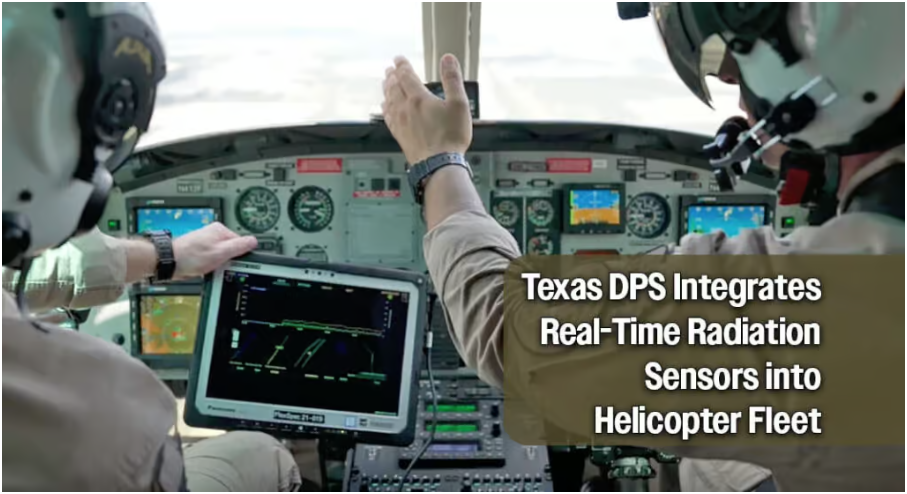
According to reports, this capability is implemented jointly by the Aviation Operations Division and the Radiation/Nuclear Unit of the Commercial Vehicle Enforcement Division. The equipment has already been used to support security operations for major events, including FIFA-related venues in Houston and Dallas, and will continue to serve security planning for other large public events across Texas.
Stacy·Holland, Chief Pilot of the Aviation Operations Division at the Texas Department of Public Safety, stated that the role of aviation platforms in public safety is continuously expanding. By integrating advanced radiation detection technology onto helicopters, partner law enforcement agencies can achieve faster situational awareness, greater coverage, and an added layer of protection for public safety.
The airborne radiation detection equipment was procured through the "Securing the Cities" (STC) federal grant program administered by the City of Houston, managed by the Houston Office of Homeland Security. The team has carried out system modernization and deployment efforts around the Texas Department of Public Safety Bell 412 helicopter, including installing specialized mounting brackets, integrating satellite-link real-time data transmission capabilities, and validating system effectiveness through calibration and training.
Major Omar·Villarreal, Commander of the Commercial Vehicle Enforcement Division, stated that addressing radiological and nuclear threats requires sustained innovation and collaborative efforts. The division's Radiation/Nuclear Unit has accumulated years of experience operating ground-based detection equipment, and extending detection capabilities to the air helps improve anomaly identification capabilities and enhance emergency preparedness levels during large public events.
According to the Texas Department of Public Safety, the Bell 412 helicopter possesses the payload capacity required to carry specialized detection equipment and can transmit sensor data in real time during flight, eliminating the need to wait until after the mission concludes for centralized analysis. This capability can be used to rapidly establish radiation baselines around stadiums, transportation corridors, and other critical infrastructure, providing support to state and local homeland security partners.
Currently, the system remains in the operational commissioning phase, but baseline surveys have already been conducted around FIFA-related venues in Houston and Dallas. During testing, the system detected expected readings near hospitals and other facilities with legitimate uses of radioactive materials, demonstrating corresponding sensitivity and effectiveness.
The Texas Department of Public Safety stated that, as the program continues to advance, plans call for deploying the technology on Bell 412 and Bell 407 helicopters, further enhancing the ability to detect and respond to relevant security threats from the air.
Disclaimer: Information republished from partner media, institutions or other websites is provided for reference and communication purposes only. It does not imply endorsement of its views or verification of its accuracy. Please contact us if any content infringes rights or requires correction.