
Brookhaven National Laboratory Pilots Training Program for Nuclear Technology and Radiochemistry Talent
 Scan to share
The U.S. Department of Energy's Brookhaven National Laboratory and Suffolk County Community College (SUNY Suffolk) recently completed a pilot program to train talent in nuclear technology and radiochemistry. Eleven students and recent graduates completed one semester of coursework and three weeks of intensive laboratory training, becoming the first cohort to complete the "Nuclear Technology and Radiochemistry Technician Pathway (NTRTP)" program.
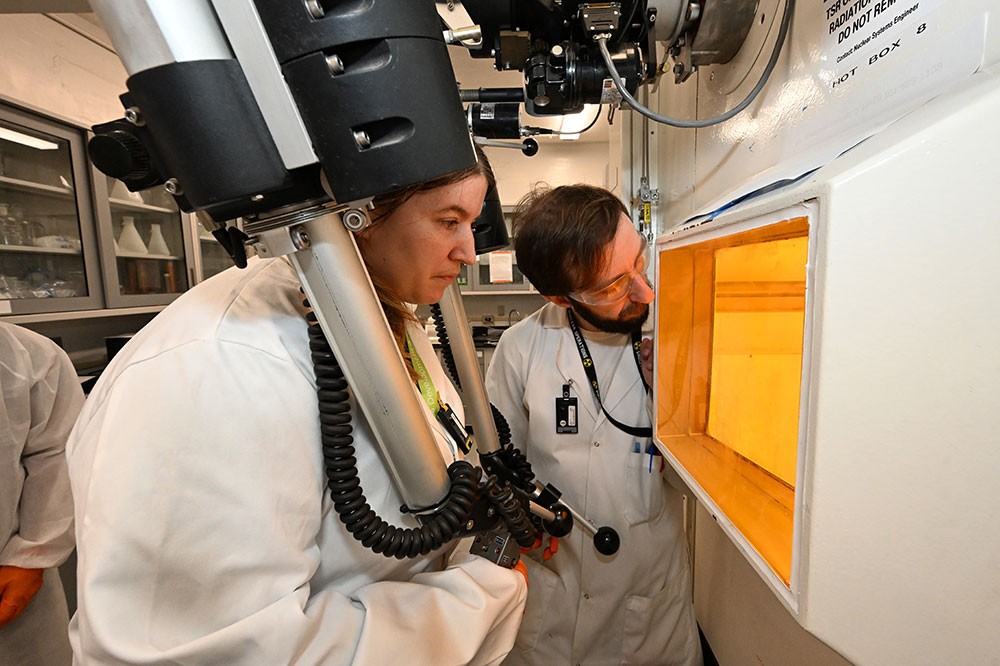
SUNY Suffolk student Arin Morton (left) simulates operation of equipment in a hot cell facility under the guidance of mentor Michael Chimes at Brookhaven National Laboratory's Isotope Research and Production Division. Hot cell facilities are specialized laboratories and equipment required for handling radioactive materials. (Brookhaven National Laboratory)
The program is supported by the U.S. Department of Energy (DOE) Office of Science's Office of Workforce Development for Teachers and Scientists (WDTS), and aims to promote collaboration between national laboratories and regional community colleges to cultivate local technical talent in fields such as nuclear technology and radiochemistry. Brookhaven National Laboratory is one of five U.S. national laboratories invited to participate in the initiative.
Under the program structure, students began 15 weeks of classroom instruction in January, covering fundamentals of nuclear technology, radiochemistry concepts, radiation control regulations, and methods for radioisotope identification and quantitative analysis. Students then entered Brookhaven National Laboratory for three weeks of immersive hands-on training, learning safe material handling, laboratory procedure compliance, data analysis, and operation of specialized instruments.
During the hands-on training, students interacted with cyclotron engineers, radiation control personnel, isotope researchers, and related emergency support staff, and toured the Brookhaven Linac Isotope Producer, the Van de Graaff tandem accelerator, and radioactive waste management facilities. Among these, the Brookhaven Linac Isotope Producer is one of the few facilities in the United States used to produce isotopes for medical diagnostics and therapy; the Van de Graaff tandem accelerator is partially used to support the NASA Space Radiation Laboratory in studying cosmic radiation effects.
Brookhaven National Laboratory stated that the program not only trains students in laboratory procedures, radiation safety standards, and technical operational methods, but also helps them understand the application scenarios of nuclear science and nuclear technology in medicine, environmental monitoring, national nuclear security, engineering, and facility operations.
The program concluded on June 12. At the final presentation, students reported on the techniques and concepts they learned and explained how these competencies can be applied to different career paths. Several students noted that the laboratory experience gave them a more intuitive understanding of the practical applications of nuclear technology and radiochemistry, and strengthened their confidence in pursuing further study and careers in related fields.
Program organizers stated that this pilot provides a replicable model for joint training of technical talent between national laboratories and community colleges. Moving forward, relevant institutions will continue to explore regional workforce development pathways in nuclear science and other critical technology fields based on the pilot results.
Disclaimer: Information republished from partner media, institutions or other websites is provided for reference and communication purposes only. It does not imply endorsement of its views or verification of its accuracy. Please contact us if any content infringes rights or requires correction.