
EIC and CERN Strengthen Cooperation to Advance International Scientific Exchange for the Electron-Ion Collider
 Scan to share
August 12, 2026 - The collaboration between the Electron-Ion Collider (EIC) project and the European Organization for Nuclear Research (CERN) is deepening further. On May 28, CERN hosted a workshop themed around the EIC to introduce the project's scientific goals, construction progress, and future research opportunities to its international scientific community.
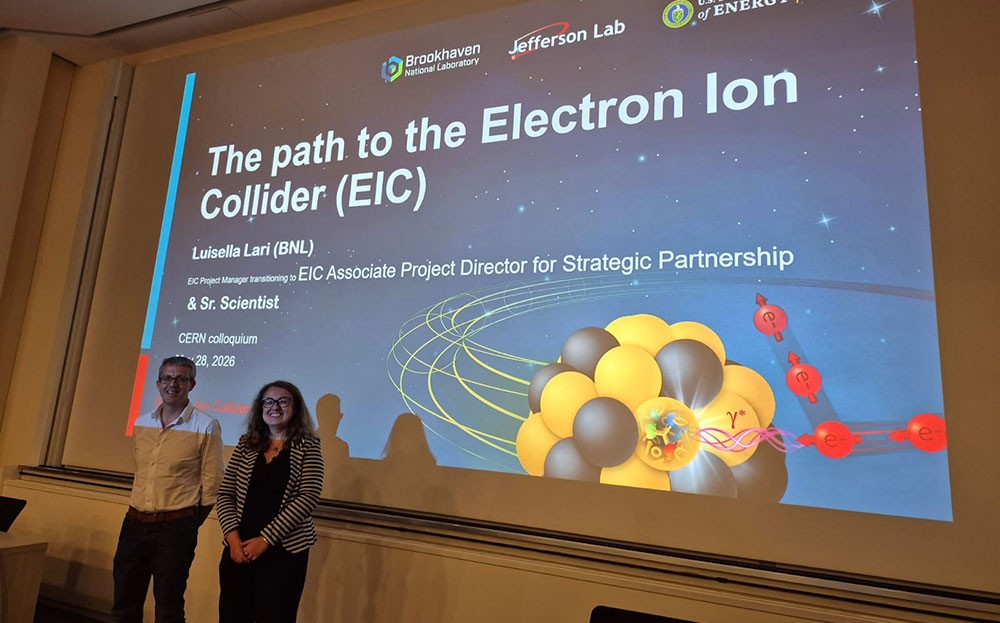
Luisella Lari (right), Deputy Director for Strategic Partnerships of the Electron-Ion Collider (EIC) project, poses with Matthew Chalmers, organizer of the CERN lecture series, after delivering a talk titled "The Road to the Electron-Ion Collider" at CERN.
Luisella Lari, senior scientist on the EIC project, delivered a talk titled "The Road to the Electron-Ion Collider" at the workshop. Lari has served as EIC Project Manager since 2022 and is currently transitioning to the role of Deputy Director for Strategic Partnerships. In her presentation, she introduced the current status of the EIC project, its scientific mission, and the potential research impact the facility could generate in the future.
The Electron-Ion Collider is located at the U.S. Department of Energy's Brookhaven National Laboratory and will be built in partnership with the U.S. Department of Energy's Thomas Jefferson National Accelerator Facility. Once completed, it will be the world's first polarized electron-ion collider, designed to study the structure of protons, neutrons, and atomic nuclei in unprecedented ways, helping scientists explore key questions related to the fundamental building blocks of visible matter.
The workshop also provided a window for the EIC project to showcase its latest progress to the international high-energy physics and nuclear physics communities. Lari noted that CERN researchers have shown strong interest in the EIC science program, with physicists eager to obtain new and different types of data for their research.
Following the presentation, participants engaged in discussions on topics including collider operations, research opportunities, and the role of artificial intelligence in future physics research. Lari believes that maintaining ongoing dialogue with the physics community helps sustain international attention on the EIC project.
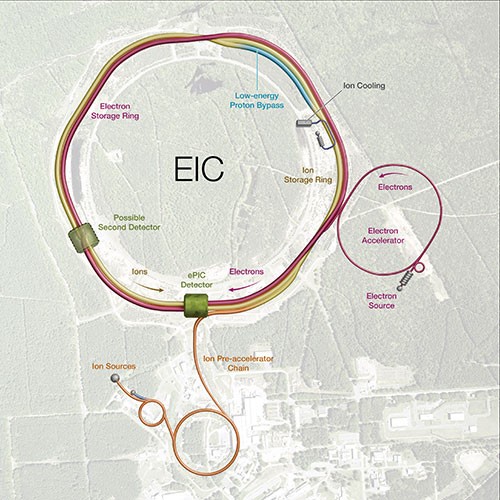
This rendering depicts the Electron-Ion Collider (EIC), whose scientific vision and technical progress have recently drawn attention through collaborations and presentations at CERN and other international accelerator conferences. (Valerie A. Lentz/Brookhaven National Laboratory)
It was noted that CERN and the EIC project have a long-standing foundation of cooperation, including exchanges of technical expertise, resource support, and joint research and development. These collaborations are advancing key technologies related to the EIC's future operations. Scientists and engineers from multiple institutions around the world are also continuously participating in the project's construction, further giving the EIC the characteristics of a major international scientific facility.
Recently, the EIC has also strengthened its connections with the global accelerator community through several international activities. Earlier this year, Lari chaired the EIC Accelerator Collaboration satellite meeting during the 17th International Particle Accelerator Conference, where accelerator experts from multiple countries exchanged views on the project's technical progress, accelerator design, and international collaboration opportunities. The EIC's accelerator design also drew attention during the CERN 2026 Future Circular Collider Week, where discussions focused on technical synergies between the EIC and the Future Circular Collider, as well as the research and development challenges that next-generation collider projects may jointly face.
As the EIC project continues to advance toward construction and future operational phases, project representatives stated that sustained collaboration with researchers worldwide will help build a broader scientific network and prepare future users to fully leverage the facility's research capabilities.
Disclaimer: Information republished from partner media, institutions or other websites is provided for reference and communication purposes only. It does not imply endorsement of its views or verification of its accuracy. Please contact us if any content infringes rights or requires correction.