
SwissFEL Achieves Ultralow-Temperature X-ray Observation of Quantum States
 Scan to share
Researchers at the Paul Scherrer Institute (PSI) in Switzerland recently reported that the Cristallina experimental station of the Swiss Free-Electron Laser (SwissFEL) can now observe quantum states that only emerge at extremely low temperatures using X-ray scattering at temperatures close to absolute zero.
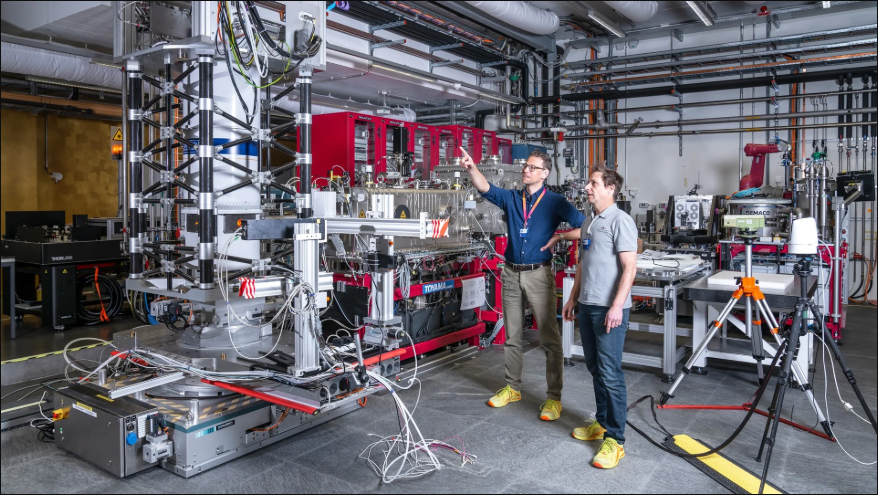
Simon Gerber (left) and Bill Pedrini (right) at the Cristallina experimental station of SwissFEL. With the help of a custom-built cryostat connected to the beamline (far left), quantum states can now be studied at extremely low temperatures. Paul Scherrer Institute PSI/Markus Fischer
According to the team, they recently achieved a low temperature of 35 millikelvin in experiments, approximately 0.035 kelvin above absolute zero. This is the lowest temperature achievable with the current experimental setup. The researchers noted that, to their knowledge, this is also the lowest temperature ever reached in measurements conducted using X-ray scattering.
Ultralow-temperature environments are crucial for quantum research. Many special quantum states only appear at temperatures close to absolute zero. The team's goal is to use SwissFEL to image quantum states and their dynamic processes within this temperature range, thereby observing transient phenomena that were previously difficult to capture directly.
The experimental approach draws on the "diffraction before destruction" principle from structural biology. X-ray experiments typically cause sample heating and radiation damage, but X-ray free-electron laser pulses are extremely short—usually only tens of femtoseconds or even shorter—while also being highly intense, allowing instantaneous structural information to be recorded before the sample is heated or damaged.
The researchers describe SwissFEL as an ultrafast camera for the atomic world: after cooling the sample to extremely low temperatures, a powerful X-ray pulse is used to take a "snapshot," capturing the quantum state before X-ray-induced heating suppresses it. The completion of this experimental station provides a new observation window for low-temperature quantum states, quantum dynamics, and materials research.
Disclaimer: Information republished from partner media, institutions or other websites is provided for reference and communication purposes only. It does not imply endorsement of its views or verification of its accuracy. Please contact us if any content infringes rights or requires correction.