
Russian Team Proposes Compact "Siberian Snake" Design for NICA Collider to Control Proton Polarization
 Scan to share
Experts from the Moscow Institute of Physics and Technology and the Joint Institute for Nuclear Research have proposed a compact "Siberian snake" magnetic field device design for Russia's NICA collider. The device employs a transverse magnetic field, aiming to maintain proton spin direction during acceleration to a maximum of 13.5 GeV and control polarization orientation during experiments. Related numerical simulations of proton polarization show that this design can effectively suppress beam depolarization.
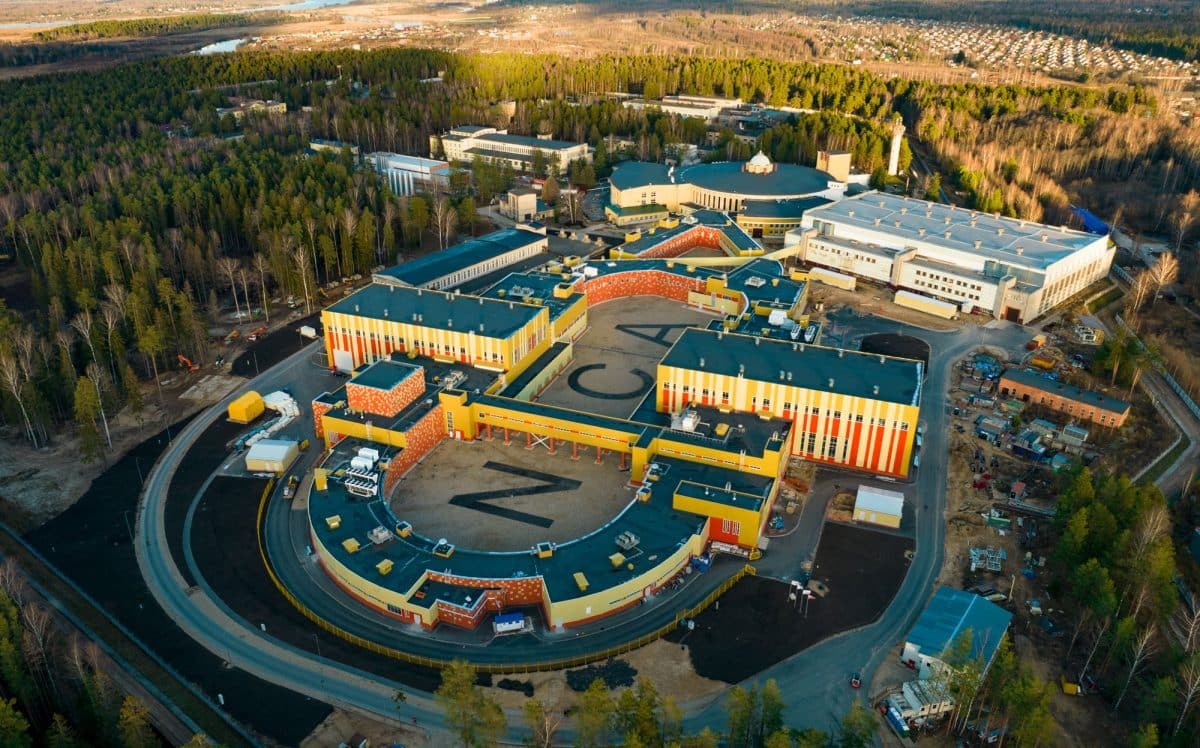
Russia's NICA accelerator complex — Moscow Institute of Physics and Technology press office
In an accelerator, proton beams travel along a closed orbit, and particle spins precess around a specific rotation axis. When the beam reaches certain energies, spin may resonate with periodic perturbations in the ring structure, causing beam depolarization; without dedicated control measures, the beam polarization state required for experiments would be difficult to maintain.
Spin physics detectors at the NICA collider conducting spin polarization research require beams with vector polarization greater than 80% and luminosity up to 10³² cm⁻² s⁻¹. Additionally, the system must support rapid spin flipping of particles during experiments to reduce systematic errors caused by detector asymmetries and accelerator structure imperfections.
As part of the NICA spin polarization research infrastructure, the research team is developing the "spin transparency" method. This method involves placing identical "Siberian snake" structures in opposite regions of the collider to rotate particle spins by 180 degrees, thereby weakening the influence of structural dipole magnets on beam polarization; combined with a weak-field "spin navigator" to stabilize spin dynamics, the required polarization direction for detectors can be achieved.
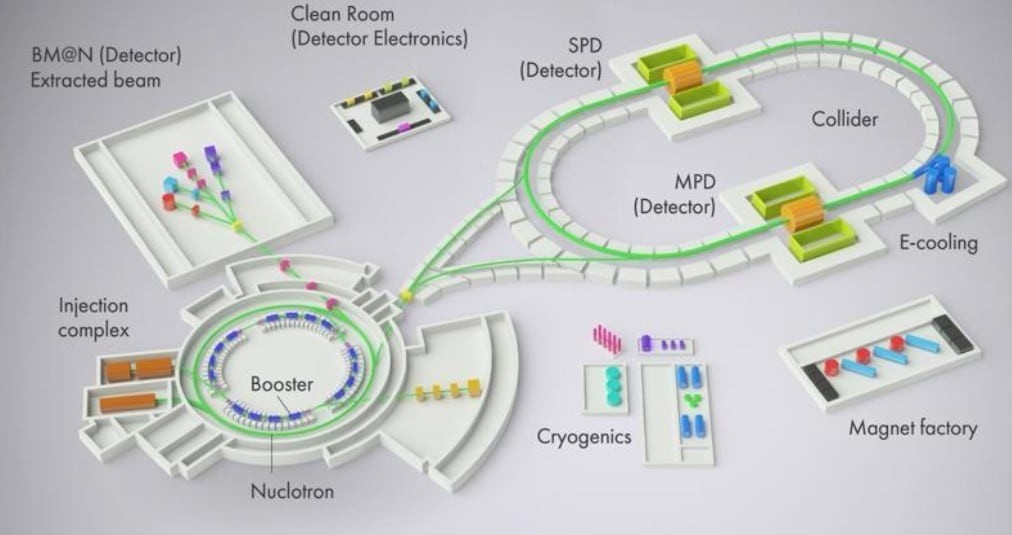
Schematic of the NICA accelerator complex in Dubna. The "Siberian snake" is located in a special straight section of the collider ring
Researchers had previously considered installing solenoid-based "Siberian snakes" in the accelerator optical structure, but such schemes require the longitudinal field integral to be proportional to particle momentum, imposing high demands on installation space. In contrast, the field integral of a transverse-field "Siberian snake" remains nearly constant with energy, making it more suitable for high-energy and ultra-high-energy applications.
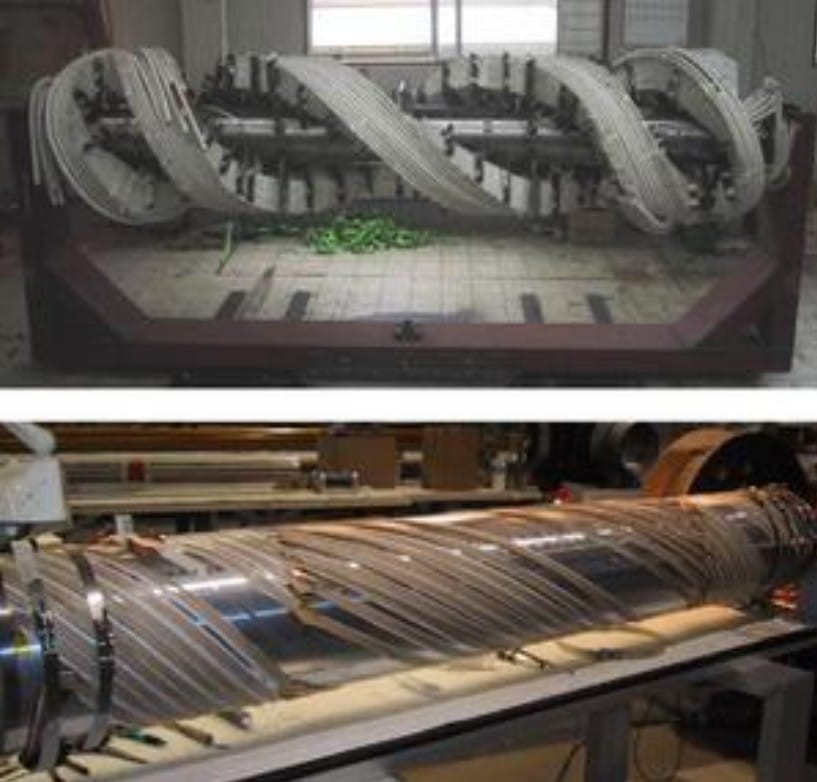
Siberian helical snake observed at the AGS synchrotron and RHIC collider
In their paper, the research team proposed replacing complex helical magnets with a set of conventional superconducting dipole magnets with alternating field directions. This scheme can reduce orbit deviation at low energies: at 3.5 GeV, the orbit deviation is approximately 4 cm, remaining within the magnet aperture range. For comparison, a similar helical magnet scheme applied to NICA could result in an orbit deviation of up to 20 cm at 3.5 GeV, exceeding the collider magnet aperture.
Based on the dipole "Siberian snake" and longitudinal polarization navigator stabilization technology, researchers conducted numerical simulations of spin dynamics during proton acceleration in the spin transparency mode of the NICA collider. The results show that during acceleration to 13.5 GeV, the deviation of the beam's longitudinal spin component does not exceed 5%, indicating that this dipole magnet scheme can suppress resonant depolarization across the entire operating energy range of NICA.
The research results have been published in Physics of Particles and Nuclei Letters and received funding from the Russian Science Foundation project. The researchers stated that compared to helical "Siberian snake" structures, the scheme based on standard dipole magnets helps reduce aperture constraints at low energies, making the device more compact and structurally simpler, while providing a technical pathway for precision spin studies of polarized protons at NICA.
Disclaimer: Information republished from partner media, institutions or other websites is provided for reference and communication purposes only. It does not imply endorsement of its views or verification of its accuracy. Please contact us if any content infringes rights or requires correction.