
U.S. FRIB Secures Contract from Naval Nuclear Laboratory to Develop Quantum-Classical Hybrid Nuclear Reaction Calculation Methods
 Scan to share
A research project at the Facility for Rare Isotope Beams (FRIB) at Michigan State University, led by Dean Lee, Professor of Physics at FRIB, Professor in the Department of Physics and Astronomy at Michigan State University, and Head of the Theoretical Nuclear Science Department at FRIB, has received one-year contract support from the Naval Nuclear Laboratory. The laboratory is managed by Fluor Marine Propulsion. The project will study how to combine quantum computers with classical computers to improve the accuracy of predictions for neutron interactions with matter. This also represents the first phase of a five-year plan aimed at developing and evaluating new computational tools for nuclear science.
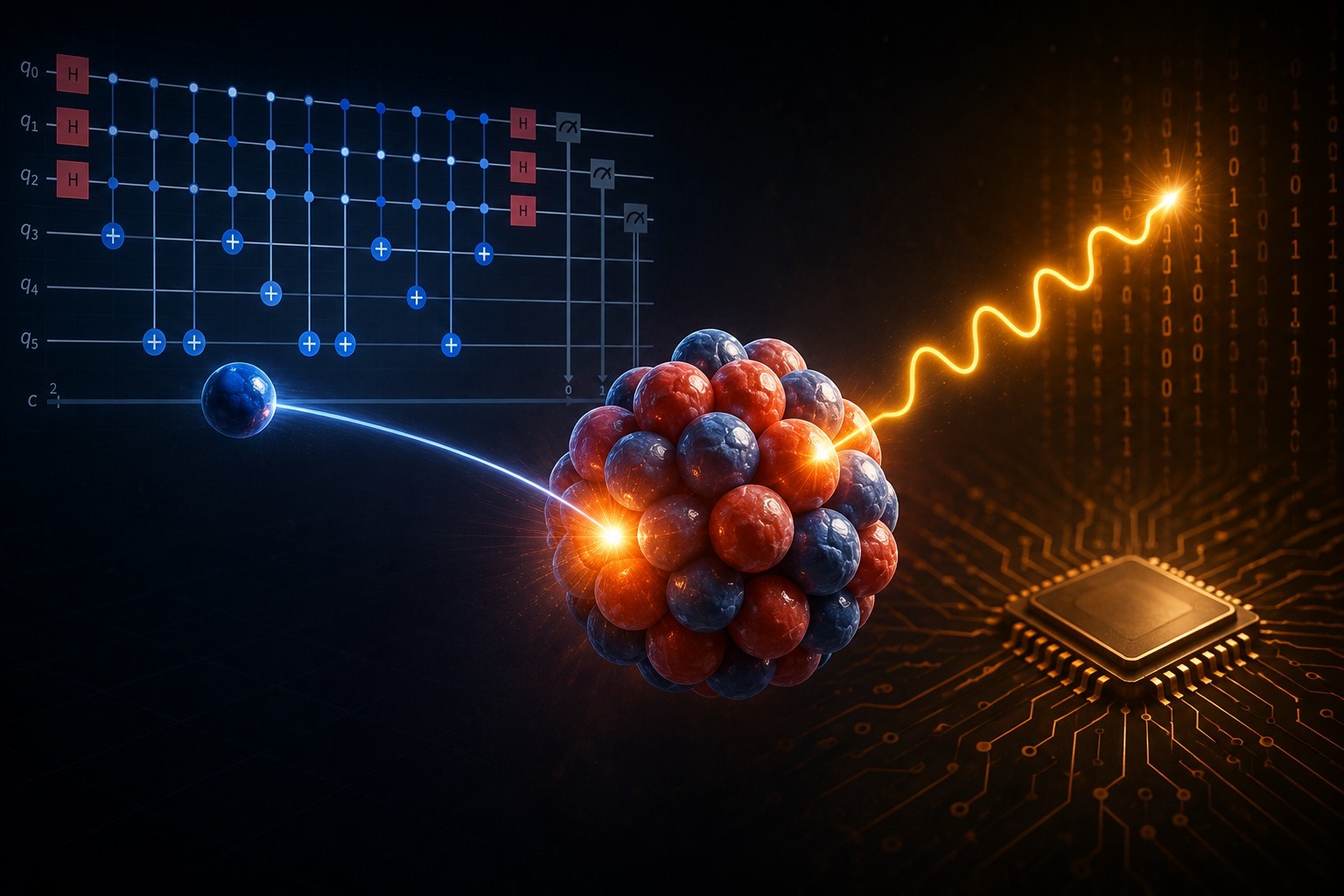
In nuclear physics research, accurately predicting how neutrons interact with atomic nuclei is an important and computationally complex task. Such interactions are central to understanding nuclear reaction mechanisms and have applications in reactor design, radiation shielding, isotope production, and nuclear astrophysics. Existing nuclear theories can describe the relevant reactions, but as nuclei grow larger and their structures become more complex, the required computational effort increases rapidly.
To address this challenge, Dean Lee's team plans to develop a hybrid computational framework that combines high-performance supercomputers with quantum computers. The researchers will design new Monte Carlo simulation methods that can run on classical supercomputers while also leveraging quantum computers to benchmark calculation results for smaller nuclear systems. These tools are expected to enable more accurate calculations of neutron capture processes in complex nuclei in the future.
Dean Lee noted that FRIB has conducted extensive research in lattice Monte Carlo simulations of nuclear structure and reactions, quantum computing algorithm state preparation, and applications of machine learning and artificial intelligence methods. This project requires the integration of these techniques and will further explore the boundaries of quantum computer applications in nuclear reaction research.
The first phase of the project will focus on using existing quantum hardware to conduct test calculations on small nuclear systems. According to the five-year roadmap, as relevant technologies gradually mature, the research will advance to larger-scale and more complex reaction calculations to enhance predictive capabilities for the performance of materials used in nuclear energy applications.
According to available information, the Naval Nuclear Laboratory focuses on improving data related to reactor materials, and the same physical principles can also be used to explain rapid neutron capture processes. These processes involve reactions with rare isotopes and are associated with the formation of many heavy elements in the universe, representing one of FRIB's key scientific research directions.
FRIB is operated by Michigan State University and serves as a U.S. Department of Energy Office of Science user facility, funded by its Office of Nuclear Physics. FRIB conducts rare isotope research using a heavy-ion accelerator, with work serving applications in nuclear physics, nuclear astrophysics, fundamental interactions, as well as in medicine, homeland security, and industry.
Disclaimer: Information republished from partner media, institutions or other websites is provided for reference and communication purposes only. It does not imply endorsement of its views or verification of its accuracy. Please contact us if any content infringes rights or requires correction.