
Search Results
Keyword:neutron capture
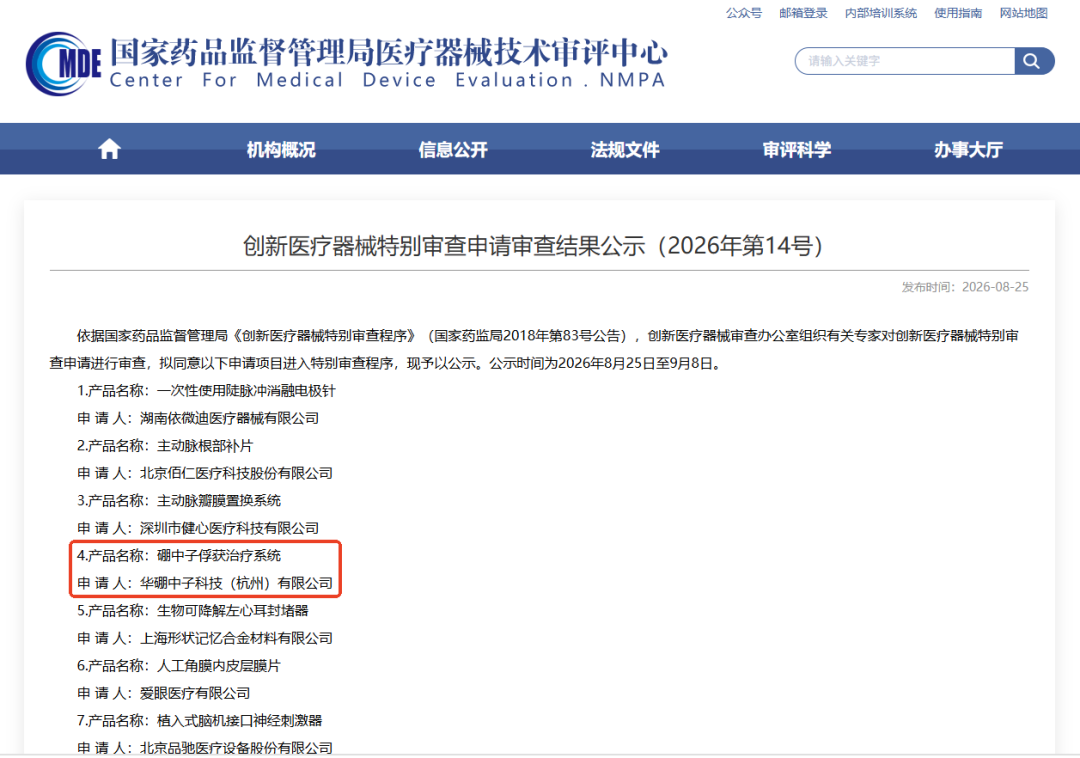
Domestically Developed "Boron Neutron Capture Therapy System" Enters the National Special Review Procedure for Innovative Medical Devices
Recently, the Medical Device Technical Review Center of the National Medical Products Administration issued a public notice on the review results of applications for the Special Review Procedure for Innovative Medical Devices (No. 14 of 2026). The boron neutron capture therapy system independently developed by Huapeng Neutron Technology (Hangzhou) Co., Ltd. has officially entered the National Special Review Procedure for Innovative Medical Devices after the public notice period. Screenshot from the official website of the Medical Device Technical Review Center of the National Medical Products Administration. The Special Review Procedure for Innovative Medical Devices is a review channel established by the National Medical Products Administration to encourage medical device innovation and promote the application of new technologies, effective since December 1, 2018. According to the relevant procedures, drug regulatory authorities and technical institutions will, on the premise of not lowering standards and not reducing procedures,...
2026-09-10

Huzhou, Zhejiang Launches Phase I "Drug-Device Combination" Clinical Trial for the Province's First BNCT System
Recently, the Boron Neutron Tumor Treatment Center at Huzhou Hospital Affiliated to Zhejiang University School of Medicine has drawn attention with the introduction of the province's first Boron Neutron Capture Therapy (BNCT) system. Previously, the system had already initiated a Phase I BNCT drug-device combination clinical trial. According to the system developer, Huapeng Neutron Technology (Hangzhou) Co., Ltd., BNCT is a radiotherapy technique combining drugs and devices, with its core lying in the coordinated use of boron-containing drugs and neutron irradiation. After entering the human body, the boron-containing drug can be absorbed by tumor cells; subsequent neutron beam irradiation triggers a localized reaction to achieve targeted radiotherapy against tumor cells. Unlike conventional radiotherapy, which typically employs fractionated irradiation over a longer treatment course, BNCT emphasizes selective targeting of tumor cells, aiming to reduce damage to surrounding healthy tissues and lower radiotherapy-related side effects such as hair loss and immunosuppression.
2026-08-27

Phase I of Jinjiang Ruisi Ke Particle Therapy Equipment Production Base Fully Operational
Recently, Phase I of the Ruisi Ke Advanced Particle Therapy Equipment Production Base for tumors, located in Dongshi Town, Jinjiang, Fujian, has been fully put into operation, marking new progress in the life and health industry sector of Quanzhou South Wing National High-Tech Zone. As the first launch project in the local effort to build the "China Nuclear Medicine Valley," this project is accelerating the clustering of the nuclear medical equipment industry chain. It is understood that all four production workshops of Phase I of the Ruisi Ke production base have commenced operations, with a total floor area of nearly 30,000 square meters. Inside the workshops, relevant personnel are performing precision machining on core components of the proton therapy system. The base possesses research and development, production, and testing capabilities for proton therapy systems and boron neutron capture therapy systems, making it one of the few...
2026-08-24
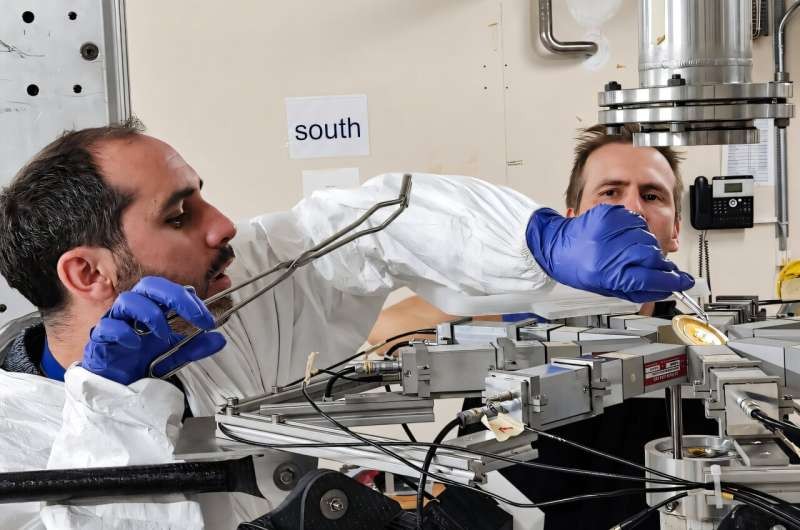
CERN measures niobium-94 neutron capture for the first time, shedding new light on the mystery of molybdenum abundance in ancient stardust
The n_TOF collaboration at CERN recently reported that researchers have for the first time measured the probability of neutron capture by niobium-94. The results, published in Physical Review Letters, provide new experimental evidence for explaining the anomalous abundance of molybdenum-94 in presolar grains. The EAR2 facility in the n_TOF experiment at CERN produces intense neutron beams, opening new possibilities for nuclear research. Credit: CERN Niobium-94 is a niobium isotope containing 41 protons and 53 neutrons, occupying a critical juncture in the nuclear reaction chain that produces heavy elements in dying stars. Researchers are interested in it because niobium-94 is very close to molybdenum-94, differing by just one fewer proton and one more neutron. Under the high-temperature, high-pressure conditions inside stars, niobium-94 may either transform into molybdenum-94 through beta decay or form niobium-95 through neutron capture. The competition between these two reaction pathways directly affects scientists' understanding of the origin of molybdenum-94.
2026-08-20
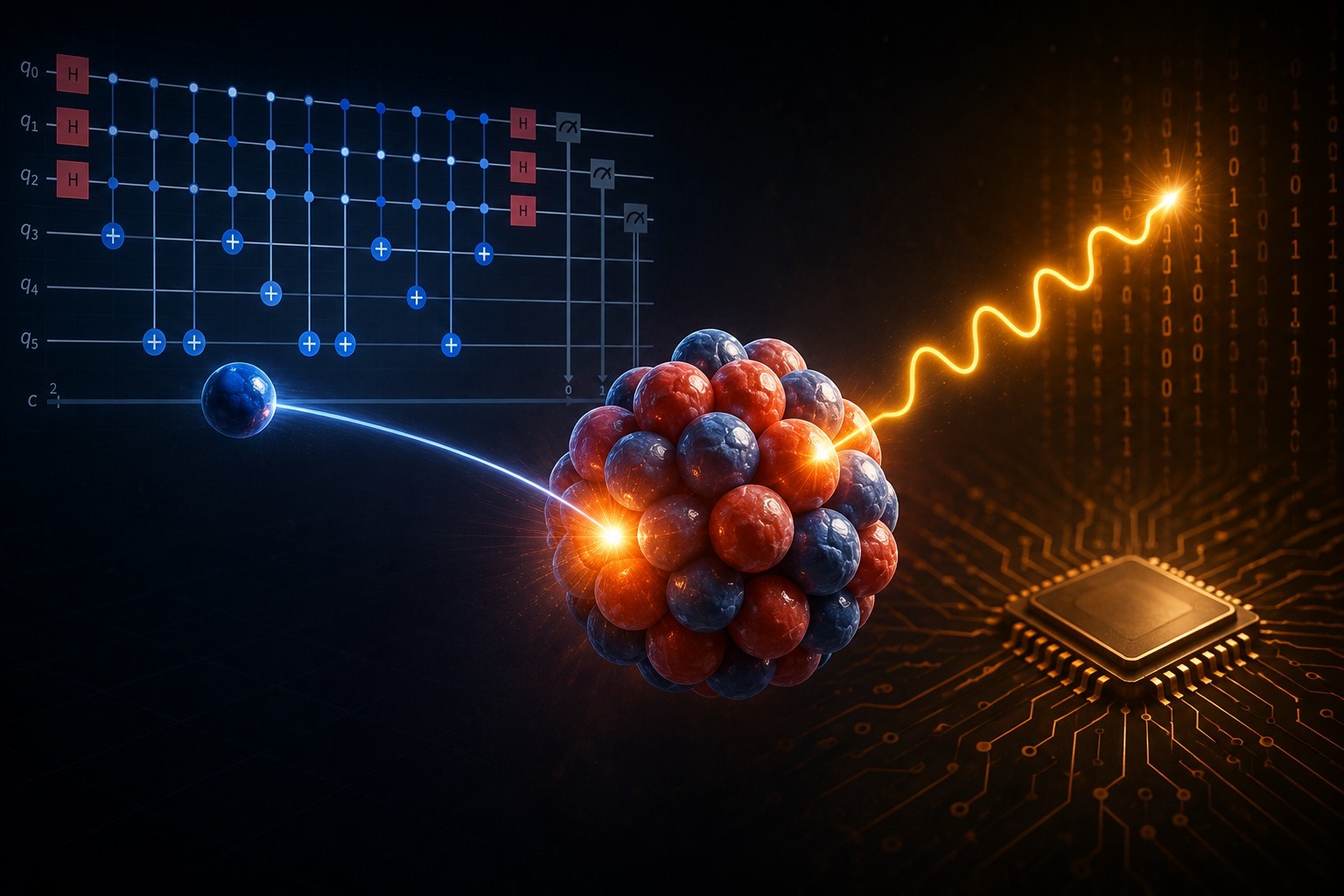
U.S. FRIB Secures Contract from Naval Nuclear Laboratory to Develop Quantum-Classical Hybrid Nuclear Reaction Calculation Methods
A research project at the Facility for Rare Isotope Beams (FRIB) at Michigan State University, led by Dean Lee, Professor of Physics at FRIB, Professor in the Department of Physics and Astronomy at Michigan State University, and Head of the Theoretical Nuclear Science Department at FRIB, has received one-year contract support from the Naval Nuclear Laboratory. The laboratory is managed by Fluor Marine Propulsion. The project will study how to combine quantum computers with classical computers to improve the accuracy of predictions for neutron interactions with matter. This also represents the first phase of a five-year plan aimed at developing and evaluating new computational tools for nuclear science. In nuclear physics research, accurately predicting how neutrons interact with atomic nuclei...
2026-08-18

China's First Qualification for Radiation Health Testing and Evaluation of BNCT Equipment Approved
Recently, the Beijing Municipal Health Commission, in accordance with the "Administrative Measures for Radiation Health Technical Service Institutions" (Guoweiban ZhiJian Fa [2026] No. 1), organized experts to conduct on-site reviews of two qualification expansion applications submitted by the National Center for Occupational Safety and Health under the National Health Commission. The projects include performance testing and evaluation of Boron Neutron Capture Therapy (BNCT) equipment and thyroid iodine-131 testing. During the review process, the expert panel conducted a comprehensive examination of the center's management system, personnel allocation, instruments and equipment, and technical capabilities related to radiation health testing and evaluation through document review, technical inquiries, on-site practical operations, and simulated demonstrations...
2026-08-12
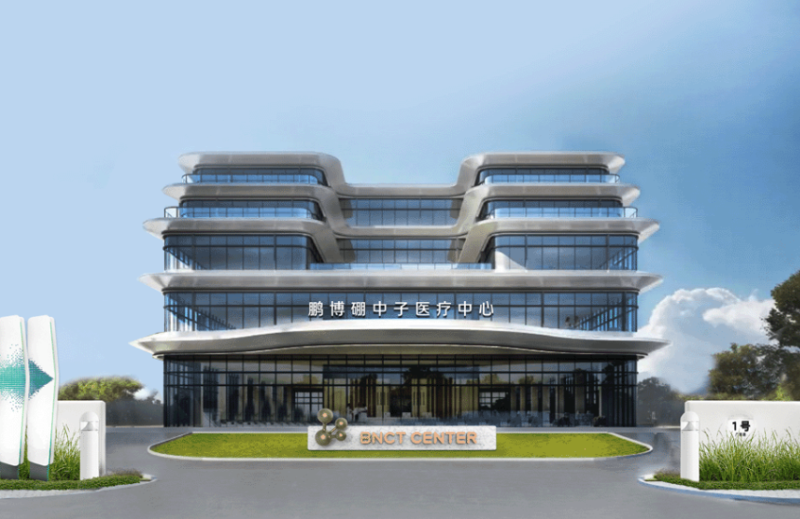
China Bio-Pharma: Enters Cooperation Agreement with Stella Pharma on Boron Neutron Therapy Drug
China Bio-Pharma Holdings Limited announced on August 12 that the company, Pengbo (Hainan) Boron Neutron Medical Technology Co., Ltd., and Japan's Stella Pharma Corporation signed a legally binding Master Cooperation Agreement on August 11, 2026, to jointly advance the development and commercialization of Steboronine in China. Steboronine is described in the announcement as the world's first approved boron neutron therapy drug, applied in Boron Neutron Capture Therapy (BNCT). Under the agreement, the cooperation between the two parties is divided into a development phase and a commercialization phase. During the development phase, the cooperation aims to leverage real-world data, real-world evidence, and real-world studies generated by the China Bio-Pharma Group to facilitate Stella Pharma in obtaining and maintaining, as soon as possible, marketing approval from China's National Medical Products Administration (NMPA) for Steboronine for the treatment of head and neck cancer; after Stella Pharma obtains marketing and manufacturing approval from the Japanese government for Steboronine for meningioma, the relevant China filings may also be extended to the meningioma indication.
2026-08-12
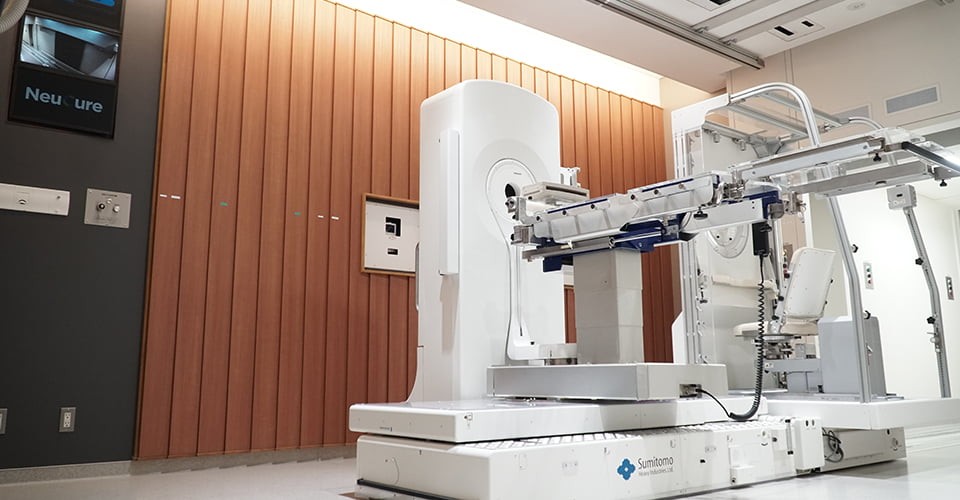
Fujita Health University in Japan Advances Research on Expanding BNCT Indications for Deep-Seated Cancers, to Conduct 18F-FBPA PET Exploratory Evaluation
On August 10, Stella Pharma Corporation of Japan announced that it is collaborating with Fujita Health University and other institutions to advance research and development aimed at expanding Boron Neutron Capture Therapy (BNCT) to deep-seated cancers. As part of this project, Stella Pharma will participate in an exploratory study on 18F-FBPA uptake capacity in deep-seated cancers conducted by Fujita Health University. The study will use 18F-FBPA PET to evaluate the tumor accumulation of boron drugs used in BNCT in deep-seated cancers, and based on the findings, explore the possibility of expanding BNCT indications in the future. The study plans to collect data from 50 cases, including pancreatic cancer, hepatocellular carcinoma, and biliary tract cancer, to accumulate foundational evidence needed for the development of BNCT for deep-seated cancers. BNC...
2026-08-11

International Team Measures Niobium-94 Neutron Reactions, Explaining Anomalous Molybdenum-94 Abundance in the Solar System
An international team of physicists has, for the first time, conducted a comprehensive study of the interactions between neutrons and the niobium-94 isotope. The findings have been published in Physical Review Letters. The study suggests that the elevated abundance of molybdenum-94 in the primordial material of the solar system can be explained by a series of neutron-involving nuclear reaction processes inside old stars, without requiring the introduction of previously unknown special formation mechanisms. The research was led by Alberto Mengoni, a researcher at the Italian National Institute for Nuclear Physics. The team conducted experiments using the n_TOF facility at CERN, focusing on tracking the interactions between neutrons and niobium-94 atoms. The n_TOF facility is used to...
2026-08-11
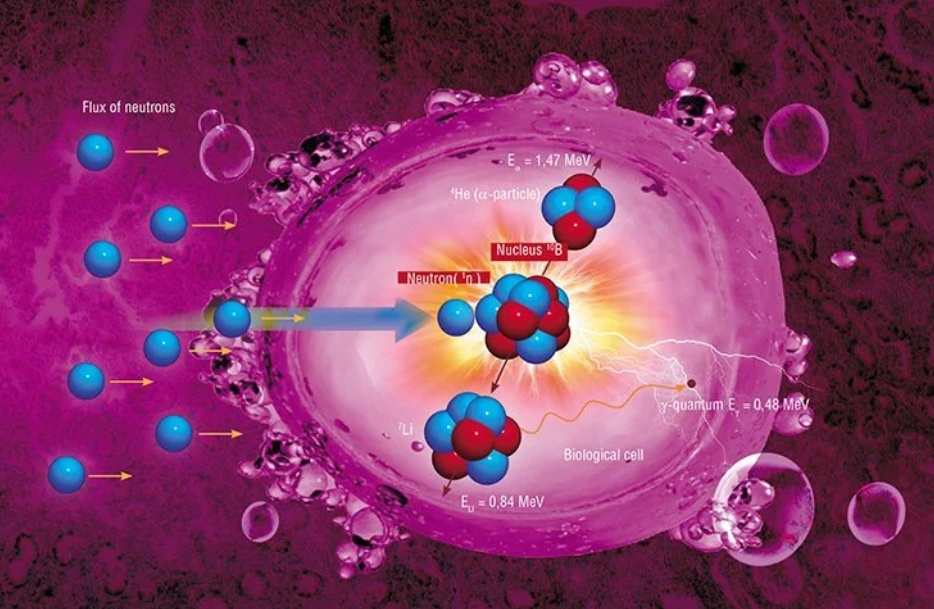
Russia's Vector Research Center Proposes Quantum Dots for Boron Delivery in Neutron Capture Therapy
Russia's Vector Research Center has proposed using quantum dots as targeted boron delivery systems in boron neutron capture therapy (BNCT) to explore more precise approaches to tumor treatment. Yuri Tumanov, the center's chief researcher, presented this research progress at a conference on engineering biology and biopharmaceuticals. Boron neutron capture therapy is a cancer treatment method that combines boron-containing drugs with neutron irradiation. The basic concept involves first allowing boron-containing drugs to accumulate in tumor cells, then subjecting the patient to neutron irradiation, which triggers a nuclear reaction that releases energy concentrated within boron-containing cancer cells, thereby destroying tumor cells. How to construct boron delivery systems that are low-toxicity, highly efficient, and capable of participating in targeted tumor destruction remains one of the key challenges in this field...
2026-08-01