
Bhabha Atomic Research Centre (BARC) in India develops 72 improved crop varieties through radiation mutation technology
 Scan to share
The integration of nuclear technology with agricultural production is demonstrating increasingly tangible value in Indian farmlands. Through radiation-induced mutation and hybrid breeding techniques, the Bhabha Atomic Research Centre in India has successively developed 72 improved crop varieties, covering peanuts, rice, mung beans, mustard, and other crops. India's Minister of State Jitendra Singh disclosed this progress in a written reply to Parliament, showing that the peaceful application of nuclear science has extended from laboratories to the frontlines of agricultural production.
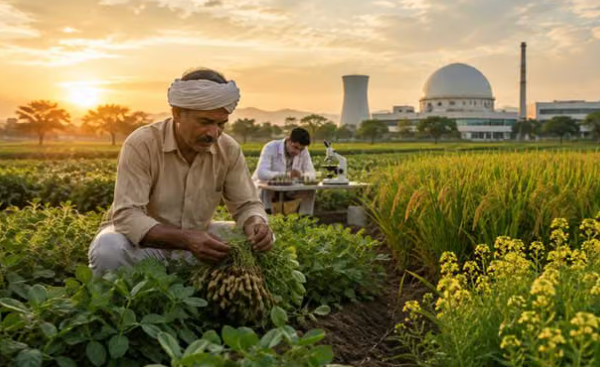
In terms of variety composition, peanut new varieties are the most numerous, reaching 17; rice has 10, mung beans and mustard 9 each, black gram 8, pigeon pea 5, sorghum 3, and cowpea, wheat, and soybean 2 each. Additionally, new varieties have also been developed for banana, sesame, flax, sunflower, and jute. The direction of these crop improvements is fairly clear, focusing mainly on increasing yield, enlarging grain size, shortening maturity periods, and enhancing drought tolerance, heat tolerance, salt-alkali tolerance, and disease resistance, to help farmers cope with uncertainties brought by climate change.
Radiation-induced mutation is not simply about "altering" crops, but rather expanding the sources of genetic variation through scientific means, from which superior-performing materials are then selected. Before any new variety is promoted, it must undergo multi-year, multi-location trials and be compared with existing varieties. Only when it demonstrates advantages in indicators such as yield, adaptability, or stress resistance will it be recommended to farmers. This process means that relevant varieties are not rushed to market but have undergone a relatively long cycle of validation and testing under agricultural production conditions.
In the promotion phase, the Bhabha Atomic Research Centre has not stopped at laboratory breeding but has collaborated with state agricultural universities to expand seed production of the "Trombay" series varieties, and has disseminated technical knowledge to farmers through farmer fairs, field days, outreach activities, and other means. Relevant institutions have also distributed small seed kits to farmers and conducted technical training, enabling farmers to more directly understand and utilize the peaceful applications of nuclear technology in agriculture.
In addition to crop breeding, India's Department of Atomic Energy has also developed radiation-based food preservation technologies to reduce post-harvest losses and extend the shelf life of agricultural products such as vegetables, fruits, pulses, and spices. These technologies have been transferred to private enterprises, and the construction of multi-product food irradiation facilities is being promoted under the "Prime Minister's Farmer Wealth Scheme." Meanwhile, the Department of Atomic Energy has established research collaborations with agricultural universities in 14 states and works with Indian Council of Agricultural Research institutions in areas such as peanuts, soybeans, and pulses, forming an agricultural technology network spanning research, breeding, and extension applications.
Disclaimer: Information republished from partner media, institutions or other websites is provided for reference and communication purposes only. It does not imply endorsement of its views or verification of its accuracy. Please contact us if any content infringes rights or requires correction.