
Nuclear technology breeding helps Laos improve rice varieties and increase yields
 Scan to share
Rice is a vital staple food and source of income for rural households in the Lao People's Democratic Republic, and serves as the foundation of the country's food security. Over 80% of local farmers grow rice, with paddy fields accounting for approximately 60% of the nation's cultivated land. To enhance food supply capacity, Laos has set a target of increasing rice production to 5.5 million tonnes.
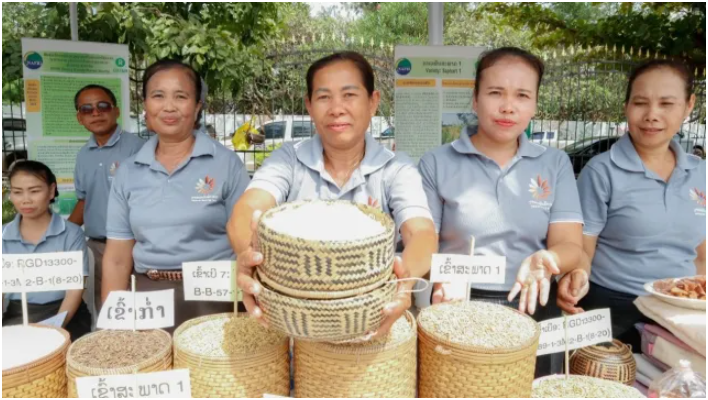
The Saphart 1 rice variety was launched at the 2023 National Seed Fair for Food Security and Nutrition. (Photo: S. Phommalath/ RCCRC)
Facing challenges such as environmental change, flooding, plant diseases, and increasing pressure on agricultural systems, agricultural researchers in Laos are turning to nuclear technology to improve rice varieties. The National Agriculture and Forestry Research Institute of Laos, in collaboration with the International Atomic Energy Agency and the Food and Agriculture Organization of the United Nations, is carrying out rice variety development work through the Joint FAO/IAEA Centre of Nuclear Techniques in Food and Agriculture, with support from the IAEA Technical Cooperation Programme.
The research combines mutation breeding with conventional breeding methods to create and screen for beneficial genetic variations that may be lacking in existing varieties. Through field evaluation and screening, researchers focus on improving rice yield, maturity period, and performance under adverse growing conditions, aiming to develop varieties better suited to local environments and market demands.
Currently, the Saphart 1 rice variety developed using these techniques has demonstrated clear production advantages. Compared with traditional varieties, this variety matures approximately 20 days earlier and yields about 20% higher. Another improved variety, Houykhod 2, exhibits moderate resistance to rice blast disease and tolerance to flooding, and possesses characteristics suitable for producing rice noodles and other high-value-added products, providing farmers with a more stable planting option.
During the promotion of new varieties, farming communities have been deeply involved in variety evaluation, screening, seed multiplication, and distribution. Since 2022, farmer groups in Laos have continuously promoted the spread of improved rice seeds across communities. In Saphatt Village, Vapy District, Saravan Province, 19 farmers took the lead in producing and selling Saphart 1 seeds, producing and selling 9.5 tonnes of seeds during the 2026 growing season.
Currently, more than 300 farmers in Vapy District alone are growing Saphart 1 for household consumption and local market supply. The dry-season planting area for this variety is approximately 350 hectares, with expectations of reaching 450 hectares in the wet season. The seeds have also spread to neighboring areas of Saravan Province, further improving the local agricultural production system.
Throughout this process, women have participated in the multiplication, distribution, and promotion of improved rice seeds through community seed production groups, combining local agricultural experience with scientific research results to bring new varieties to farmers more quickly. Through early-maturing, high-yielding, and more stress-tolerant rice varieties, Laos is enhancing the stability of its rice supply while supporting increased farmer incomes and long-term food security.
Disclaimer: Information republished from partner media, institutions or other websites is provided for reference and communication purposes only. It does not imply endorsement of its views or verification of its accuracy. Please contact us if any content infringes rights or requires correction.