
Russian Segment of ISS Adjusts BTN-M2 Equipment Configuration, Continues Neutron and Gamma Radiation Observations
 Scan to share
On August 13, 2026, during the ISS-75 expedition mission, Russian cosmonauts Pyotr·Dubrov and Anna·Kikina performed configuration adjustments to the BTN-M2 scientific equipment inside the “Nauka” module of the Russian Segment of the International Space Station.
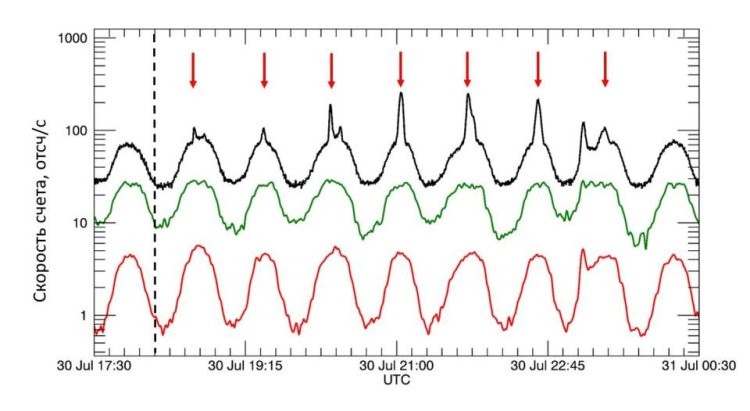
Figure 1. Profiles of gamma rays (energies below 500 keV, black curve), 511 keV photons from electron-positron annihilation (green curve), and high-energy neutrons (red curve) detected by the BTN-M2 instrument aboard the ISS on July 30–31, 2026. Red arrows indicate the phases of enhanced gamma-ray flux as the ISS passed over high-latitude regions of the Earth during the solar proton event (SPE). The dashed line indicates the arrival time of protons from the Sun based on data from the geostationary meteorological satellite GOES-18. Source: Department of Nuclear Planetology, Space Research Institute, Russian Academy of Sciences
After completing the shield configuration, the BTN-M2 detector will gain a wider field of view, enabling detection of neutron flux in the direction of the ISS orbital flight. In this “forward-looking” mode, the neutrons recorded by the instrument primarily originate from the Earth's upper atmosphere ahead of the station, produced by interactions involving galactic cosmic rays and solar cosmic rays. The corresponding flux increases as the station travels from the equator toward the poles and decreases as it travels from the poles toward the equator.
The detector will also record secondary neutrons generated inside the station by high-energy galactic and solar particles. In the current “forward-looking” configuration, the US Segment, which lies within the instrument's field of view, is one of the significant sources of detectable neutron radiation on the ISS.
During the “open” configuration flight from July 30 to August 13, 2026, the gamma-ray spectrometer in the BTN-M2 instrument recorded a notable change: between 18:00 and 23:00 UTC on July 30, when the ISS passed over orbital segments near the Earth's north and south poles, the gamma radiation flux in the 400—1000 keV range increased significantly.
Researchers believe that this enhancement of polar gamma radiation may be associated with the solar proton event that occurred at that time. The influx of solar protons into the Earth's ionosphere and upper atmosphere can trigger a corresponding radiation response. During periods of quiet solar activity, gamma rays at high geomagnetic latitudes are primarily produced by interactions of galactic cosmic ray particles with the atmosphere and structural materials around the ISS; these particles typically have higher average energies than solar particles.
However, during the solar proton event of July 30, no increase was observed in the neutron flux at the ISS orbit or in the 511 keV photon flux. The 511 keV photons typically originate from electron-positron annihilation processes. This result indicates that the proton energies from that particular solar proton event may have been insufficient to trigger cascade reactions in the Earth's atmosphere that produce neutrons and electron—positron pairs.
This background gamma radiation enhancement posed no radiation risk to the cosmonauts. According to available data, this is because the solar flare in question was of relatively low intensity, and the Earth's magnetosphere deflected the solar proton flux at critical low-latitude orbital segments. However, for future crewed deep-space missions beyond the protection of the Earth's magnetosphere, strong solar proton events may still pose significant radiation risks. Studying radiation safety for deep-space crew members is one of the key objectives of the BTN-Neutron experiment.
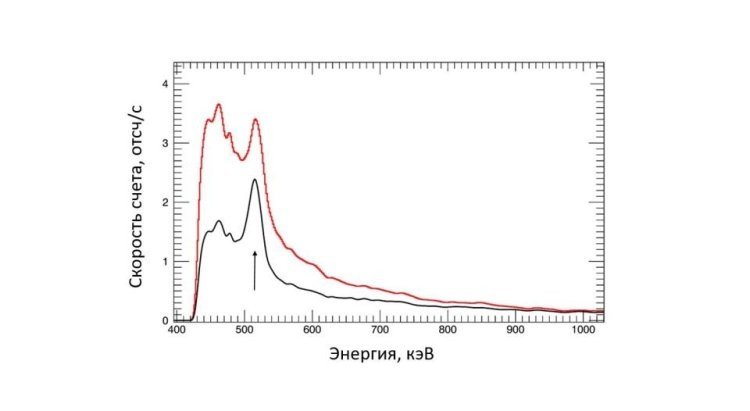
Figure 2. Energy spectra of gamma-ray counts in the polar regions of the ISS orbit from 19:00 to 23:00 UTC on July 30, 2026. The red curve represents the solar proton event (SPE) maximum, and the black curve represents quiet solar activity. The arrow indicates the photon line at 511 keV, which originates from electron-positron annihilation processes. Data source: Department of Nuclear Planetology, Space Research Institute, Russian Academy of Sciences
The BTN-Neutron experiment has been operating since 2007 and includes the BTN-M1 instrument mounted outside the “Zvezda” module, as well as the BTN-M2 instrument operating inside the pressurized “Nauka” module since December 2024. Both instruments were developed by the Department of Nuclear Planetology at the Space Research Institute of the Russian Academy of Sciences. The experiment aims to study temporal and spatial variations of neutron and gamma-ray fluxes in near-Earth space and to test neutron radiation shielding systems for future crewed deep-space missions.
Disclaimer: Information republished from partner media, institutions or other websites is provided for reference and communication purposes only. It does not imply endorsement of its views or verification of its accuracy. Please contact us if any content infringes rights or requires correction.