
US Inertia Fusion Fuel Preparation Time Significantly Reduced
 Scan to share
US fusion startup Inertia Enterprises said it has made progress in inertial fusion energy fuel preparation in collaboration with Lawrence Livermore National Laboratory (LLNL), reducing the time required for the critical step of forming a cryogenic deuterium-tritium fuel layer from potentially several days in the past to tens of minutes. The company said this achievement completes a key task in the first phase of its commercial fusion power plant development goals.
The fundamental approach of inertial fusion energy involves using high-energy lasers to compress and heat small targets containing deuterium-tritium fuel, bringing the fuel to ignition conditions and releasing energy. The National Ignition Facility (NIF) has validated the relevant physics mechanisms multiple times. Inertia Enterprises has chosen to follow the target design approach already validated by NIF, rather than adopting unproven new target structures or drive schemes, thereby shifting fuel preparation from a physics feasibility question to an engineering and scalable production challenge.
These targets typically consist of a spherical carbon shell, with a layer of solid deuterium-tritium fuel formed inside under cryogenic conditions as smoothly as possible, while retaining deuterium-tritium gas in the center. For NIF ignition experiments, defects in the fuel layer are amplified during compression and can affect the ignition process, so preparation precision requirements are extremely high, with a single fuel layer formation process potentially lasting up to a week and requiring multiple manual interventions.
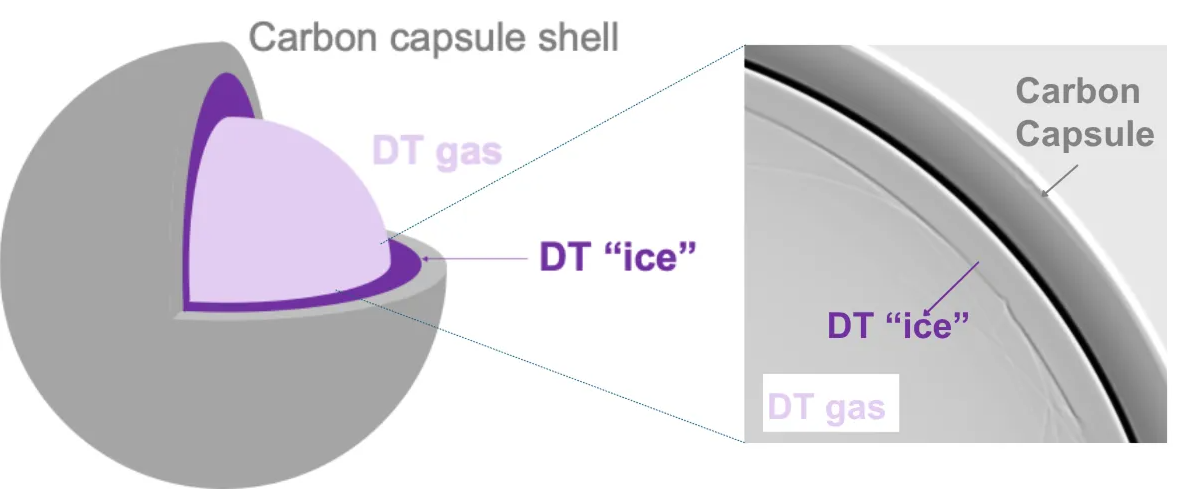
Figure 1: Cross-sectional schematic and example X-ray image of a fusion fuel capsule, showing the outer spherical carbon shell and the DT fuel "ice" layer with a gas core. For Inertia, the capsule diameter is approximately 4-5 mm. Forming a sufficiently smooth DT ice layer is critical for ignition.
Inertia Enterprises said its new process can complete deuterium-tritium crystal layer growth in approximately 30 minutes, with the entire fuel target preparation process taking about two to three hours. The company believes the process has potential for industrial-scale expansion, supporting the continuous fuel supply required for utility-scale fusion power plants.
Anne Kritcher, co-founder and chief scientist of Inertia Enterprises, said this progress comes from the company's collaboration with LLNL on target manufacturing and physics design, helping to advance the ignition pathway validated by NIF toward commercial fusion energy applications. LLNL researchers involved also stated that the quality of the rapidly formed deuterium-tritium ice layer is close to fuel layers produced by NIF over longer preparation times and meets the requirements of Inertia Enterprises' target design.
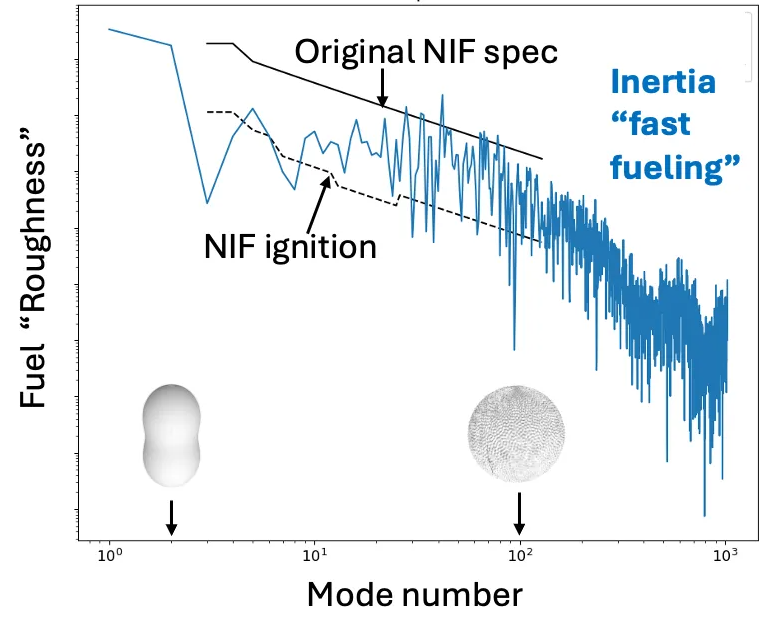
Figure 2: DT ice roughness measured using the new manufacturing method versus mode (angular frequency of roughness) fully meets the original NIF ignition specification, is more precise than Inertia's specification, providing considerable margin and the option of a faster manufacturing method.
Compared with NIF, Inertia Enterprises plans to use a higher-power laser system. The company said its commercial system is designed with laser energy higher than NIF, so it has greater tolerance for fuel layer defects and does not need to pursue "perfect" targets to the extreme standards of NIF ignition experiments. Simulation results show that within a certain defect range, fuel layer roughness and structural differences do not significantly reduce fusion energy output.
Faster fuel preparation may also reduce tritium inventory requirements in plant operations. Tritium is radioactive, has limited supply and high cost, and its handling, storage, and regulatory requirements are stringent. Inertia Enterprises said shortening the fuel loading and preparation cycle can reduce fuel residence time on site, lower the tritium reserve needed at startup, and help reduce material handling costs and regulatory burden.
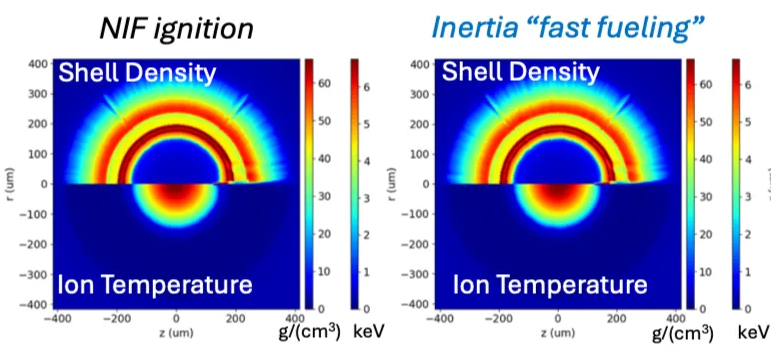
Figure 3: Detailed simulations show that compared with a perfectly smooth "NIF ignition" ice layer, Inertia's faster fuel injection speed shows no significant difference or performance loss, as shown by the compressed shell and thermonuclear fuel near peak implosion velocity.
According to the company's vision, a future full-scale commercial fusion power plant may consume approximately 10 fuel pellets per second. Jeff Lawson, co-founder and CEO of Inertia Enterprises, said reducing delays in the fuel preparation step can reduce facility size, accelerate processes, and improve overall efficiency.
Disclaimer: Information republished from partner media, institutions or other websites is provided for reference and communication purposes only. It does not imply endorsement of its views or verification of its accuracy. Please contact us if any content infringes rights or requires correction.