
IAEA Launches New Project to Enhance Nuclear Fuel and Materials Testing Capabilities in Research Reactors
 Scan to share
The International Atomic Energy Agency (IAEA) recently launched a four-year coordinated research project aimed at optimizing the experimental design of nuclear fuel and structural materials testing in research reactors, enhancing the safety, effectiveness, and efficiency of irradiation experiments.
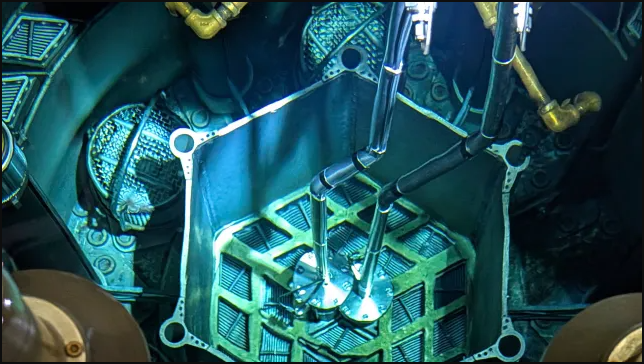
Top view showing a materials testing reactor core loaded with two in-core materials testing devices. (Photo: Y. Ostrovsky/MIT)
With the continued advancement of new nuclear reactor technologies, growing interest in small modular reactors, and existing nuclear power plants seeking long-term operation, the demand for reliable testing of new nuclear fuels and structural materials is increasing. These fuels and materials must be tested and qualified under harsh conditions such as radiation and high temperatures before being put into use in nuclear reactors, in order to assess their long-term performance.
Research reactors provide a dedicated platform for such testing. Currently, more than 60 operating research reactors worldwide are involved in fuel and materials testing activities. However, advanced fuels and materials typically require more complex test conditions, including specific temperatures, pressures, chemical environments, neutron fluxes, and energy spectrum ranges. With limited irradiation positions available, designing test devices that can reproduce these conditions has become an important challenge for research institutions.
This coordinated research project will bring together experts from research reactor facilities worldwide, as well as relevant stakeholders in the fuel and materials testing field, with a focus on improving the design and implementation of irradiation experiments. The project will examine equipment such as irradiation rigs, irradiation devices, and irradiation loops, and will address technologies for monitoring and controlling test conditions during irradiation. Additionally, researchers will explore advances in instrumentation that enable measurements to be taken during the irradiation process, rather than relying solely on post-irradiation examination results.
An IAEA official stated that research reactors play a unique role in supporting the safe application of new fuels and materials in nuclear energy production, as well as in supporting the supply of medical radioisotopes. By improving experimental design, countries can make better use of existing testing capabilities and plan for future additional testing capacity.
According to the project plan, the outcomes are expected to produce recommendations, technical guidance, and practical tools to help countries design safer and more efficient fuel and materials testing experiments, and to support the deployment of new reactors, new fuel technologies, and the long-term operation of existing nuclear power plants.
The IAEA stated that research institutions interested in participating in this coordinated research project may submit proposals for research contracts or agreements by 31 October 2026. The project will prioritize proposals that demonstrate functionality, innovation, deployability, and transferability in research reactor fuel and materials testing equipment and methods, and will encourage the participation of women and early-career researchers.
Disclaimer: Information republished from partner media, institutions or other websites is provided for reference and communication purposes only. It does not imply endorsement of its views or verification of its accuracy. Please contact us if any content infringes rights or requires correction.