
US Study Shows Inertial Fusion Implosions Can Tolerate Certain Asymmetries
 Scan to share
Researchers at the Lawrence Livermore National Laboratory (LLNL) in the US have recently found that implosion designs for inertial fusion energy (IFE) can withstand considerable imperfections before performance degrades sharply. This result aids in the design of fuel targets for future fusion power plants, particularly in assessing the tolerance of target capsules to errors under high-frequency injection and laser-driven conditions.
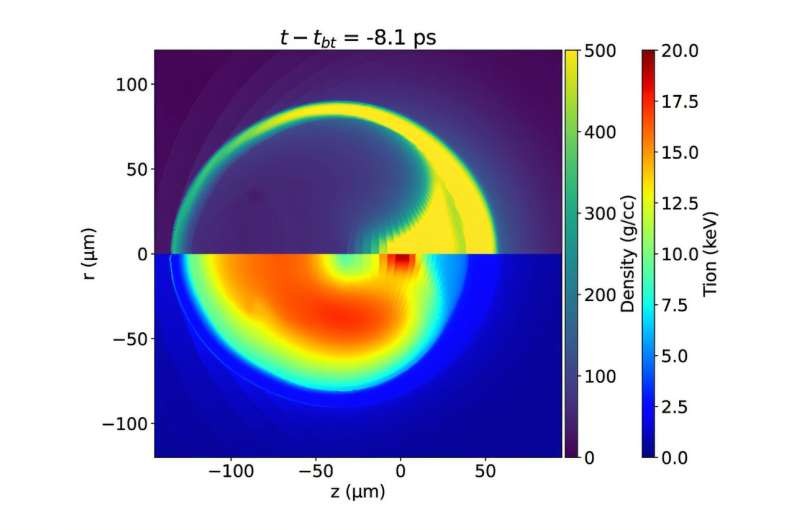
The study's simulation results show the density (top) and temperature (bottom) at the instant just before fusion reactions peak in an asymmetric implosion. The hottest spot coincides with the point of highest fuel density, indicating direct ignition of high-density fuel jets driven by asymmetry. The image was recently selected for the cover of the journal Physics of Plasmas. Image credit: Lawrence Livermore National Laboratory
The related research, titled "Robustness of inertial fusion energy relevant implosions to low-mode asymmetry," was published in Physics of Plasmas. The study was led by physicist Timothy Johnson of the Lawrence Livermore National Laboratory, with contributions from Daniel Casey, Chris Weber, Omar Hurricane, Ryan Nora, and Seth Davidovits.
The research team focused on the impact of degradation mechanisms such as asymmetry and fuel mixing on inertial fusion energy implosions. Johnson stated that future fusion power plants will need to produce energy stably and predictably during continuous operation. If each implosion suffers yield losses due to imperfections, the cost of electricity generation will correspondingly rise.
Unlike the single, precisely controlled experiments at the National Ignition Facility (NIF), future fusion power plants may need to launch multiple fuel target capsules per second and rapidly inject them into designated positions. In such an operating environment, slight deviations when lasers irradiate high-speed moving targets are nearly unavoidable, making it necessary to define the performance boundaries of implosions under asymmetric drive.
Using two-dimensional radiation hydrodynamics simulations, the researchers scaled up the design that achieved first ignition at the National Ignition Facility into a target capsule scheme capable of producing approximately 30 megajoules of energy, and progressively introduced controlled asymmetries—i.e., non-uniformities in the drive radiation irradiating the target—to observe changes in implosion performance.
The simulation results showed that as asymmetry increases, fusion yield does not decline gradually but remains largely stable until a certain critical threshold is reached. Once that threshold is exceeded, performance drops suddenly and the target capsule fails to ignite. The researchers described this change as crossing a "cliff"-like boundary.
Johnson explained that the hot spot at the center of the implosion is the region of high-temperature fuel where fusion reactions begin. Asymmetry draws energy away from the hot spot, causing the target to expand earlier and leaving less time for ignition. If the design has sufficient margin, the hot spot may still reach ignition conditions before the target disassembles; but once the margin is exhausted, the yield collapses rapidly rather than decaying gradually.
The study also showed a trade-off between yield and robustness. Future fusion power plants, during startup and commissioning phases, may first adopt implosion schemes with lower yield but greater fault tolerance; as identification and control of asymmetry sources gradually improve, they could then switch to designs with higher yield but narrower tolerance ranges.
Johnson noted that the degree of asymmetry a real inertial fusion energy power plant would introduce remains to be studied, as it involves complex conditions such as rotating target injection and laser firing rates of up to ten times per second. The research team's next step is to connect this robustness framework with features already observed in real NIF implosions, including brightness distribution patterns in neutron images, and to further assess whether implosions exhibit similar tolerance when fuel mixes with surrounding target capsule material.
Disclaimer: Information republished from partner media, institutions or other websites is provided for reference and communication purposes only. It does not imply endorsement of its views or verification of its accuracy. Please contact us if any content infringes rights or requires correction.