
Novartis Files Localized Production Application in China for Lutetium [177Lu] Vipivotide Tetraxetan
 Scan to share
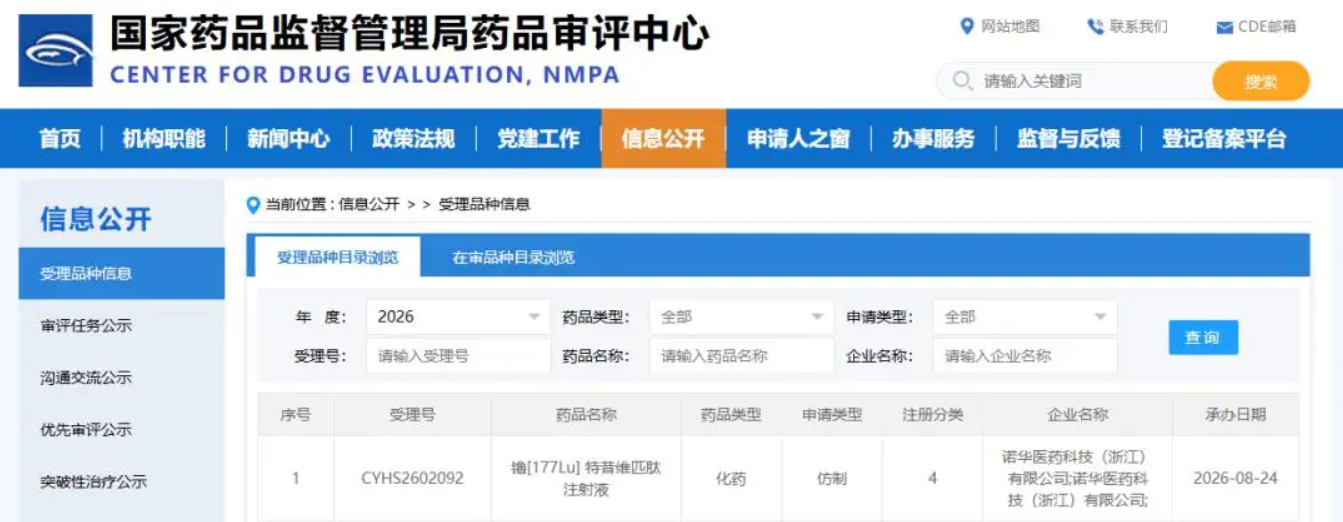
On August 24, information on the website of the Center for Drug Evaluation (CDE) of China's National Medical Products Administration showed that Novartis' nuclear medicine product Lutetium [177Lu] Vipivotide Tetraxetan had a localized production application submitted in China. On the same day, two indications for the drug were proposed for priority review, and the relevant review matters may correspond to this localized production application.
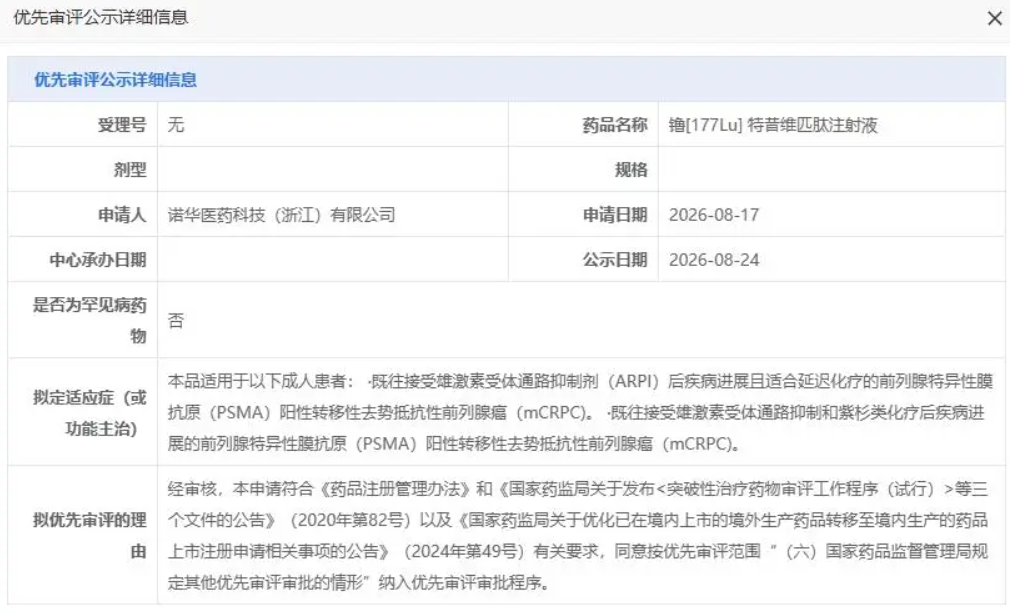
Lutetium [177Lu] Vipivotide Tetraxetan, namely 177Lu-PSMA-617, is a radioligand therapy (RLT) drug acquired by Novartis following its acquisition of Endocyte. The drug consists of a small-molecule compound targeting prostate-specific membrane antigen (PSMA) conjugated to the therapeutic radionuclide Lutetium-177. Upon entering the bloodstream, the drug binds to prostate cancer cells expressing PSMA, after which Lutetium-177 releases radiation energy, causing damage to target cells and surrounding tumor cells, disrupting their DNA replication capacity, or inducing tumor cell death. Based on this mechanism of action, the drug has the potential to replace systemic radiotherapy.
Public progress shows that in March 2022, based on the Phase III VISION study, Lutetium [177Lu] Vipivotide Tetraxetan received its first FDA approval for the treatment of patients with PSMA-positive metastatic castration-resistant prostate cancer (mCRPC) who had progressed after prior treatment with androgen receptor pathway inhibitors (ARPI) and taxane-based chemotherapy. This indication has been approved in China.
In March 2025, based on the Phase III PSMAfore study, the drug was approved in the United States for the treatment of PSMA-positive mCRPC patients who had received ARPI therapy and were considered suitable for deferred chemotherapy. This indication has also been approved in China.
In August 2026, based on the Phase III PSMAddition study, Lutetium [177Lu] Vipivotide Tetraxetan received approval in the United States for a third indication, for patients with PSMA-positive metastatic androgen-pathway-modulated non-sensitive (mAPMN/S) prostate cancer, a disease previously referred to as hormone-sensitive prostate cancer. This indication has not yet been approved in China.
To date, Lutetium [177Lu] Vipivotide Tetraxetan has covered multiple treatment stages of PSMA-positive metastatic prostate cancer. The submission of this localized production application in China, coupled with two indications proposed for priority review, suggests that the registration and supply layout of this radiopharmaceutical in the domestic market may see further advancement.
Disclaimer: Information republished from partner media, institutions or other websites is provided for reference and communication purposes only. It does not imply endorsement of its views or verification of its accuracy. Please contact us if any content infringes rights or requires correction.