
South Korean team develops biodegradable microgel for localized radiation therapy
 Scan to share
Pusan National University announced on August 25 that a research team led by Professor Yang Seung-yun from the Department of Biomaterials Science, in collaboration with Professor Kim Hoon-soo from the Department of Dermatology and Professor Kim Geun-young from the Department of Nuclear Medicine at Pusan National University Hospital, as well as SNBIA Co., Ltd., has developed a precision localized radiation therapy technology based on biodegradable radioactive isotope materials for the treatment of refractory keloids that tend to recur after surgery.
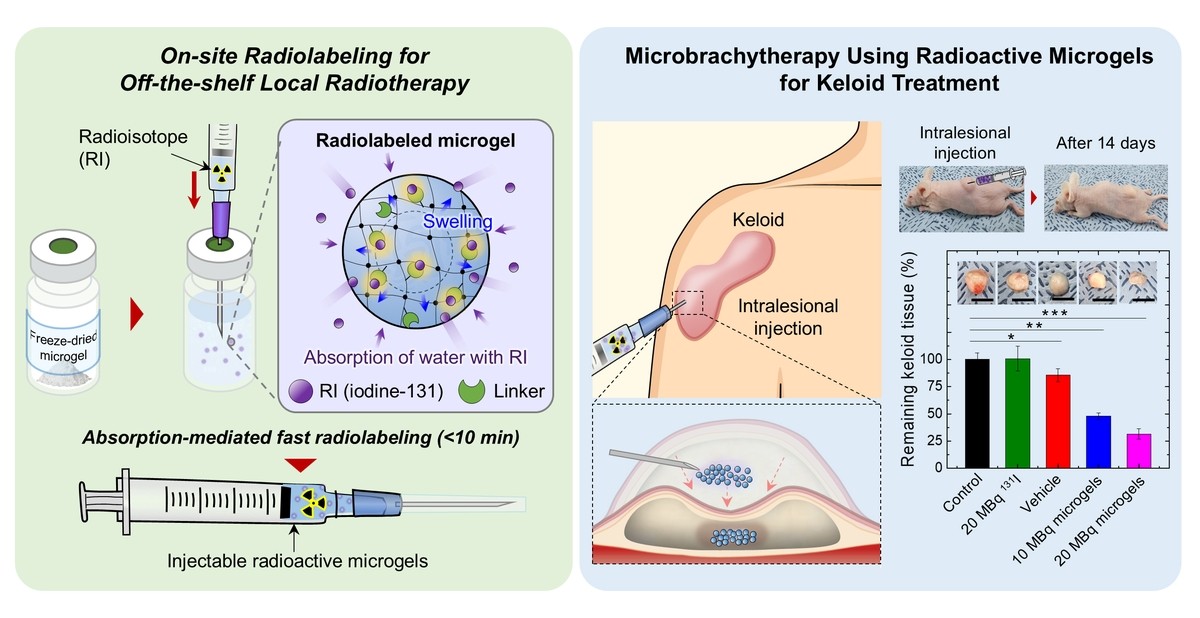
Conceptual diagram of precision treatment technology for refractory keloids. Provided by Pusan National University.
Keloids are caused by abnormal proliferation of fibroblasts and excessive accumulation of collagen after skin injury. Existing treatment methods include surgery, steroid injections, laser therapy, etc., but the risk of recurrence is relatively high, and drug treatment options are limited. External beam radiation therapy and brachytherapy can be used to suppress recurrence; however, the former faces difficulties in precisely targeting small, irregular lesions, while the latter is challenged by complex preparation and supply processes for therapeutic materials and relatively high costs.
To address these limitations, the research team developed freeze-dried hyaluronic acid microgels. These microgels, made from photo-crosslinkable hyaluronic acid and freeze-dried to form a porous structure, can absorb radioactive isotope solutions at the medical site for rapid labeling. Experiments showed that the material could label more than 90% of the therapeutic radioisotope iodine-131 within 10 minutes and retain the isotope relatively stably, thereby reducing complex purification steps and radioactive waste generation.
In an animal model containing patient-derived keloid tissue, the researchers injected iodine-131-labeled hyaluronic acid microgels directly into the lesions. After two weeks, keloid volume was reduced by more than 70%; in comparison, the group administered an iodine-131 solution showed a reduction of approximately 15%. The study also showed that the radioactive microgels remained predominantly stable within the lesions, with no significant radioactive signals or tissue damage observed in major non-target tissues, suggesting that this approach helps concentrate therapeutic effects on local lesions while reducing systemic radiation exposure.
The research team also verified the feasibility of combining this platform with other therapeutic radioisotopes. For example, hyaluronic acid microgels containing DOTA functional groups can be used for rapid labeling of lutetium-177. The team believes that this material could potentially be expanded to various therapeutic platforms in the future, including precision localized radiation therapy and long-acting drug delivery systems.
The researchers stated that the technology is still in the preclinical stage, and further non-clinical and clinical validation is required. The findings were published online on August 10 in the Journal of Controlled Release, with a print version scheduled for October 10. The paper is titled "Ready-to-use miniature brachytherapy for keloid treatment using on-site rapid radiolabeling technology."
Disclaimer: Information republished from partner media, institutions or other websites is provided for reference and communication purposes only. It does not imply endorsement of its views or verification of its accuracy. Please contact us if any content infringes rights or requires correction.