
Russian Research Team Proposes New Method for Measuring Proton and Deuteron Electric Dipole Moments in a Single Storage Ring
 Scan to share
Physicists from several Russian research institutions have proposed a new method for searching for the electric dipole moments of protons and deuterons, potentially enabling the study of both particle types in a single storage ring. The participating institutions include the Moscow Institute of Physics and Technology, the Institute for Nuclear Research of the Russian Academy of Sciences, the National Research Nuclear University MEPhI, and the Landau Institute for Theoretical Physics of the Russian Academy of Sciences. The research was published in the journal *Nuclear Science and Technology* and was supported by a grant from the Russian Science Foundation.
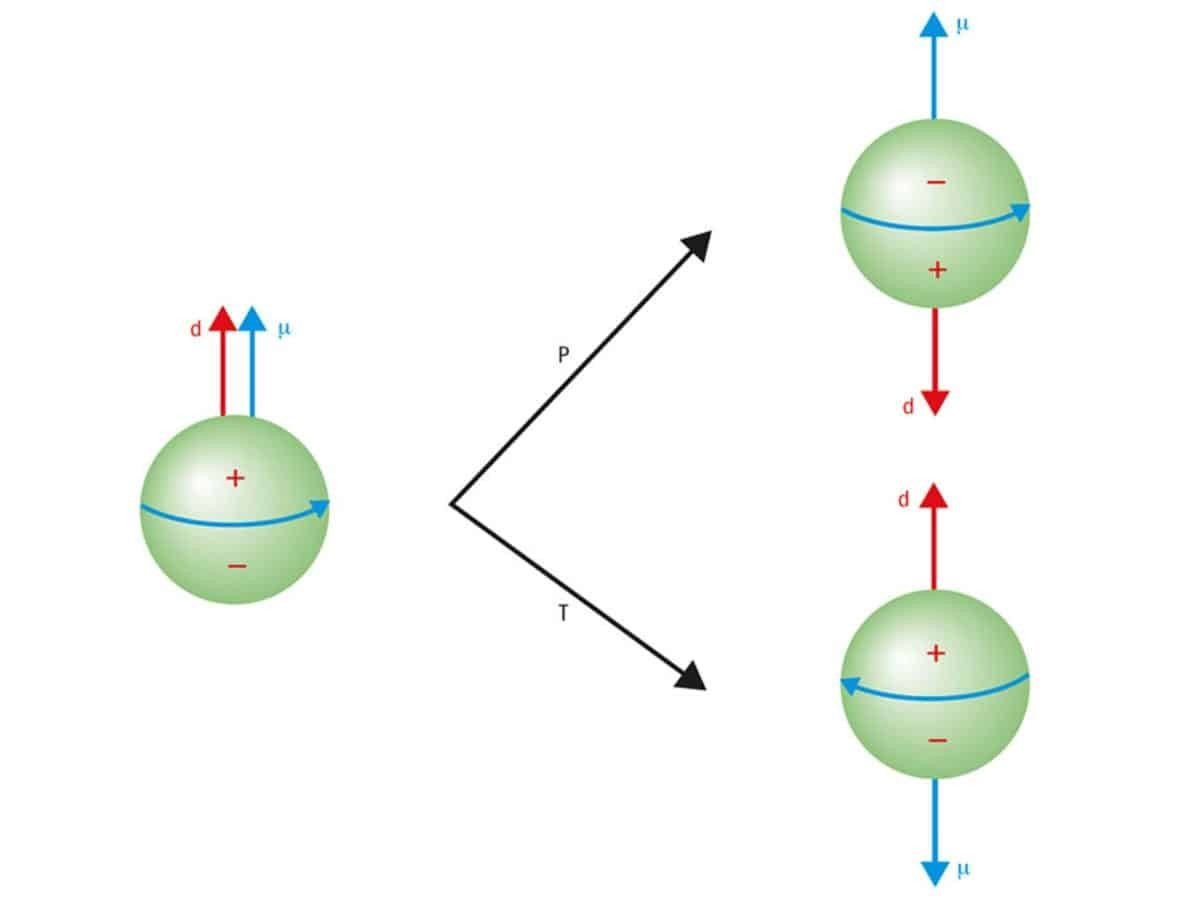
The electric dipole moment reflects whether there is a tiny asymmetry between the internal charge distribution of a particle and its spin direction. According to Standard Model predictions, the electric dipole moments of the proton and deuteron are nonzero but extremely small, on the order of 10⁻³¹ e·cm, far below current experimental sensitivity. If experiments detect a larger electric dipole moment, it could provide clues to new physics beyond the Standard Model.
Such measurements are also relevant to the matter-antimatter asymmetry problem. The electric dipole moment is highly sensitive to CP violation, and high-precision measurements of it can help test whether CP-violating mechanisms beyond known sources exist in nature.
Experimentally, physicists typically use storage rings to circulate polarized light-nucleus beams along closed orbits multiple times, recording changes in particle spin direction with polarimeters. The challenge lies in the fact that the particle's magnetic dipole moment induces spin precession far stronger than the electric dipole moment effect. To isolate the weak electric dipole moment signal, researchers need to compensate for this precession, keeping the particle spin in a “frozen” or “quasi-frozen” state relative to the beam direction.
The traditional proton “frozen spin” scheme relies on a purely electrostatic storage ring; however, due to the opposite sign of the deuteron's anomalous magnetic moment, the deuteron cannot achieve frozen spin in the same way and requires simultaneous use of electric and magnetic fields. This means that proton and deuteron measurements have traditionally required different ring configurations, making it difficult to directly integrate such devices into existing accelerator systems where magnetic elements control the beam orbit.
The present study adopts the “quasi-frozen spin” approach. This method does not require the spin to remain fixed throughout the entire ring; instead, the spin is allowed to deviate in certain sections of the ring, with dedicated compensation elements canceling the accumulated rotation so that the spin essentially returns to its initial state after each repeated ring segment.
The research team compared the behavior of protons and deuterons in the same ring configuration and determined the minimum length requirements for the compensation elements. In the proposed scheme, magnetic elements maintain the beam orbit, while compensators are placed in straight sections to cancel the spin rotation accumulated as particles pass through the magnetic arc sections. The researchers analyzed two types of compensator designs: one is a Wien filter that uses crossed electric and magnetic fields to adjust the spin while minimally altering the beam trajectory; the other is a combination of electrostatic deflectors that deflects the beam and affects the spin, then returns the particles to the desired orbit.
Calculations show that this configuration can be applied to both deuterons and protons. Switching between different operating modes is accomplished primarily by changing the compensator polarity or orientation and adjusting the beam energy. For deuterons, approximately 99% of the effective signal can be retained over 16 ring periods compared to the ideal frozen-spin state; for protons, the same configuration retains approximately 80% of the effective signal. The researchers believe this sets a clear design requirement for proton measurements: the ring structure must contain a sufficient number of repeating segments, otherwise sensitivity will be compromised.
The study also notes that at optimal energy, the compensator length required for the proton beam is nearly five times that for the deuteron beam. To accommodate measurements of both particle types in a single storage ring, the team proposes reducing the proton energy to shorten the compensator length, although this would also reduce proton measurement sensitivity.
The researchers state that the next step is to experimentally validate the quasi-frozen spin method and achieve a spin coherence time of 1000 seconds, while also developing other means of measuring electric dipole moment signals. The proposed configuration could potentially be studied at the NICA-Nuclotron facility in the future, or a dedicated storage ring could be considered. The configuration could also be used for polarization control, higher-energy beam studies, and searches for axion-like particles.
Disclaimer: Information republished from partner media, institutions or other websites is provided for reference and communication purposes only. It does not imply endorsement of its views or verification of its accuracy. Please contact us if any content infringes rights or requires correction.