
XENONnT Dark Matter Detector Captures Faintest Solar Neutrino Signal Ever Observed
 Scan to share
September 1 news - The XENONnT dark matter detection experiment at the Gran Sasso National Laboratory in Italy has achieved new progress. The XENON collaboration research team announced that the detector has captured low-energy solar neutrino collision signals never observed before, lowering the neutrino detection energy threshold to approximately 17 kiloelectron-volts (keV). The research team's analysis indicates that the probability of the signal being merely a statistical fluctuation is less than one in a million.
Neutrinos are elementary particles with no electric charge and extremely small mass, which can be produced in processes such as nuclear fusion reactions in the solar core, supernova explosions, and nuclear fission in reactors. Due to the extremely weak interaction between neutrinos and matter, vast numbers of neutrinos can pass through the Earth, making detection highly challenging. Traditional neutrino detectors typically focus on events that release relatively large amounts of energy during collisions, whereas XENONnT has captured solar neutrino signals of extremely low energy this time.
The research team stated that the energy released by this low-energy solar neutrino collision is approximately one billionth of the energy of proton collisions at CERN's Large Hadron Collider. The detected signals primarily originate from neutrinos produced by the proton-proton (pp) fusion reaction inside the Sun. This reaction is a crucial process in solar energy production, and pp neutrinos also account for the vast majority of neutrinos emitted by the Sun.
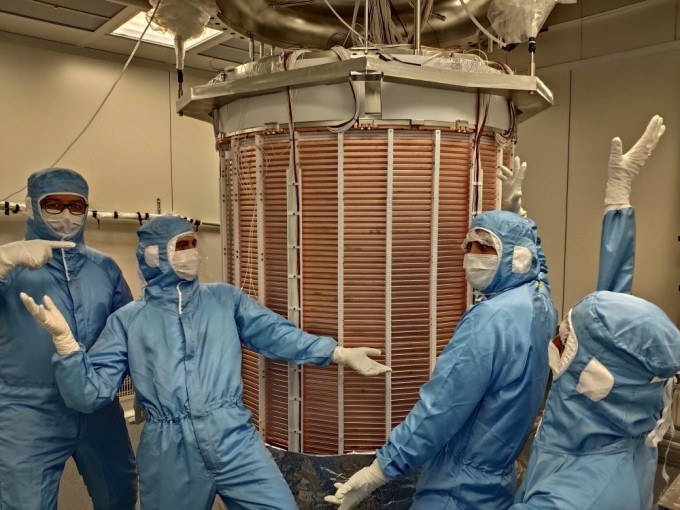
XENONnT was originally designed to directly search for particle dark matter in the Milky Way. Its core instrument is a dual-phase xenon time projection chamber (TPC) containing 5.9 tons of ultra-high-purity liquid xenon, installed approximately 1,400 meters underground in the Gran Sasso mountain range in Italy. The detector operates by capturing the faint light and electrical signals produced when particles interact with xenon atoms.
Dark matter is believed to constitute approximately 85% of all matter in the universe, but because it neither emits nor absorbs light, it has not yet been directly detected. For a long time, dark matter experiments have continuously reduced background noise and improved sensitivity. These results demonstrate that the detection technology has become sensitive enough to observe low-energy neutrino signals that were previously difficult to capture.
The researchers also noted that as the sensitivity of dark matter detectors continues to improve, solar neutrinos may appear more frequently in detection data and become an unavoidable background factor in dark matter searches. Future experiments will need to accumulate data over longer periods and improve their ability to distinguish neutrino signals from potential dark matter signals.
Disclaimer: Information republished from partner media, institutions or other websites is provided for reference and communication purposes only. It does not imply endorsement of its views or verification of its accuracy. Please contact us if any content infringes rights or requires correction.