
CERN Finds Statistical Hints of Higgs Boson Pair Production
 Scan to share
Physics teams at CERN have recently found statistical hints of Higgs boson pair production in data analysis from the Large Hadron Collider. Researchers analyzed millions of collision results over eight years at the collider, with the findings presented at the ICHEP conference and published as two preprints.
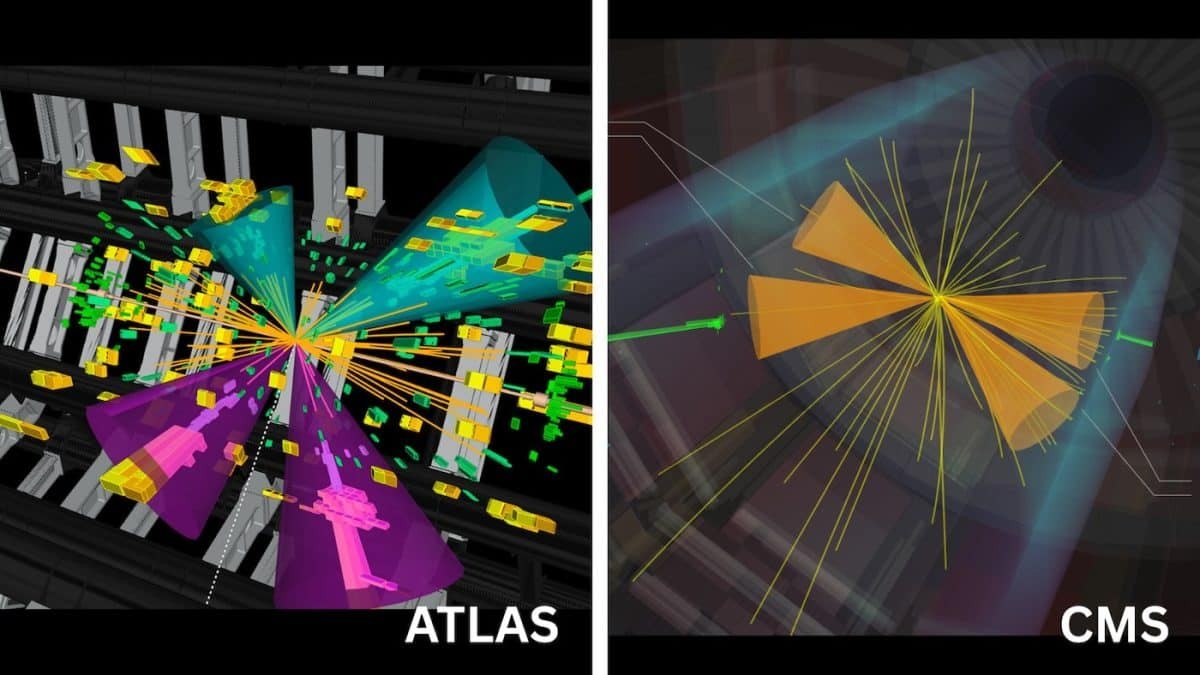
The figure shows schematic diagrams of events involving the production of two Higgs bosons as observed by ATLAS (left) and CMS (right) CERN
The Higgs boson was discovered in 2012, and since then physicists have continuously measured its interactions with other elementary particles to test the Standard Model's explanation of the origin of mass. However, the self-interaction of the Higgs boson has not yet been directly observed. This self-interaction process is of great significance for testing the Standard Model and also contributes to studies on the stability of the physical vacuum in the universe.
However, Higgs boson pair production is extremely rare. In proton collisions, a pair of Higgs bosons may appear only once for approximately every 1,500 single Higgs bosons produced. Due to the extremely short lifetime of these particles, researchers cannot directly observe them over extended periods and can only search for traces through their decay products.
The ATLAS and CMS international collaborations focused on analyzing one class of events: one Higgs boson decaying into a bottom quark and an anti-bottom quark, and the other decaying into a tau lepton and its antiparticle. Since tau lepton decays produce neutrinos that are difficult to detect, event reconstruction is subject to background noise interference. Researchers therefore introduced machine learning algorithms to separate potential target signals from complex data, and combined data from earlier runs of the Large Hadron Collider with early data from Run 3 spanning 2015 to 2023.
The results show an increase in the number of events resembling Higgs boson pair production compared to previous observations. The ATLAS collaboration observed a signal strength 2.6 standard deviations above the expected background, while the CMS collaboration imposed stricter constraints, ruling out the possibility that the Higgs boson pair production rate reaches four times the Standard Model prediction.
Researchers believe the new data provide direct hints of the Higgs boson pair production process, but the current statistical significance is still insufficient to confirm the observation. In the future, as the Large Hadron Collider enters high-luminosity operation mode, the data volume is expected to increase significantly, which should further suppress statistical noise and make the signal of this rare process clearer.
Disclaimer: Information republished from partner media, institutions or other websites is provided for reference and communication purposes only. It does not imply endorsement of its views or verification of its accuracy. Please contact us if any content infringes rights or requires correction.