
Argentina Plans to Commission RA-10 Multipurpose Reactor in 2027
 Scan to share
Argentina's National Atomic Energy Commission (CNEA) and the Nuclear Affairs Secretariat recently stated that the RA-10 multipurpose research reactor at the Ezeiza Atomic Centre is planned to begin commissioning before the end of this year, with the goal of achieving operation in 2027.
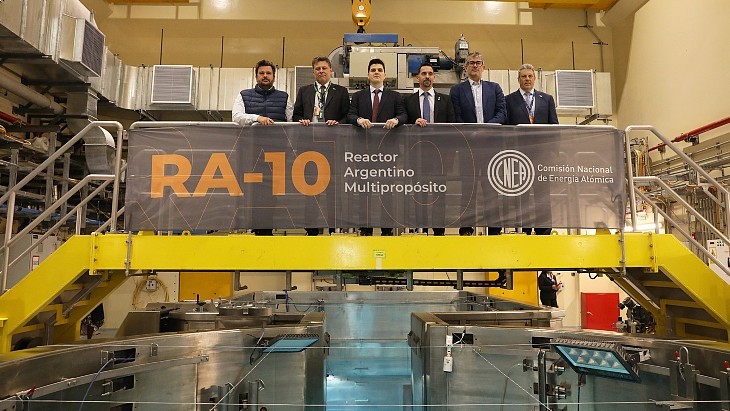
(Image source: CNEA)
According to the project site, RA-10 is currently in its final phase, with approximately 530 workers completing the remaining construction and system testing in preparation for subsequent reactor commissioning and operation. The project is currently about 96% complete overall.
RA-10 is a 30 MW open-pool multipurpose research reactor that will provide products and services to the medical, scientific, technological, and industrial sectors once completed. Among these, molybdenum-99 will be one of its key products. Molybdenum-99 is a critical radioisotope widely used in nuclear medicine diagnostics, and the project team estimates that RA-10 could meet approximately 20% of the global demand for molybdenum-99 in the future.
Argentina's Nuclear Affairs Secretary Federico Ramos Napoli and CNEA President Martín Polo, while presenting the project's progress, stated that the goal is to begin commissioning before the end of this year after obtaining the license from Argentina's Nuclear Regulatory Authority (ARN).
In a related CNEA report, the Nuclear Affairs Secretariat has proposed a model for introducing private capital to fund the development and construction of production facilities associated with the reactor, as well as supporting production and commercial activities. The Argentine government will maintain strategic leadership, while regulatory oversight and supervision of related activities will remain under the responsibility of the ARN.
The report also noted that RA-10's planned production capacity exceeds Argentina's projected domestic demand. Once the project becomes operational, it will on the one hand strengthen the supply of domestically produced products and equipment for Argentina's healthcare system, and on the other hand enable the export of surplus products, generating foreign exchange revenue and high-skilled employment opportunities in an international market with limited suppliers and high technical barriers.
The RA-10 project was approved in June 2010 and officially launched by CNEA. The ARN issued the construction license in November 2014, and civil works began in 2016. Argentina's Applied Research Company (INVAP) participated in the design and construction of the reactor and associated support facilities, serving as the general contractor.
Disclaimer: Information republished from partner media, institutions or other websites is provided for reference and communication purposes only. It does not imply endorsement of its views or verification of its accuracy. Please contact us if any content infringes rights or requires correction.