
First Light Fusion's Low-Cost Fusion Compression Technology Achieves Experimental Validation, Driving Source Cost Expected to Drop by an Order of Magnitude
 Scan to share
UK commercial fusion innovator First Light Fusion has announced that its independently developed pulse power facility “M3” (M3 pulse power facility) has successfully completed a series of proof-of-principle experiments, formally validating the core fuel compression physics mechanism of its proprietary fusion pathway FLARE (Fusion via Low-power Assembly and Rapid Excitation). The experiments confirmed that, relying on a precisely designed Multi-layered liner, fusion fuel can be effectively compressed to a high-density state using a driver with a more streamlined configuration and lower peak power.
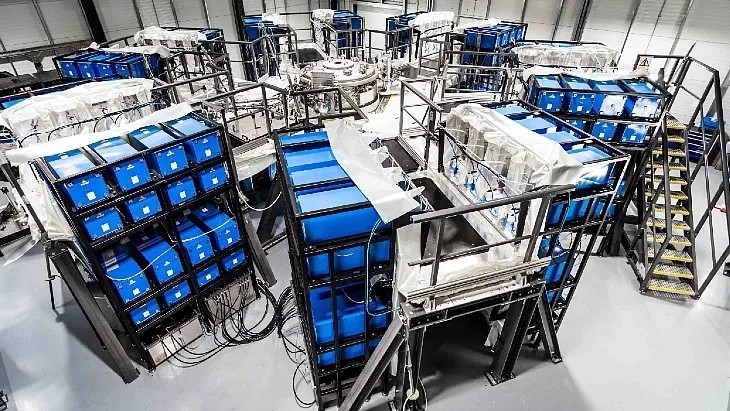
The core design logic of the FLARE technology pathway lies in decoupling the Inertial Confinement Fusion (ICF) process——drawing on the engineering principle of an internal combustion engine that “first compresses the air-fuel mixture, then ignites at the appropriate moment,” the fusion physics process is divided into two independent stages: pre-compression and high-density assembly of fuel, and ignition triggered by an externally applied ultrafast pulse. The M3 experiments specifically conducted isolated validation of the first-stage compression process, breaking through the engineering constraint that conventional inertial fusion must rely on oversized, highly precise, and costly peak pulse drivers.
At the level of commercial engineering feasibility, conventional high-power driver devices are prone to enduring extreme mechanical and thermal stress under repeated discharge conditions, resulting in high failure probability of core components, frequent downtime for maintenance, and difficult-to-control capital expenditure. The FLARE pathway innovatively “transfers and embeds” the waveform tuning and timing control functions of the compression process “into the target structure itself” (Target-led compression), using a multi-layered shell target structure to convert the input base current pulse into a gradient-controlled traveling shock wave, effectively suppressing early overheating while progressively achieving ultra-high-density fuel compression. Company estimates indicate that this design can greatly simplify the external generator construction and enhance operational robustness, and the end cost of the FLARE compression driver is expected to be reduced by an order of magnitude compared with similar inertial fusion systems.
As the company's first milestone achievement following the completion of £25 million in strategic financing this year, this round of experiments did not directly pursue fusion ignition or net energy gain output, but rather aimed to systematically eliminate key underlying physics risks in the FLARE core technology pathway. Professor Jeremy Chittenden (Prof. Jeremy Chittenden), Chairman of the First Light Fusion Scientific Advisory Board and Director of the Inertial Fusion Research Centre at Imperial College London (Imperial College London), noted that using a multi-layered liner on a low-voltage generator to drive materials to an ultra-high-pressure state has laid solid evidence for the scientific feasibility of the FLARE concept. Next, the company will further advance high-temperature, high-density integrated heating experiments oriented toward fusion fuel conditions, building on this scalable mass-production multi-layered liner process.
Disclaimer: Information republished from partner media, institutions or other websites is provided for reference and communication purposes only. It does not imply endorsement of its views or verification of its accuracy. Please contact us if any content infringes rights or requires correction.