
Type One Energy to Invest $5.8 Million in Tritium Breeding R&D
 Scan to share
Recently, "Type One Energy" announced that the company and the "University of Tennessee, Knoxville" (UT Knoxville) have received support from the U.S. state of "Tennessee"'s first "Innovation & Research for Industry Success" (IRIS) program. The two parties will invest $5.8 million in a two-year collaborative R&D effort focused on developing novel "coated ceramic breeder particles" and exploring technical pathways to enhance "tritium" breeding and fuel management capabilities for future "fusion power plants."
The project has a total R&D investment of $5.8 million over a two-year period, with "Type One Energy" contributing $2.9 million and the U.S. state of "Tennessee" government providing the other $2.9 million through the "Innovation & Research for Industry Success" program; the "Innovation & Research for Industry Success" program is administered by the "Office of Innovation" of the "Tennessee Department of Economic and Community Development" (TNECD), with funding derived from Tennessee's fiscal year 2026 budget. The state legislature approved $63 million in allocations to the "Tennessee Department of Economic and Community Development" in spring 2025 for multiple innovation investments—the largest innovation investment in the state's history—and this grant is the first project announced under that program.
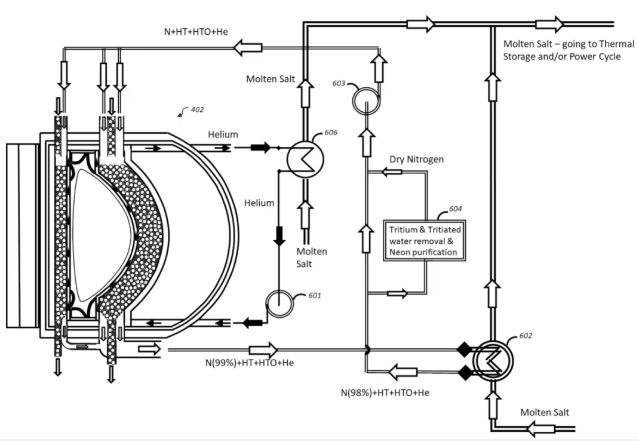
The core of this collaboration is the development of novel "coated ceramic breeder particles" (i.e., "ceramic pebbles") for fusion reactor "breeding blankets"; "tritium" is an important fuel for the "deuterium-tritium fusion reaction" but exists in very limited quantities in nature. Future fusion power plants will need to use high-energy neutrons produced by fusion reactions to bombard lithium-containing materials to produce "tritium," which is then extracted, recovered, and reinjected into the "plasma." In solid breeder blankets purged with helium gas, lithium-containing ceramic materials such as "lithium metatitanate" (Li₂TiO₃) and "lithium orthosilicate" (Li₄SiO₄) are typically fabricated into millimeter-scale pebbles packed inside the blanket. Their size, porosity, microstructure, mechanical strength, and stability under irradiation and thermal stress all affect heat transfer, gas flow, and "tritium" extraction efficiency. The coating composition and performance metrics of the proposed novel coated ceramic particles remain to be verified through subsequent experiments.
In terms of division of labor, the "University of Tennessee, Knoxville" will leverage its strengths in advanced materials fabrication and characterization, irradiation effects, and nuclear materials science, while "Type One Energy" will contribute its "stellarator" technology, fusion device design, and commercial fusion power plant systems engineering experience; the company is advancing "Project Infinity" in the U.S. state of "Tennessee," with its first deployment project, "Infinity Two," planned for 400 MWe of installed capacity. Previously, in January 2026, "Type One Energy," the "University of Tennessee," and the U.S. "Department of Energy" (DOE) "Oak Ridge National Laboratory" (ORNL) also announced a collaboration to build a "high-heat-flux materials testing facility" using pressurized helium cooling and electron beam technology, planned for completion by the end of 2027, gradually forming a local collaborative network in Tennessee covering materials R&D, component testing, and university talent development.
It is understood that "Type One Energy" researchers also published a paper titled "Observations for a Fusion Tritium Economy" in the journal "Fusion Science and Technology" in September 2026, exploring from the perspectives of "neutron transport," the "fuel cycle," and plant economics a cross-plant collaboration framework in which tritium-production-focused plants supply fuel to other plants. This commercial deployment model remains at the theoretical analysis stage and faces engineering and regulatory challenges. Combined with the current "coated ceramic breeder particles" R&D, it is evident that the company is advancing related exploration on two levels: in-reactor "tritium" production management and future fusion power plant fleet fuel supply.
Disclaimer: Information republished from partner media, institutions or other websites is provided for reference and communication purposes only. It does not imply endorsement of its views or verification of its accuracy. Please contact us if any content infringes rights or requires correction.