
Framatome Completes Manufacturing of First Fuel Plates for FRM-II Conversion
 Scan to share
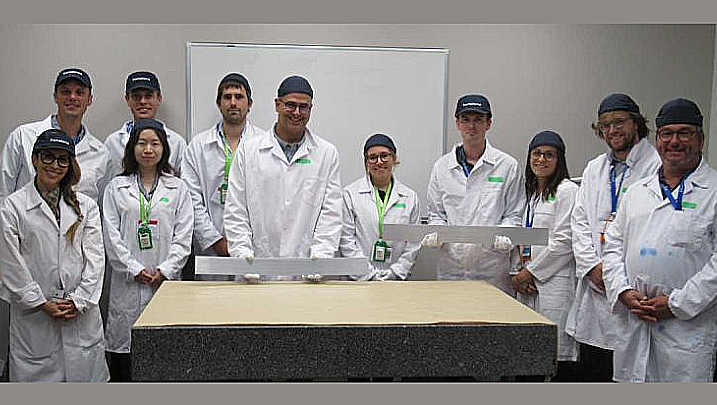
Recently, "Framatome" completed the manufacturing of the first batch of depleted uranium fuel plates, an important technical milestone in advancing the conversion of the "FRM II research reactor" at the "Technical University of Munich" (TUM) from "Highly Enriched Uranium" (HEU) fuel to "High-Assay Low-Enriched Uranium" (HALEU) fuel. These fuel plates were produced at Framatome's "CERCA" manufacturing facility in "Romans-sur-Isère", France, continuing the collaboration agreement signed in 2024 between the French company and the "Technical University of Munich", aimed at achieving industrial-scale production of "uranium-molybdenum" (U-Mo) monolithic fuel with uranium-235 enrichment below 20% while possessing the highest uranium fuel density achieved to date in Europe.
According to reports, the 20 MWt "FRM II research reactor", in operation since 2005, is one of the most efficient and modern high-flux neutron sources in the world, primarily used for medical radioisotope production and industrial and scientific research such as high-purity silicon doping for the semiconductor industry, rather than for power generation; however, to generate high-density neutron flux, the reactor currently uses "Highly Enriched Uranium" fuel with uranium-235 enrichment exceeding 95%, which is regarded as a nuclear proliferation risk. The "Technical University of Munich" has been collaborating with "Framatome" since 2019 to advance the reactor's conversion to lower-enrichment fuel, and "Framatome" completed the development of an innovative "uranium-molybdenum" monolithic fuel core assembly in 2023, which, with its high uranium density, enables the reactor to operate as designed with uranium-235 enrichment below 20%.
"Framatome" stated that the successful manufacturing of depleted uranium fuel plates is an important milestone in future fuel design development; although these fuel plates are not intended for reactor operation, it is an important step toward fuel design qualification, and the advanced manufacturing processes developed jointly with the "Technical University of Munich" confirm the maturity of the technologies required to establish industrial-scale production capacity for advanced research reactor fuel in Europe. "Ralf Gathmann", "Vice President of Framatome's CERCA", stated that this achievement demonstrates "Framatome"'s ability to translate ambitious R&D projects into industrial reality; the successful manufacturing of the first molybdenum-uranium monolithic fuel plates validates the technical choices made jointly with the "Technical University of Munich" and establishes an important milestone for the future qualification of low-enriched uranium fuel for the "FRM II research reactor".
"Christian Reiter", "Director of the FRM II Research Reactor Conversion Project", stated that the production of the first two depleted uranium fuel plates at final dimensions demonstrates the progress achieved by combining the conversion design of the "Technical University of Munich"'s "FRM II research reactor" with "CERCA"'s manufacturing expertise, and that this result provides a solid foundation for subsequent development and qualification steps. According to reports, the next phase of the project will include the manufacturing of a "Generic Test Assembly" of "uranium-molybdenum" monolithic fuel plates using "High-Assay Low-Enriched Uranium", with irradiation testing planned for 2028; the conversion project is funded by the "Free State of Bavaria" through the "Technical University of Munich" under a direct contract with "Framatome", and receives support from the "European Commission" and "Euratom" through multiple projects, including the "EU-CONVERSION" project launched in early 2025 with a budget of EUR 12.8 million (approximately USD 13.3 million).
It is understood that research reactors are primarily used for scientific research, development, education and training; increasing total uranium content without increasing uranium-238 volume requires the use of pure metallic "High-Assay Low-Enriched Uranium-molybdenum" monolithic fuel containing 10% molybdenum rather than aluminum-based dispersion fuel. The realization of this first batch of depleted uranium fuel plates not only advances the proliferation-resistant fuel conversion process of Germany's high-flux research reactor but also provides engineering practice reference for similar high-performance research reactors worldwide to eliminate dependence on highly enriched uranium.
Disclaimer: Information republished from partner media, institutions or other websites is provided for reference and communication purposes only. It does not imply endorsement of its views or verification of its accuracy. Please contact us if any content infringes rights or requires correction.