
Finland's Posiva Completes First Trial Transfer to Encapsulation Plant
 Scan to share
Recently, Finnish radioactive waste management company "Posiva" successfully completed the first trial transfer of a spent fuel "transfer cask" to the "encapsulation plant" at "Olkiluoto." This "encapsulation plant" is part of the "Posiva" "Onkalo final disposal facility" complex. After final disposal operations commence in the future, spent fuel will be transported from the interim storage facility to the "encapsulation plant," loaded into final disposal canisters made of copper and "spheroidal graphite cast iron," and then transferred from the "encapsulation plant" to disposal repository tunnels at a depth of 400 to 450 meters underground, and further placed into disposal holes lined with "bentonite buffer."
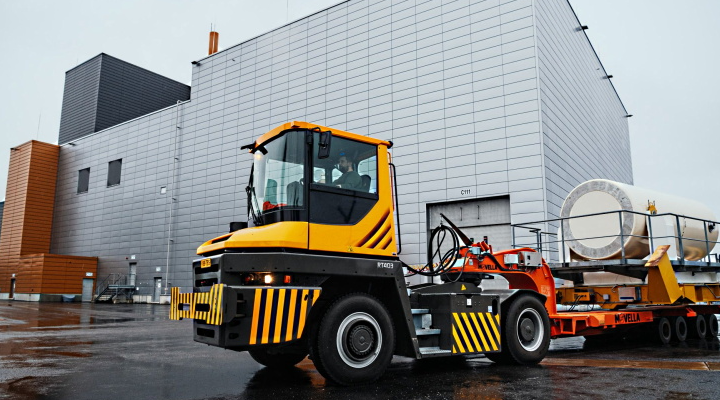
The "transfer cask" is a heavy-duty container designed specifically for the safe transport of spent fuel. It had previously been used in Finland for many years to transport spent fuel from nuclear power plants to the "Olkiluoto" spent fuel interim disposal facility. This trial transfer, however, extended the transport route to the "Posiva" "encapsulation plant" for the first time, increasing the transport distance from several hundred meters to approximately three kilometers. During the trial, the "transfer cask" was docked with the "handling cell." After the "Posiva" disposal facility commences operation in the future, actual handling of spent fuel will be carried out within the "handling cell." Following the successful trial, the "transfer cask" was hoisted back onto the transport vehicle.
"Posiva Operations Manager" Pasi Rantamäki stated that everything progressed smoothly without any unexpected issues. This was the first time the "transfer cask" arrived at the "encapsulation plant," was loaded onto the company's own "transfer trolley," and was operated using "Posiva" equipment. Cooperation with "Teollisuuden Voima Oyj" (TVO) was also highly efficient, with both companies demonstrating clear commitment to the trial. The company will make minor adjustments to equipment based on the trial results to ensure smoother handling of the "transfer cask."
"Posiva Production Director" Karri Osara stated that although the cask was not loaded with actual fuel, the trial run was a demanding process requiring thorough advance planning. The team not only verified system operability but, more importantly, observed the effectiveness of collaboration between different organizations of the two companies in practice. Such trials combine technical capabilities, procedures, and personnel coordination, and the overall process ran very well. The trial also accumulated experience for the "encapsulation plant" in receiving and handling casks, demonstrating "Posiva's" capability to receive actual "transfer casks."
It is understood that the successful trial transfer of the "transfer cask" is part of "Posiva's" ongoing large-scale commissioning process and testing, aimed at verifying that the "encapsulation plant" is ready to commence production operations and is progressing step by step according to a precise plan. "Posiva Operations Manager" Pasi Rantamäki stated that another "transfer cask" trial run will be conducted subsequently, advancing further in cask handling and testing the "fuel transfer machine" using the fuel positions of an actual "transfer cask." At that time, procedures for the controlled area will also need to be activated.
In December 2021, "Posiva" submitted an operating license application to Finland's "Ministry of Economic Affairs and Employment" for the spent fuel "encapsulation plant" and the "Onkalo final disposal facility," with an application period from March 2024 to the end of 2070. The facility is designed to dispose of spent fuel generated by "Teollisuuden Voima Oyj's" "Olkiluoto" nuclear power plant and "Fortum's" "Loviisa" nuclear power plant. The operating license was approved last month, but the facility is still awaiting commissioning and startup. The total amount of spent fuel to be disposed of is equivalent to approximately 3,300 disposal canisters. After full operation, it is planned to dispose of a maximum of 60 disposal canisters per year. Final disposal operations are expected to continue until the 2120s, after which the disposal repository will be backfilled and closed.
Disclaimer: Information republished from partner media, institutions or other websites is provided for reference and communication purposes only. It does not imply endorsement of its views or verification of its accuracy. Please contact us if any content infringes rights or requires correction.