
U.S. Discloses SR-1 Space Reactor Mission and I&C Design
 Scan to share
Recently, at the space reactor instrumentation and control special session of the "American Nuclear Society" (ANS) Winter Meeting, researchers from "Idaho National Laboratory" (INL), the "National Aeronautics and Space Administration" (NASA) "Johnson Space Center," and "Oak Ridge National Laboratory" (ORNL) presented the engineering constraints, on-orbit operation planning, and testing roadmap of the "SR-1 Freedom mission"; the mission is planned for launch in late 2028, aiming to become the first "fission nuclear energy"-powered spacecraft to fly beyond Earth orbit, demonstrate "deep-space nuclear propulsion" technology, and deliver to "Mars" the "SkyFall payload" carrying three next-generation Mars helicopters. Its core design is led by "Idaho National Laboratory," employing "High-Assay Low-Enriched Uranium fuel" (HALEU fuel) under a conditional supply commitment from the "Department of Energy" (DOE) and a "closed Brayton cycle" conversion system, with electrical power output exceeding 20 kilowatts.
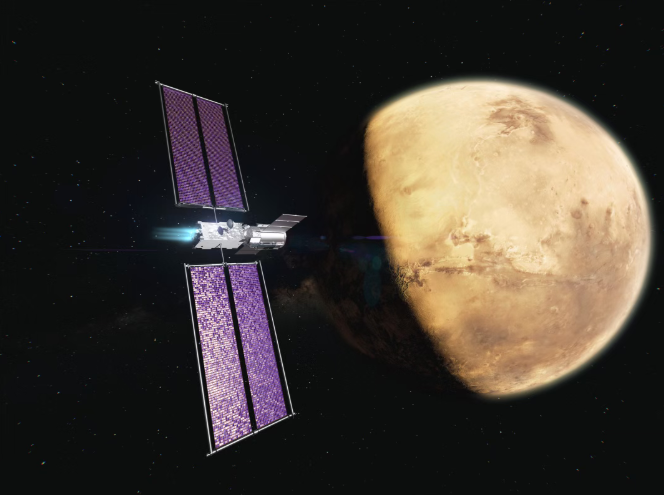
Regarding space environment engineering constraints, although the "United States" had achieved ground-based criticality testing of five reactors by 2026, space reactor "Instrumentation and Control" (I&C) systems face physical conditions different from ground-based reactors. Ground-based reactors can rely on massive concrete and water shielding against radiation, whereas space reactors are constrained by launch mass limits, meaning nearly all I&C components will be directly exposed to higher radiation doses. Existing space-grade radiation-tolerant equipment is mostly qualified using "cobalt-60 sources" that emit high-energy "gamma rays" rather than the reactor core "neutron environment," and the industry still lacks publicly available test data for electronic equipment such as "Programmable Logic Controllers" (PLCs) in reactor neutron fields. Meanwhile, traditional cables are neither suited to the space environment nor are they among the heaviest payloads on spacecraft; design work must integrate nuclear engineering with aerospace engineering.
"Data links" are similarly constrained. Due to bandwidth limitations of NASA's "Deep Space Network," only a small fraction of data collected by onboard sensors can be transmitted back to Earth. The development team addressed trade-offs regarding data volume and onboard storage from an early stage, and proposed developing advanced on-orbit computing capabilities to perform local processing and transmit only necessary information without reducing the number of sensors.
Regarding regulatory boundaries and operational planning, the "SR-1 reactor" will be started after entering space. Before and during launch, it will be managed under the "Department of Energy" nuclear facility authorization pathway. After entering the "Earth-Mars transfer orbit," the space environment is not subject to ground-based nuclear regulation, allowing the team to assume higher verification risks during on-orbit testing. The mission proceeds in two phases: after orbit insertion, the team plans to start the reactor and thermoelectric conversion system as early as possible, with startup and checkout taking approximately 7 days, jointly completed by "Department of Energy" and "National Aeronautics and Space Administration" operators at "Johnson Space Center." The reactor will then be shut down until the "SkyFall payload" is delivered to "Mars." After delivery is complete, most radiation restrictions will be lifted, and the team plans to restart the reactor based on first-startup experience to conduct higher-intensity operational tests and even actively trigger component failures, collecting as much engineering data as possible within allowed bandwidth. The diagnostic system will be key to determining restart timing and feasibility.
It is understood that "NASA Administrator" Jared Isaacman previously characterized the "SR-1 mission" as a 70% feasibility validation approach, while the project team positions it as a C+ class precursor reactor, following a "good enough" principle to obtain flight-measured data to support industry's subsequent development of A+ class reactors. Ground testing will be conducted at "Idaho National Laboratory," including development of an engineering demonstration prototype and zero-power criticality tests. Some flight control hardware will also be integrated into "Idaho National Laboratory's" "Versatile Autonomous Lightweight Kilowatt Reactor Experiment" (VALKRE) for validation; the facility is planned to reach criticality in summer 2027, at which time flight systems will be used to control it to a zero-power critical state. Project officials declined to comment on whether a neutron source would be used for startup.
Regarding control architecture and cross-mission reuse, the "SR-1 mission" has certain automation capabilities but cannot achieve full autonomy. The project draws on experience from "Idaho National Laboratory's" "Transient Reactor Test Facility" (TREAT), executing step-by-step per scripts and pausing at preset nodes for ground personnel confirmation before proceeding to the next step. The "SR-1 mission" is the starting point of NASA's long-term space nuclear power sequence, with the "LR-1 lunar reactor" and "SR-2 space reactor" already planned. Although the "LR-1 lunar reactor" has far fewer Earth data transmission constraints than the Mars mission, it is expected to operate for at least 10 years, imposing higher requirements on autonomous systems, long-life components, and supply chains. However, from the perspective of underlying equipment, the core I&C components of various space reactors are relatively similar, and the cross-mission I&C architecture overall still possesses high commonality.
Disclaimer: Information republished from partner media, institutions or other websites is provided for reference and communication purposes only. It does not imply endorsement of its views or verification of its accuracy. Please contact us if any content infringes rights or requires correction.