
Search Results
Keyword:SR-1 Freedom
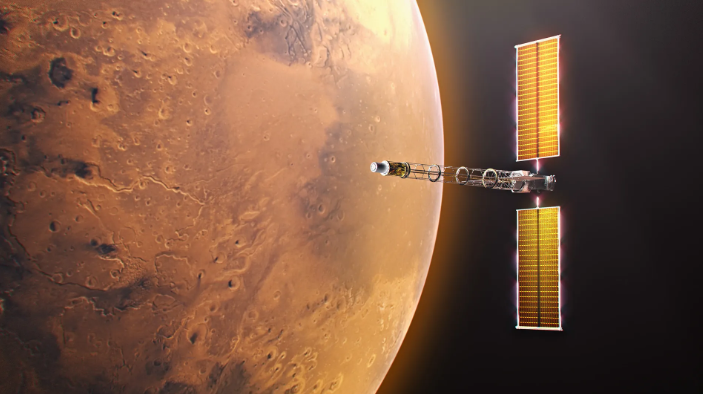
NASA's SR-1 Freedom deep-space nuclear reactor progresses smoothly, planned to set sail in 2028
Recently, the National Aeronautics and Space Administration (NASA) announced that its Space Reactor-1 (SR-1) Freedom has achieved a key breakthrough in the development of nuclear power modules and has reached an important contract consensus with partners. The reactor will become the first spacecraft to demonstrate nuclear fission power beyond Earth orbit, with launch planned for late 2028 en route to Mars. It is understood that Sierra Lobo will provide the closed Brayton cycle power conversion system for SR-1 Freedom, responsible for converting the thermal energy generated by the fission reactor into electricity to drive the nuclear electric propulsion system. The power conversion system will be deeply integrated with the fission reactor designed and developed by the U.S. Department of Energy (DOE) Idaho National Laboratory (Idaho National Lab...
2026-10-21
U.S. Plans to Launch Nuclear Fission-Powered Spacecraft to Fly by Mars by End of 2028
The National Aeronautics and Space Administration (NASA) is advancing the Space Reactor-1 "Freedom" (SR-1 Freedom) mission, with the goal of launching a nuclear fission-powered spacecraft by the end of 2028 to validate deep-space nuclear electric propulsion technology. According to existing mission documentation, the mission plans to fly by Mars in 2029 and deploy the SkyFall payload. The SR-1 Freedom is neither a fusion spacecraft nor a crewed Mars vehicle. Its core experiment is to operate a small uranium fission reactor, an energy conversion system, and Hall-effect thrusters in coordination beyond Earth orbit, accumulating engineering data for future higher-power deep-space missions...
2026-08-24