
BlueStar Fusion Completes "Angel+" Round Financing, High-Temperature Superconducting Stellarator Project Moves to Engineering Implementation Phase
 Scan to share
Recently, Hefei BlueStar Fusion Technology Co., Ltd. (BlueStar Fusion, hereinafter referred to as “BlueStar Fusion”) completed an “Angel+” round of financing on the scale of several hundred million RMB, with a post-investment valuation exceeding 3 billion RMB. Following the completion of this financing round, the company will continue to advance the verification of key components, engineering manufacturing, and full-system integration of the high-temperature superconducting stellarator, with the goal of initiating the construction of the Phase I high-temperature superconducting stellarator system by 2027.
BlueStar Fusion was established in August 2025 and is primarily engaged in the R&D and engineering of high-temperature superconducting stellarator technology. The company has assembled a professional team of nearly 100 members, covering fusion physics, superconducting magnets, structures and precision manufacturing, cryogenic engineering, artificial intelligence, and other disciplines. Since its inception, the company has completed three consecutive rounds of financing on the hundred-million scale, with investors including multiple venture capital, private equity institutions, and industrial investors.
In device construction, physics design is only the starting point. The stellarator concept must be further translated into specific engineering objects such as coils, structural components, cryogenic systems, vacuum vessels, control systems, and assembly interfaces. Whether the coils can be manufactured, whether components can achieve high-precision assembly, whether the structure can withstand electromagnetic loads, and whether the magnets can operate stably in cryogenic environments will all directly affect subsequent full-system construction. The high-temperature superconducting model coil has therefore become a critical verification link connecting physics design and engineering manufacturing.
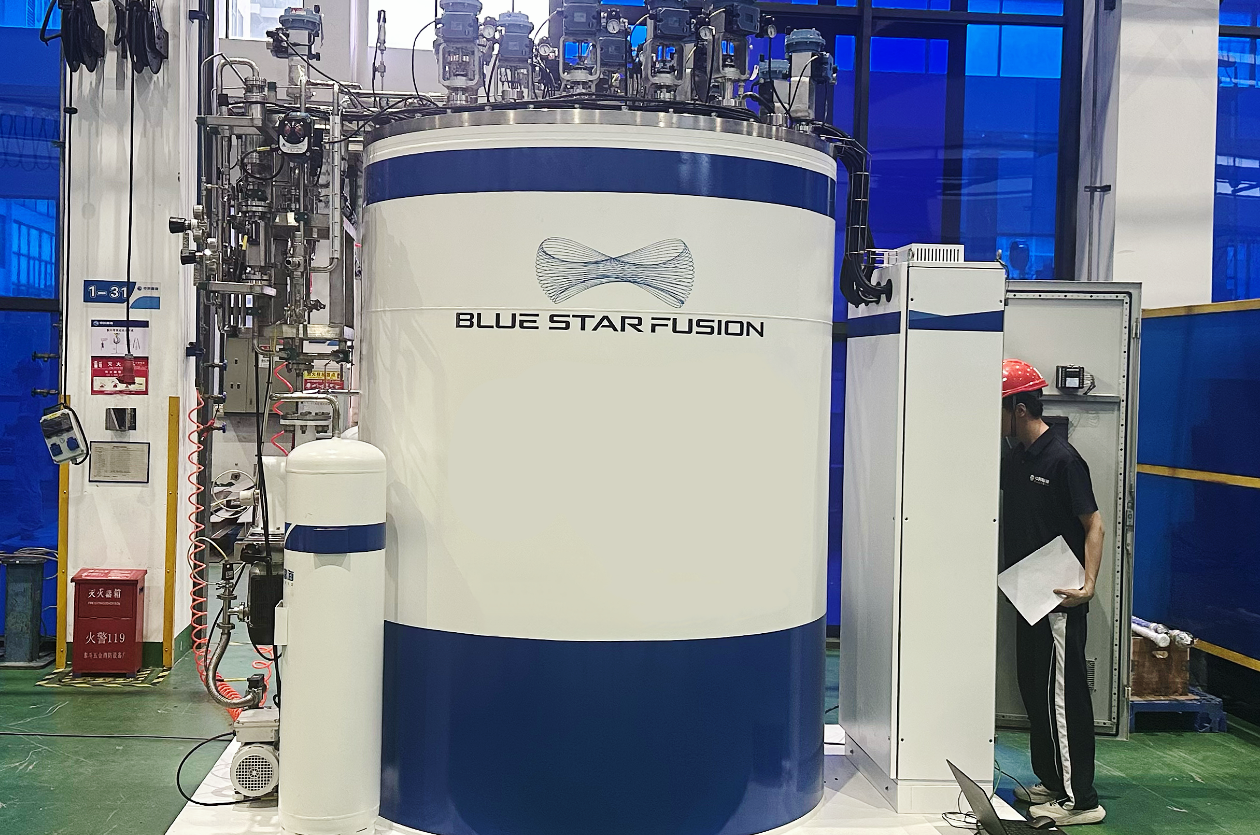
BlueStar Fusion cryogenic refrigeration system
According to BlueStar Fusion, the company recently completed current-carrying tests of the high-temperature superconducting stellarator model coil under real operating conditions of cold helium gas and conduction cooling. During the tests, the model coil repeatedly reached the designed operating current; in the ultimate current-carrying test, the current-carrying capacity exceeded twice the normal operating current, with a maximum magnetic field reaching 10.3 Tesla. The company stated that this is the highest magnetic field level ever achieved by a high-temperature superconducting stellarator model coil in China to date.
BlueStar Fusion stated that this test was conducted under actual operating conditions of the full-system magnet, providing support for the transition of the high-temperature superconducting stellarator from key component verification to full-system engineering implementation. Currently, the project is shifting from conceptual design and simulation validation to a new phase where engineering drawings, procurement and manufacturing, quality control, and system integration proceed in parallel.
The stellarator relies primarily on external three-dimensional magnets to generate the confining magnetic field and has the potential for long-term steady-state operation. However, its complex three-dimensional structure also presents engineering challenges in configuration design, coil manufacturing, assembly precision, and system integration. To address this issue, BlueStar Fusion applies artificial intelligence technology to concept evaluation, parameter search, multi-objective optimization, and engineering constraint coordination, and has developed the coil optimization AI tool NextOpt to accelerate concept generation, simulation validation, and design iteration.
The company stated that in the next phase, it will continue to advance core engineering areas including high-temperature superconducting magnets, cryogenic systems, and vacuum and structural systems, striving to complete the construction of the Phase I high-temperature superconducting stellarator system by 2027, accumulating experience for subsequent fusion energy engineering.
Disclaimer: Information republished from partner media, institutions or other websites is provided for reference and communication purposes only. It does not imply endorsement of its views or verification of its accuracy. Please contact us if any content infringes rights or requires correction.