
ZiaCore Microreactor Achieves Criticality in High-Temperature Zero-Power Experiment
 Scan to share
Los Alamos National Laboratory announced on July 30 that its ZiaCore microreactor design has completed a high-temperature zero-power criticality proof-of-principle experiment at the National Criticality Experiments Research Center (NCERC) in Nevada, successfully achieving initial criticality.
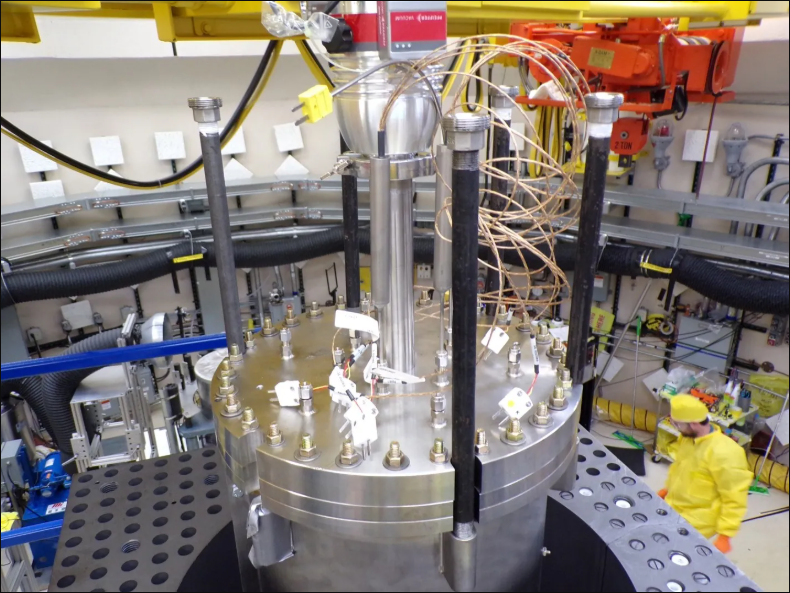
ZiaCore is an advanced nuclear energy microreactor design that uses low-enriched uranium dioxide fuel. The experiment lasted approximately four weeks from April to May this year, advancing the ZiaCore system to zero-power criticality under high-temperature conditions. According to the reactor design and verification process, zero-power criticality experiments can be used to validate the effectiveness of reactor physics designs, providing key benchmark data for subsequent engineering development.
The microreactor design emphasizes fuel utilization efficiency, structural compactness, and manufacturability. The research team began advancing related technology development in 2021, focusing on the design of the reactor core and key components, employing zirconium hydride moderator and heat pipe cooling solutions. In addition to the main components, the team also designed a vacuum vessel to house the ZiaCore reactor fuel assemblies, heat pipes, zirconium hydride moderator components, fuel, and custom electric heaters.
In this experiment, the ZiaCore fuel assemblies loaded into the vacuum vessel were deployed on the Deimos test stand at NCERC. Researchers conducted a series of near-zero-power criticality tests in a high-temperature environment exceeding 800 degrees Celsius, obtaining important data on the operating characteristics of the full-scale system, including reactor physics parameters such as the reactivity temperature coefficient. These data not only serve the ZiaCore design itself but can also provide references for the development of similar microreactor technologies.
The so-called "zero-power" criticality refers to establishing and maintaining a fission chain reaction but stopping the reaction before the fission process generates measurable heat. Since very few fission products are produced during the experiment, the radioactivity level is low, and the relevant laboratory space can be restored for use relatively quickly; at the same time, the nuclear fuel is not consumed and can still be used for subsequent experiments.
According to project documents, the ZiaCore microreactor could also use high-assay low-enriched uranium fuel in the future once the supply chain matures. High-assay low-enriched uranium typically refers to uranium fuel with a uranium-235 enrichment level below 20% and is considered an important fuel option for various advanced reactor designs.
NCERC is located at the Nevada National Security Sites and is the only general-purpose criticality experiment facility in the United States, supported by the Nuclear Criticality Safety Program.
Disclaimer: Information republished from partner media, institutions or other websites is provided for reference and communication purposes only. It does not imply endorsement of its views or verification of its accuracy. Please contact us if any content infringes rights or requires correction.