
Hefei Institute of Energy and Xianchu Nuclear Assembly Jointly Establish a Joint Laboratory for Tritium-Related Environmental Control Equipment for Fusion
 Scan to share
On July 23, the Institute of Energy, Hefei Comprehensive National Science Center, and Shijiazhuang Xianchu Nuclear Energy Equipment Co., Ltd., a subsidiary of Xianchu Energy Development Group, held a signing ceremony in Hefei, Anhui Province, for the "Joint Laboratory for Tritium-Related Environmental Control Equipment for Fusion." The collaboration will focus on the development of tritium-related environmental control equipment for nuclear fusion devices, advancing key technology breakthroughs and industrial applications.
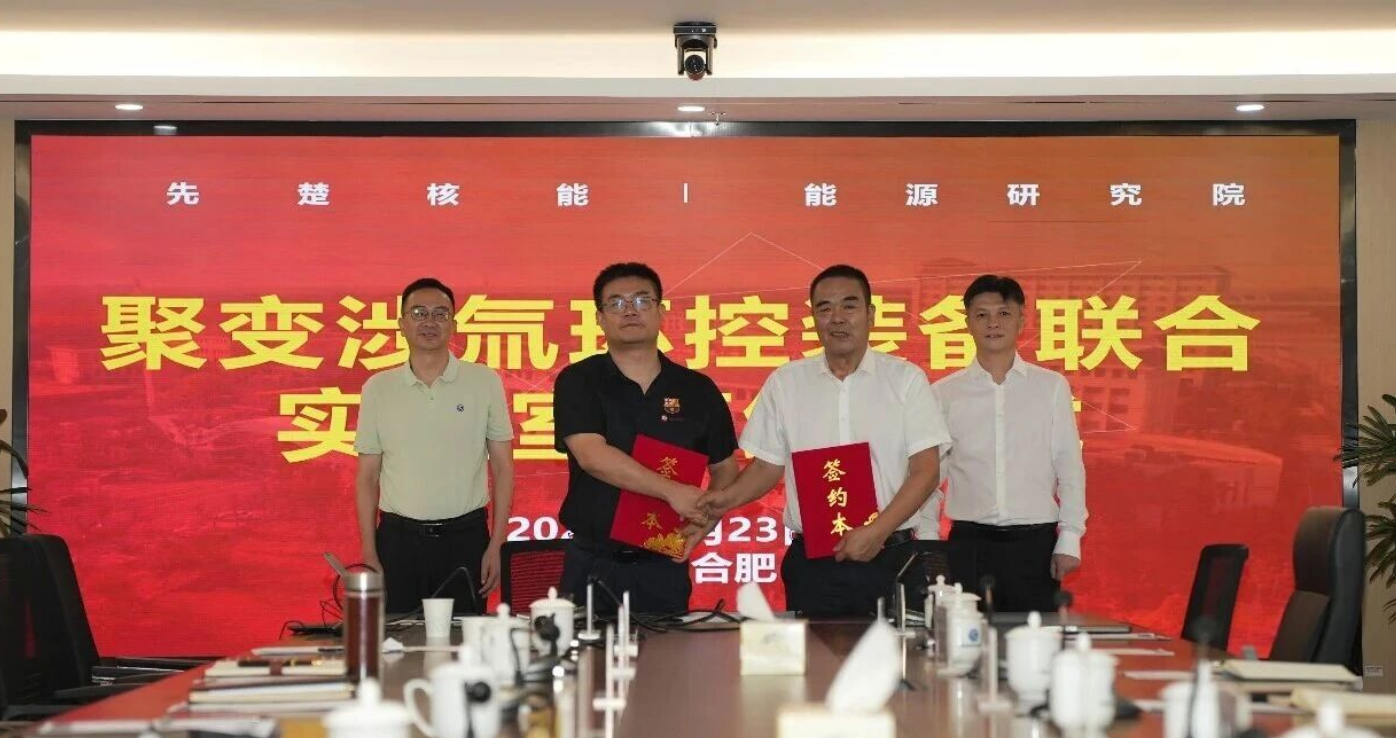
Hu Haomin, Deputy Director of the Institute of Energy, Hefei Comprehensive National Science Center; Chen Kun, Chairman of Xianchu Energy Development Group; Fang Yongsheng, Executive Deputy General Manager of Shijiazhuang Xianchu Nuclear Energy Equipment Co., Ltd.; and Zhao Xinhua, General Manager of China-Ukraine Xianchu Nuclear Energy Technology Co., Ltd., attended the signing ceremony.
Established in December 2019, the Institute of Energy, Hefei Comprehensive National Science Center, was jointly initiated by the Anhui Provincial Government and the Chinese Academy of Sciences, and co-built with the Institute of Plasma Physics, Hefei Institutes of Physical Science, Chinese Academy of Sciences; the University of Science and Technology of China; Hefei University of Technology; and Anhui University of Science and Technology. Leveraging major scientific facilities such as the Experimental Advanced Superconducting Tokamak (EAST), the Comprehensive Research Facility for Fusion Technology (CRAFT), and the Burning-plasma Experimental Superconducting Tokamak (BEST) compact fusion energy experimental device, the institute conducts research on key fusion technologies including fully superconducting steady-state magnets, compact central core fueling, and high-power radio-frequency heating, and has made progress in areas such as ammonia co-firing carbon reduction, pure ammonia-fueled power ships, and modular ammonia synthesis equipment.
Shijiazhuang Xianchu Nuclear Energy Equipment Co., Ltd. has long been engaged in the development and manufacturing of nuclear-grade equipment and is one of the earliest units to obtain the Civil Nuclear Safety Equipment Design and Manufacturing Licenses from the National Nuclear Safety Administration. Since participating in the supporting projects of the Qinshan Phase I nuclear power project in 1983, the company has supplied relevant nuclear power equipment to domestic nuclear power units under construction and in operation, as well as overseas nuclear power projects involving Chinese participation. Its products cover Generation II, III, and IV nuclear power technology routes and nuclear fusion-related equipment. According to the company, its leading product, nuclear-grade air dampers, holds a significant share in the nuclear power market segment, and it has accumulated technical expertise in nuclear radioactive waste treatment and radioactive waste disposal in nuclear medicine.
As nuclear fusion technology continues to advance, tritium-related environmental control in fusion devices has become a critical factor affecting engineering development. Tritium, as one of the fusion fuels, is radioactive and highly permeable, imposing stringent requirements on the isolation, fire protection, cooling, and liquid waste treatment capabilities of related equipment.
Under the collaboration arrangement, the two parties will jointly build the Joint Laboratory for Tritium-Related Environmental Control Equipment for Fusion based on the principles of complementary advantages and resource sharing, conducting joint research on technical challenges such as high heat load, radiation resistance, and treatment of high-humidity tritiated liquid waste in fusion environments, and promoting the iterative upgrading of tritium-related environmental control equipment.
Both parties stated that the joint laboratory will strengthen synergy between research and manufacturing, promote the development of the fusion equipment industry, and build a composite nuclear energy talent team with both theoretical research capabilities and engineering manufacturing experience through joint training and two-way mobility.
Disclaimer: Information republished from partner media, institutions or other websites is provided for reference and communication purposes only. It does not imply endorsement of its views or verification of its accuracy. Please contact us if any content infringes rights or requires correction.