
Japanese research team experimentally confirms full-gap spin-triplet superconductivity in UBe13
 Scan to share
On July 30, 2026, Kobe University and the Japan Atomic Energy Agency announced that a research team led by Professor Hideki Higashibata of the Graduate School of Science at Kobe University, along with Shoko Minami, who was a master's student at the time of the research, in collaboration with Yoshinori Haga, Research Director at the Japan Atomic Energy Agency, and researchers from Osaka University, experimentally confirmed for the first time the existence of a spin-triplet superconducting state with full-gap characteristics in the intermetallic compound UBe13. The findings were published in the Journal of the Physical Society of Japan on June 26 and were selected as an Editor's Choice paper.
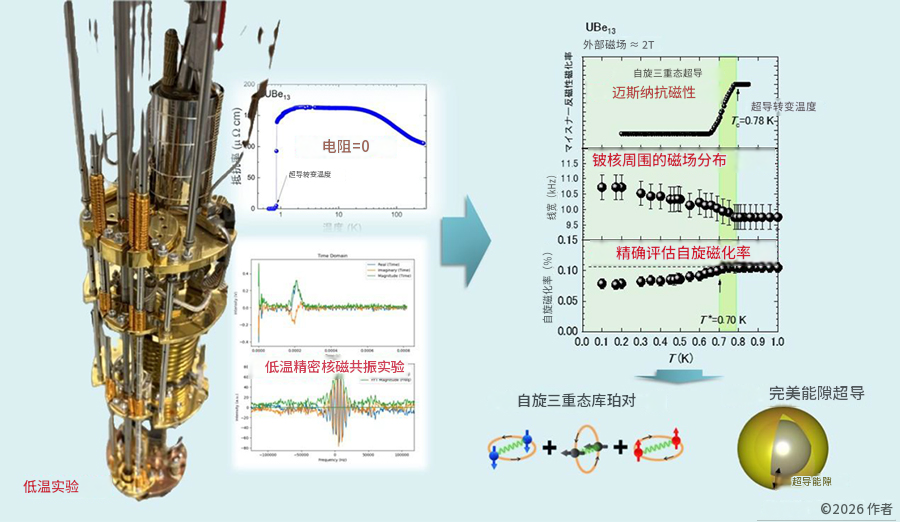
Since its discovery in 1983, UBe13 has been regarded as an important candidate material for spin-triplet superconductivity. Unlike conventional spin-singlet superconductivity, in spin-triplet superconductivity, the two electrons forming a Cooper pair have the same spin direction, and the associated superconducting state is of significant importance for understanding unconventional and topological superconductivity. However, due to difficulties in preparing high-quality samples and the anomalous properties exhibited by this material in its normal conducting state, its superconducting mechanism and gap structure had long remained unclear.
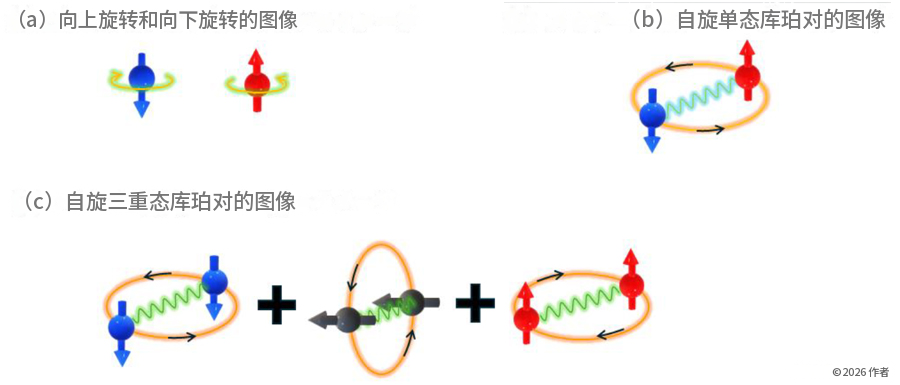
Figure 1 (a) Spin image, (b) Spin-singlet Cooper pair image, (c) Spin-triplet Cooper pair image
In this study, the research team employed nuclear magnetic resonance (NMR), a microscopic measurement technique, to conduct precise measurements on beryllium nuclei in high-quality UBe13 single crystals at ultra-low temperatures. By applying magnetic fields along the three symmetry axes of the cubic crystal, the researchers observed changes in the spin susceptibility and thereby confirmed that the material is in a spin-triplet superconducting state. Compared with conventional susceptibility measurements, NMR can probe spin states at the microscopic scale and helps avoid interference from the Meissner diamagnetic effect of superconductors.
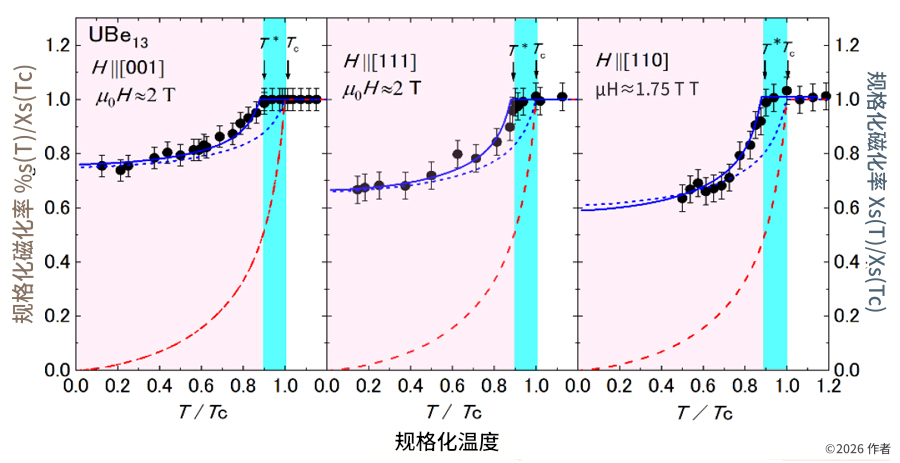
Shows the spin susceptibility curves measured using nuclear magnetic resonance (NMR) (●). The red dashed line represents the expected behavior for a conventional superconductor. The blue solid line represents the expected behavior for a spin-triplet superconductor
The research team also measured the temperature and magnetic field dependence of the NMR relaxation rate, further revealing that UBe13 is a multiband system with multiple electron paths, and confirmed that its superconducting state has a nodeless full-gap structure, meaning there are no "leak"-type nodes between the normal conducting state and the superconducting state.
The researchers believe that the "full-gap spin-triplet" state discovered in this study is a special type of superconducting state that is theoretically related to topological spin-triplet superconductivity. This achievement is expected to advance research on spin-triplet superconductivity and provide new experimental evidence for understanding topological condensed matter physics. According to relevant theoretical predictions, Majorana particle states may appear on the surface of topological spin-triplet superconductors, and these states, due to their strong robustness against environmental noise, are considered relevant to research on next-generation topological quantum computer materials.
The paper is titled "Nuclear Magnetic Resonance Evidence for Full-Gap Spin-Triplet Superconductivity in UBe13," with the DOI being
Disclaimer: Information republished from partner media, institutions or other websites is provided for reference and communication purposes only. It does not imply endorsement of its views or verification of its accuracy. Please contact us if any content infringes rights or requires correction.