
Japanese research team experimentally demonstrates that fusion plasma fluctuations can drive inward particle transport
 Scan to share
August 3, 2026, a research team from The University of Tokyo and the National Institute for Fusion Science (NIFS) under the National Institutes of Natural Sciences announced that researchers have directly observed in experiments that low-frequency electric field fluctuations in high-temperature plasma confined by a dipole magnetic field can transport particles to the central region of the plasma.
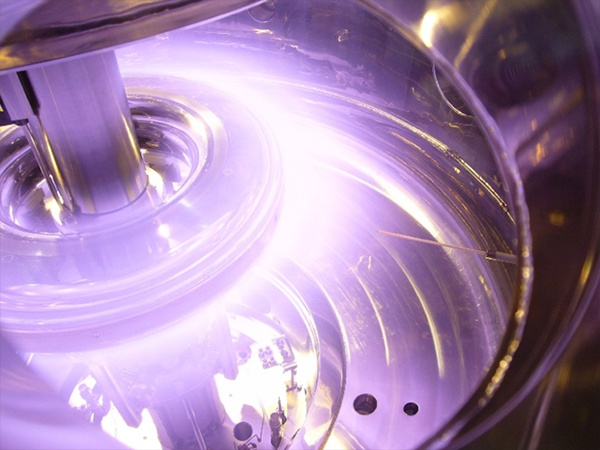
Plasma produced by the levitated dipole experiment device RT-1 (Ring Trap 1)
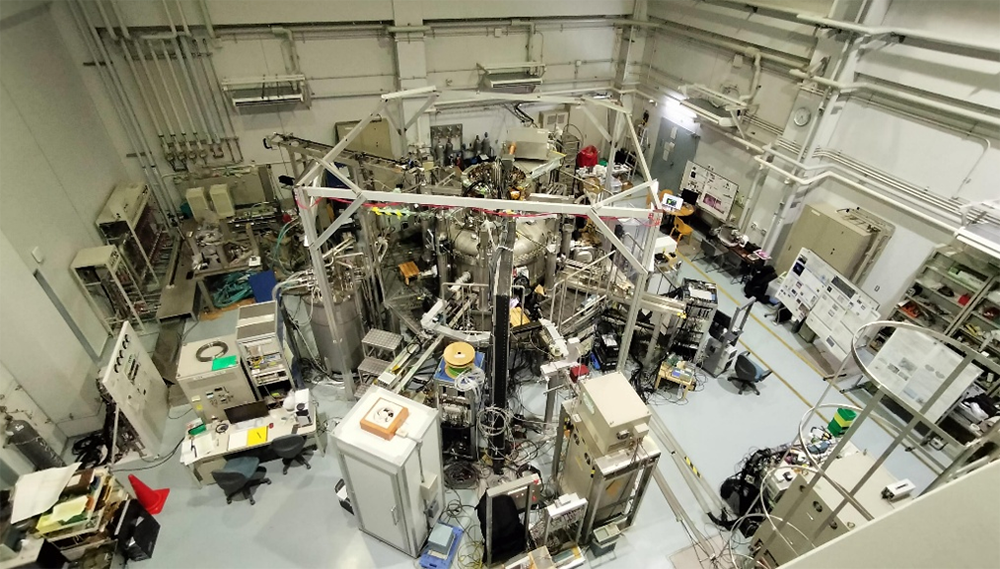
Overall view of the RT-1 device (Kashiwa Campus, The University of Tokyo)
The study was conducted using the levitated dipole experiment device Ring Trap 1 (RT-1) at The University of Tokyo. RT-1 generates a dipole magnetic field similar in structure to the magnetospheres of Earth and Jupiter using a levitated superconducting coil, forming high-temperature plasma inside a vacuum chamber. The research team employed a method capable of simultaneously measuring minute electric field fluctuations and electron density fluctuations with high temporal resolution, analyzed the correlation between the two, and confirmed that low-frequency fluctuations of approximately 1 kHz drive particle flux across magnetic surfaces toward the central region of strong magnetic field.
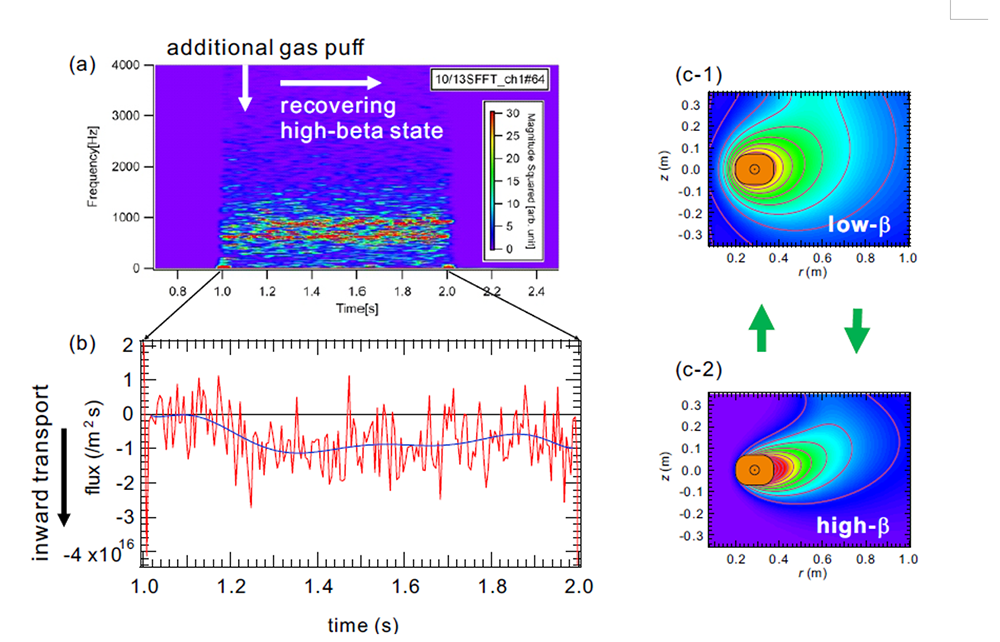
Inward transport driven by low-frequency fluctuations generated during the self-organization process of high-β structures
Under normal circumstances, plasma fluctuations are often considered to enhance particle loss and degrade confinement performance. However, in dipole magnetic field configurations, theory has long predicted that fluctuations may participate in the formation of plasma structures, causing particles to accumulate toward the center and promoting the self-organization of high-pressure, high-β plasma. The present experimental results provide direct evidence for this mechanism.
The study also found that inward particle transport occurs mainly during the process in which high-pressure plasma structures are re-formed after being temporarily disrupted; once the plasma enters a fully developed steady state, such transport almost disappears. This indicates that the relevant fluctuations do not merely disturb the plasma but play a role in the recovery and maintenance of high-pressure structures.
The dipole magnetic field approach is regarded as one of the advanced magnetic confinement paths distinct from tokamaks. The research team believes that this result helps deepen the understanding of self-organization mechanisms in dipole magnetic field plasmas and can provide experimental evidence for next-generation fusion plasma confinement schemes. Since this magnetic field structure resembles planetary magnetospheres, the findings may also contribute to understanding particle transport phenomena in the magnetospheres of planets such as Earth and Jupiter.
The results have been published in Nuclear Fusion, with the paper titled "Inward particle flux caused by low-frequency electric field fluctuations in the edge region of a dipole magnetic field configuration." The research was supported by a project related to Goal 10 of the Cabinet Office's "Moonshot Research and Development Program" and a collaborative research project at the National Institute for Fusion Science.
Disclaimer: Information republished from partner media, institutions or other websites is provided for reference and communication purposes only. It does not imply endorsement of its views or verification of its accuracy. Please contact us if any content infringes rights or requires correction.