
Lifting Task of Large Storage Tanks in Cryogenic System Tank Area of HL-3 Upgrade Project Successfully Completed
 Scan to share
On August 4, the lifting task of large storage tanks in the cryogenic system tank area of the HL-3 upgrade project, undertaken by the Southwestern Institute of Physics (SWIP), was successfully completed. After two days and one night of continuous efforts, a total of 14 large storage tanks were precisely positioned, including 6 medium-pressure high-purity helium storage tanks of 100 cubic meters each, 2 cryogenic liquid nitrogen storage tanks of 100 cubic meters each, and 6 auxiliary helium storage tanks, with a total lifting tonnage exceeding 200 tons. The achievement of this key milestone marks significant phased progress in the installation of cryogenic system equipment.
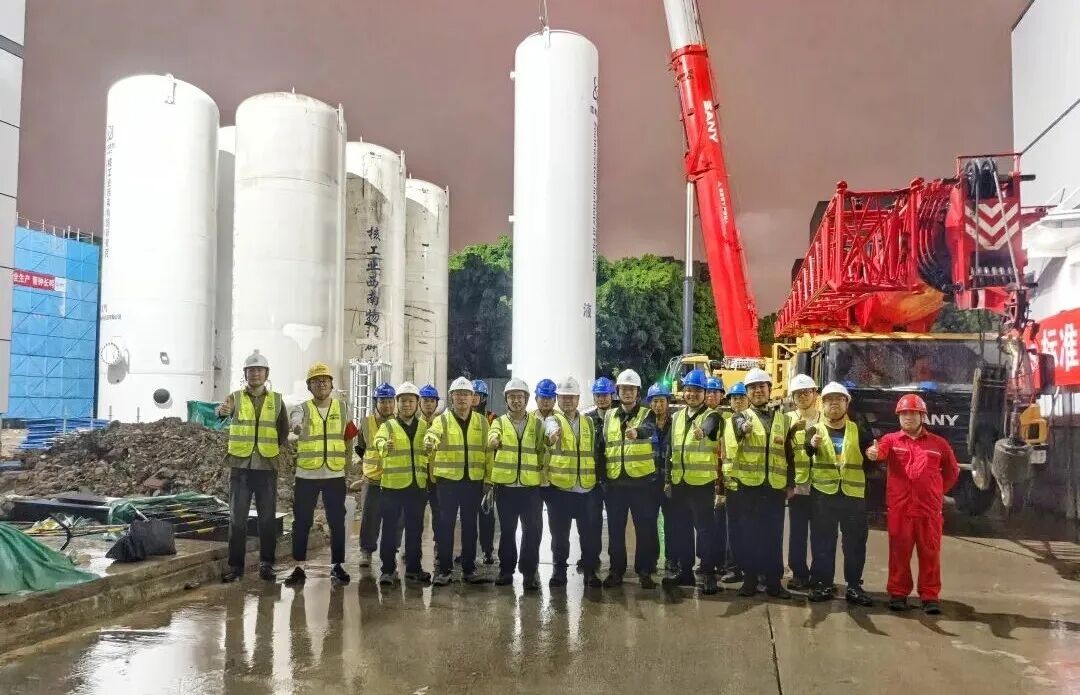
Once the cryogenic system is completed, it will provide stable and reliable cooling capacity for the neutral beam injection system and the toroidal cryopumps of the HL-3 device, effectively enhancing the neutral beam injection efficiency, improving the adsorption performance of the toroidal cryopumps, and laying a solid foundation for the high-level operation of the device.
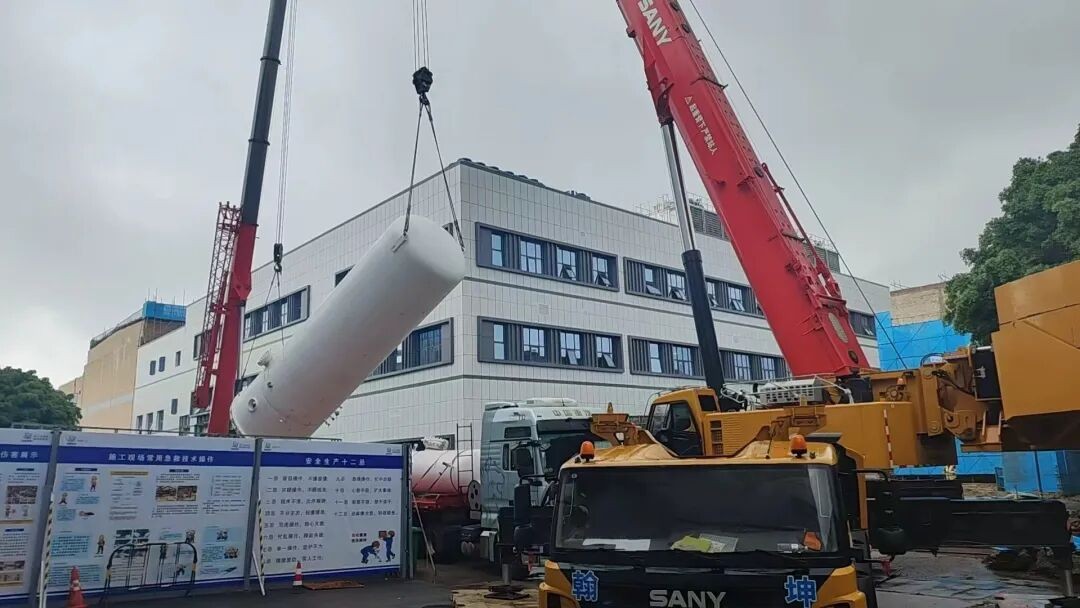
This lifting operation fell under the category of hazardous engineering exceeding a certain scale, adopting a "dual-crane tandem lifting" scheme with a 400-ton main crane and an 80-ton auxiliary crane, which posed significant technical challenges and high coordination requirements. Facing complex working conditions such as limited site space and prolonged continuous operation, the project team scientifically formulated the lifting plan, strictly implemented on-site safety and quality control, refined the operation procedures, and clarified division of responsibilities. During the operation, the main crane undertook the core load-bearing and primary movement, while the auxiliary crane precisely controlled balance and attitude adjustment, with both cranes maintaining synchronization throughout the process, ensuring that over ten large storage tanks were lifted and lowered smoothly and positioned in a single attempt, fully demonstrating professional organizational capability in large equipment lifting.
During the operation, institute leaders arrived at the site to personally direct and supervise. The Fusion Science Experimental Institute, Engineering Management Department, Equipment Management Department, Safety Management Department, CNNC Consulting, CNNC 23, and all construction units cooperated closely and proceeded in an orderly manner. All builders worked in shifts, persevering day and night, overcoming multiple adverse factors, and ultimately completed all lifting tasks with high standards and zero accidents, effectively ensuring the smooth achievement of key milestone objectives.
The successful completion of this task fully demonstrated the SWIP project team's spirit of tackling tough challenges and winning hard battles, and also laid a solid foundation for the steady progress of subsequent works. In the next step, all parties involved in the project will continue to coordinate their efforts, carry out subsequent works such as system commissioning in an orderly manner, and make every effort to ensure the project construction goals are achieved on schedule.
Disclaimer: Information republished from partner media, institutions or other websites is provided for reference and communication purposes only. It does not imply endorsement of its views or verification of its accuracy. Please contact us if any content infringes rights or requires correction.